

Psychic Soldiers, Mind Readers, and Dolphin Drones: The Cold War's Weird Paranormal History
How Soviet séances and CIA remote viewers sparked a decades-long arms race no one was supposed to know about
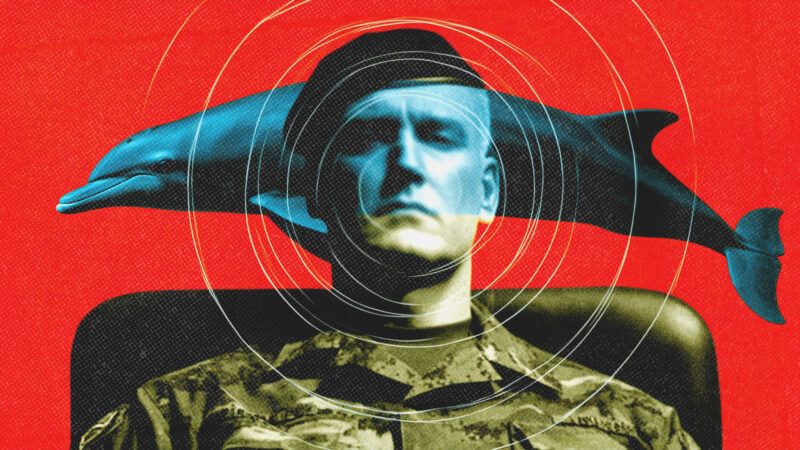
In the February 2019 issue of Armeiiskii Sbornik, the Russian Ministry of Defense's official magazine, there is an article titled "Supersoldiers for the Wars of the Future." The article claims, among other things, that the Soviet and Russian militaries learned to psychically control dolphins, disrupt radio and television broadcasts, and crash computers.
These psychic experiments began in 1924, when Gleb Bokii, head of the special section of the Soviet secret police, opened a secret laboratory at 21 Kuznetsky Bridge in Moscow. With the help of Alexander Barchenko, his spiritual guru, he conducted top-secret experiments on hypnotism, brainwashing, and mind reading.
These exploits were far from the Special Section's most eccentric. Bokii hosted wild orgies in a secret dacha in the suburbs of Moscow. Invited guests farmed, sunbathed, cooked, and ate together in the nude before engaging in group sex. Barchenko planned an expedition to Tibet to find the legendary Buddhist Kingdom of Shambhala. He believed that an ancient civilization hiding beneath the Earth's surface, in Tibet, held advanced scientific knowledge that could be used to accelerate the path to communism. When Soviet Foreign Minister Grigory Chicherin heard about the proposed expedition, he quashed it and greenlit a separate expedition with the more prosaic goal of probing anti-British feeling in Lhasa.
Bokii and Barchenko's Psychic Experiments Sparked an Arms Race
The Special Section kicked off a century-long paranormal arms race—with surprising legacies that can still be felt today.
The Russian fascination with exotic spirituality predates the Soviet era. Russian orientalism flourished after the 1858 Treaty of Aigun, which granted the czar lands that formerly belonged to China's Qing dynasty. Russian explorers and academics ventured into Inner Asia, and further afield into Xinjiang and Tibet. The intelligentsia of St. Petersburg snapped up their travel accounts, ethnographic studies, and spiritual guidebooks. In the imperial capital, Eastern spirituality met European new age trends: hollow-earth theory and meditation, reincarnation and tantric sex, Lamaism and occult science.
Bokii was active in the Ukrainian student circles of late-imperial St. Petersburg, where romantic nationalism and revolutionary socialism flourished underground. It is likely that this is where he first encountered ideas of Eastern spirituality and the occult. Barchenko, also of Ukrainian heritage, was a failed medical student turned provincial mystic and self-proclaimed scientist. Both underground movements—socialism and spiritualism—surfaced with the collapse of the Romanov dynasty and the Bolshevik coup d'état in 1917.
The Russian Revolution was not just a change in government. When the boundaries of the church, the czar, and the empire vanished, the revolutionaries believed they could reconstruct reality itself. Alongside the unprecedented violence, the early Soviet state was a laboratory testing the ideas that had been banned or suppressed in the Russian Empire. Bokii and Barchenko were at the forefront of this revolution. Their antics are described in Andrei Znamenski's Red Shambhala: Magic, Prophecy, and Geopolitics in the Heart of Asia.
One psychic skill Bokii and Barchenko undoubtedly lacked, however, was the ability to predict the future—neither foresaw that they would be executed by Soviet leader Joseph Stalin during the Great Terror. But their experiments have had a long afterlife, including in the United States.
The CIA Responds With Stargate Project 'Remote Viewing' Tests
At some point in the mid-20th century, knowledge of Soviet psychic experiments reached America. In 1950, American journalist and CIA officer Edward Hunter introduced the Chinese term "brainwashing" to English speakers. In articles, a testimony to the House Committee on Un-American Activities (where he strongly implied that the United States should have nuked North Korea), and a book titled Brain-Washing in Red China: The Calculated Destruction of Men's Minds, he claimed that the Soviet secret police had taught Chinese communists advanced interrogation techniques, which were then used against American prisoners of war in the Korean War.
In 1972, Hal Puthoff, an American electrical engineer with a Ph.D. from Stanford University, began conducting "parapsychological" experiments at the Stanford Research Institute. In Puthoff's telling, he was approached by the CIA, which told him that the Soviets were conducting similar research, and so the CIA began sponsoring his activities. This became the Stargate Project, a covert research program investigating how psychic phenomena could be used by the United States for military and intelligence purposes—later immortalized in the 2009 film The Men Who Stare at Goats, adapted from the book of the same name by Jon Ronson.
The results of Stargate are contested. In a 2005 interview with GQ, former President Jimmy Carter claimed that a psychic woman from California who worked with the CIA was able to locate a crashed plane—referred to as a Soviet Tupolev Tu-22 bomber in other sources—in an African jungle. The woman entered a trance and wrote down a series of coordinates, which the Americans used to retrieve the plane. Carter wondered if this was "just a gross coincidence." On an episode of The Joe Rogan Experience, Puthoff claimed that a CIA "remote viewer" reported the existence of the Soviet Typhoon-class submarine before it was public knowledge. Remote viewers were also said to have been involved in an attempt to use psychic powers during the Iran hostage crisis.
But are any of these stories true? A 1983 Defense Intelligence Agency report concluded that data from the Stargate Project was "highly variable" and "mixed with much extraneous or inaccurate information." These concerns led to Project Grill Flame, an attempt to establish the reality and repeatability of the remote viewing phenomenon, assess its potential military and intelligence applications, investigate the psychic capabilities of adversaries, and develop countermeasures.
Grill Flame concluded that "remote viewing is a real phenomenon" and "a potential threat to US national security exists from foreign achievements in psychoenergetics." Project documents also alleged that, in the Soviet Union, "this research is well funded and receives high-level government backing."
Russia Claims Soldiers Learned To Read Minds
Unfortunately, few documents from the Soviet side of the psychic Cold War have seen the light of day—but a handful of stories indicating their existence have emerged.
In a 2015 interview in Kommersant, Nikolai Patrushev, then secretary of the Russian Security Council, claimed former U.S. Secretary of State Madeleine Albright thought that Siberia and the Far East did not belong to Russia and that Americans were jealous of Russia's resource wealth. Albright never publicly said anything along these lines. Patrushev's "source" turned out to be a KGB-trained psychic named Georgy Rogozin who, armed with nothing but a photograph of Albright, penetrated her mind and read her thoughts. It just so happened that at that precise moment, she was thinking about carving up Russia.
Rogozin was the deputy of Alexander Korzhakov, head of the Presidential Security Service, and advised him on all matters parapsychological. Reincarnations of Bokii and Barchenko, perhaps?
The aforementioned Russian Ministry of Defense magazine claims that Russian soldiers have learned to read documents locked in safes (regardless of what languages they were in), psychically identify terrorists, and go days without eating, drinking, or sleeping. Some of these abilities were ostensibly deployed during the Chechen Wars in the 1990s. One of these abilities was, of course, mind reading.
What Drives America's and Russia's Interest in Paranormal Research?
What are we to make of all this? Just as the Soviet interest in psychic espionage came after the overthrow of the czar, modern Russian interest in paranormal warfare was an aftershock of the collapse of communism. Joseph Kellner's The Spirit of Socialism: Culture and Belief at the Soviet Collapse details a rise in mysticism and new age religious movements in Russia in the 1980s and 1990s, like those of the early 20th century. The fall of empires gives birth to all kinds of bizarre belief systems.
The American interest in psychic research seems to be a case of superpower paranoia. The dawn of the Cold War in America was accompanied by Sen. Joseph McCarthy's (R–Wis.) panic about Soviet spies, in which Hunter took part. A decade later, paranoia about Soviet moles drove former CIA counterintelligence chief James Jesus Angleton to repeatedly purge the agency. The United States conducted military interventions in search of communists all over the world—perhaps most destructively in Vietnam. And the CIA consistently overestimated Soviet capabilities, notably failing to foresee the Soviet collapse. Of course, the Soviet Union had its own paranoid overreactions: there was the omnipresent police state, the harebrained intervention in Korea, the invasions of Hungary and Czechoslovakia (punctuated by the Cuban Missile Crisis), a U.S.-averted scheme to nuke China in 1969, and Afghanistan. Amid all this, was funding psychic research really so crazy?




