
Social Media Is Not Tobacco
Plus: Hollywood is over, the war in Iran is not, Democrats are fighting about affordability, and more...
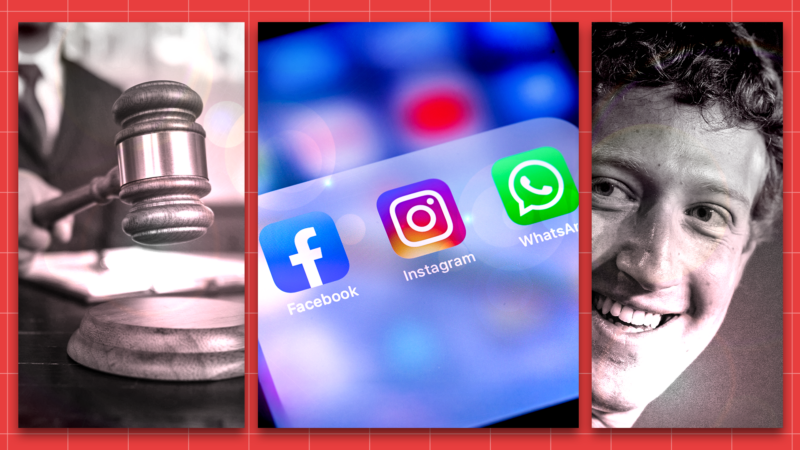
Social media addiction? One of the refrains you hear from social media critics is that it's effectively a kind of digital tobacco—unsafe, addictive, and intentionally marketed to children, despite executives knowing the harms.
In broad strokes, that was the idea behind the $375 million verdict against Meta, the parent company of Instagram and Facebook, in New Mexico last week.
The Reason Roundup Newsletter by Liz Wolfe Liz and Reason help you make sense of the day's news every morning.
On the new episode of The Reason Roundtable, Nick Gillespie, Katherine Mangu-Ward, Matt Welch, and I talk about why this metaphor fails, why these judgments are worrying for free speech, and why we seem to be entering a new era of social media prohibition.
Tobacco is a chemical that is ingested into the body with specific, measurable, physical effects.
Social media is a delivery system for speech—speech that will be different for every user, and speech that is protected by the First Amendment because, well, it's speech.
The lawyers arguing the case against Meta have said they are not attacking speech. Instead, they are arguing that it's a defective product with dangerous design features, like autoplay video and infinite scroll.
But those features wouldn't be compelling without the content—which is to say without the speech—they push to users. An infinite scroll of grass growing probably wouldn't be very engaging.
So much of this argument reminds me of the debates about Hollywood and media from my youth. In the 1980s, the political class was obsessed with profane rock and rap lyrics, which were coarsening the culture and harming youths. In the 1990s, there were congressional hearings about the dangers posed to children by violent video games like Mortal Kombat and edgy movies like Reservoir Dogs. Today, these political campaigns seem transparently ridiculous; the Mortal Kombat series is still around, but it's practically camp, with "Friendship" kills along with the old gory fatalities. And Reservoir Dogs director Quentin Tarantino is one of the most lauded and successful directors of the last 35 years; many of his movies are about how elaborate cinematic violence is a righteous salve for real-world historical wrongs.
Speaking of movies…
Is Hollywood over? In 2020, the pandemic shut down large numbers of movie theaters across the country (and the world) for the better part of a year. Then in 2023, just as the movie business was starting to come back to life with hits like Barbie and Oppenheimer, strikes by the writers and actors unions shut down production for months.
In the years since, it's become clear that Hollywood as we know it is over.
Yes, there will still be video-based entertainment—more of it than ever, most likely, thanks to cheap digital distribution and production.
But Hollywood—the place, the idea, the industry, the dream factory as it has existed for decades—is on the decline.
Los Angeles–based studios are making fewer movies and television shows, reports The Wall Street Journal, and those they are making are often being shot in other states or overseas to capitalize on tax credits. The Journal crunched the numbers on entertainment industry jobs and "the result [is] a 30% drop in employment from a late-2022 peak for actors, carpenters, costumers and the hundreds of other professions that make movies and TV shows, according to Labor Department data."
To some extent, this is a story about film tax credits. States like Louisiana, Michigan, and Georgia lured production out of Hollywood with generous taxpayer-backed subsidies and credits for film production. Georgia, in particular, came close to becoming a sort of "Hollywood East," with a huge production infrastructure and many of the Marvel Cinematic Universe movies and TV shows shot in the state, as well as countless other productions. But even Georgia's lavish tax credits couldn't save the state's business. In the past few years, much of Marvel's production has moved to London, where costs are lower and the tax environment is more favorable.
That brings us to the other part of the story: labor.
Hollywood unions staged big strikes that shut down filmmaking for much of 2023, just as the industry was finding its post-pandemic footing. The extended pause in production meant that theatrical releases slowed to a trickle. Audiences, already acclimated to watching things at home because of streaming and the pandemic, lost the habit of going to the movies. And there wasn't enough product to lure them back.
Notably, the Journal report suggests that Los Angeles might end up looking like Detroit, a once-thriving industrial town that was hollowed out as the city's flagship business dried up. Union-driven costs that couldn't be shed when the business changed helped sink Detroit. Labor isn't the only factor, but it's looking increasingly like something similar is happening in Hollywood.
Yes, people still drive cars. And some movies can still score big at the box office. The excellent Project Hail Mary looks like this year's first big blockbuster, and the new Super Mario Bros. film will almost certainly make well over $1 billion globally. But there are fewer big hits. And even more importantly, there are fewer of the sort of medium-sized successes that keep butts in seats and theaters in business between those hits. Add in competition from streamers like Netflix and social video platforms like YouTube, and it's a perfect storm for the industry.
I dearly love the movies. But I fear they are going to become a niche cultural form instead of the dominant popular art form that they were for much of the 20th century. They'll be more like jazz or ballet, as actor Timothée Chalamet warned. And at least some of the industry's many wounds appear self-inflicted.
Ground troops? The war in Iran is either over or about to begin a new, escalated phase with ground troops.
One of the biggest points of contention in the war so far is the Strait of Hormuz, a key shipping portal for the region's energy. The Strait has been largely closed since the war began, and now The Wall Street Journal reports that President Donald Trump might be willing to end the war and let the Strait stay closed.
Alternatively, he might start a ground war, or at least some sort of limited troop operations. Thousands of American troops have been moved into the region, and The New York Times reports that Trump is weighing whether to send them in. The aim, reportedly, would be to use ground forces to achieve narrow, tactical goals like securing nuclear material, safeguarding energy production, or perhaps reopening the Strait of Hormuz.
Even with clearly defined goals and targets, ground forces would represent a major escalation in the war. And these sorts of nominally narrow actions have a tendency to spin out of control.
In the meantime, the war is starting to have an effect on energy prices at home, with gasoline hitting $4 a gallon. Supply shocks from the war also might threaten the AI boom that is helping prop up the U.S. economy. Markets are already reeling because of the war.
Even if the war somehow ends tomorrow, there will be lingering, likely destabilizing effects on energy, the economy, and global trade for a long time to come.
Scenes from Washington, D.C.: Trump's new White House ballroom design is raising alarms. Architects who have reviewed the plans say it has stairs that lead nowhere, columns that block views, and oddly placed windows and bathrooms.
On the one hand, some of the complaints about Trump's ballroom are obviously just griping that the design and review process should have, well, more process. On the other hand, it does sound like some of the design features could have used a bit more thought.
In the meantime, between construction and security, there's currently no way to get a good view of the White House.
QUICK HITS
- I would not describe myself as a big fan of New York Gov. Kathy Hochul. But she is separating herself from the fiscally unserious progressives in the Democratic Party—including New York Mayor Zohran Mamdani—by saying that maybe, if they're going to run on affordability, they should regulate energy and land use a teensy-tiny bit less. It's a start!
- Immigration and Customs Enforcement (ICE) will position agents outside of Marine graduation events in South Carolina, "to identify whether any of their family members are undocumented," according to NBC News.
- Costco is getting into fertility treatments. Now you can get a baby AND a $1.50 hot dog?
- Science fiction author Andy Weir, who penned The Martian and Project Hail Mary, apparently pitched a Star Trek show but was rejected. He said recently that the current slate of Star Trek shows are "shit," which is…OK, technically that is an opinion. But it's also just the truth. Anyway, now he says that was a joke and has apologized. Andy, you were right the first time!
- There were apparently Apache helicopters operating near Kid Rock's home? And they were caught on video? And the military is investigating? Um. Ummmm. OK!
- Wired has a report on the King of Hammers, a summer road race in California. I feel obligated to link to it just because of the headline: "Guns, beer, titties, freedom." That sound you hear is me checking to see if Katherine Mangu-Ward will sign off on a new slogan for Reason.
