
How Taxes Are Reshaping Where Americans Live and Work
Increasing income taxes almost always results in less revenue and less economic activity.
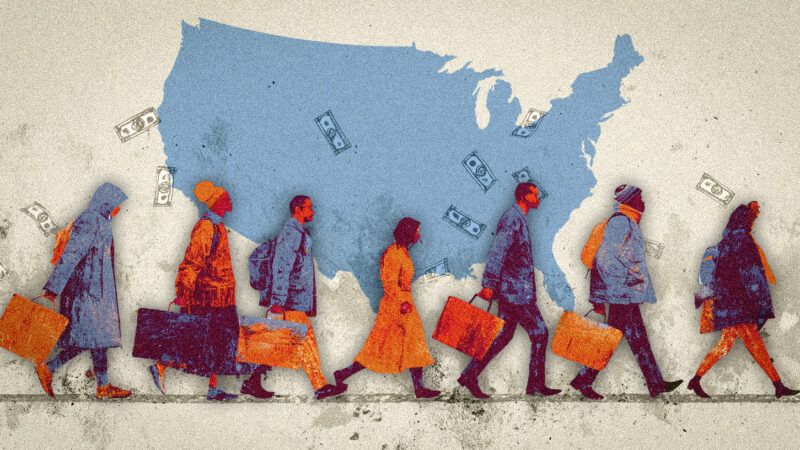
If you've spent any time on social media lately, you've probably seen some chatter about state income taxes. "Red," Republican-governed states are lowering them or eliminating them, and "blue," Democrat-governed states are actually raising them. They say that there are no controlled experiments in economics, but we have had quite a few over the years, from North and South Korea, to East and West Germany, to even Chile and Argentina. With some states raising taxes (a lot), and some states cutting taxes (a lot), you probably already know the long-term results of this experiment long before it even begins. States with lower taxes will attract talent and capital, and states with higher taxes will lose them.
This has been going on for a while, and it really started to pick up in 2017, with the passage of the Tax Cuts and Jobs Act, which limited the deductibility of state and local taxes to $10,000, amplifying the tax differences between the states. That set off a migration of people and capital so large that it has resulted in massive population changes across the United States, with California and New York being the source of migration, and Florida and Texas being the primary destinations. The long-term consequence of this is that, in time, it will completely redraw the electoral map.
These States Are Cutting Income Tax
In 2010, South Carolina had the highest state income taxes in the South at 7 percent. The state's big-government Republicans frustrated Nikki Haley's efforts to lower the state income tax while she was in office as governor from 2011 to 2017, but they have become more amenable in recent years. The tax stands at 5.2 percent currently, and revenue targets and trigger mechanisms will eventually take the state income tax to zero, repealing it entirely. South Carolina also boasts some of the lowest property taxes in the country.
Arkansas, under Republican Gov. Sarah Huckabee Sanders, intends to phase out its income tax completely. The income tax rate has already been lowered to 3.9 percent and will be lowered further, subject to revenue targets. Corporate rates are being lowered as well. The top rate stood at 7 percent as recently as 2013 and was lowered to 4.9 percent under Republican Gov. Asa Hutchinson.
Kentucky, Mississippi, and Oklahoma also intend to eliminate the income tax entirely. Interestingly, Kentucky's governor, Andy Beshear, a Democrat, vetoed the income tax cuts, but the state Legislature overrode the veto. Like South Carolina and Arkansas, triggers are in place so that the rate will be lowered in 0.5 percent increments if revenue targets are met. The tax rate has since been lowered to 3.5 percent. Mississippi has passed some similar legislation, with minor differences around the counting of revenue and appropriations. If the tax rate reaches 0 percent in Mississippi, it is explicitly eliminated, meaning it would require new legislation to bring it back. Oklahoma has reduced its top tax rate to 4.5 percent, with similar triggers based on revenue to lower it further. These tax cuts are based on the Lafferian notion that there is a hypothetical revenue-maximizing tax rate and a growth-maximizing tax rate, the idea being that tax reductions will lead to economic growth and increased revenue from other forms of taxation, such as sales taxes and property taxes.
Indiana has thus far reduced its state income tax to 2.9 percent, and plans to cut it a bit further, but not to zero. Iowa has cut rates from 5.7 percent to a flat rate of 3.8 percent, and plans to cut it to 3.5 percent next year, with no plans to eliminate it. Idaho last year lowered income taxes from 5.695 percent to 5.3 percent, with the usual complaints about revenue shortfalls and inequality from left-leaning think tanks. Nebraska lowered its top rate from 5.2 percent to 3.99 percent in 2027, and cut corporate taxes as well. Nebraska isn't strictly going to a flat tax, but is moving toward a flatter tax structure, reducing the number of brackets.
Utah has lowered taxes for six consecutive years. The tax cuts, while small, have taken the top rate from 5 percent down to 4.45 percent. Louisiana has cut state income taxes to a flat rate of 3 percent this year, down from 4.25 percent two years ago, but the state's sales tax was increased somewhat—which is not a bad thing. Missouri has cut income taxes for the fifth consecutive time, lowering rates to 4.7 percent, and adopted a plan to eventually eliminate them, while expanding sales taxes on some goods and services to make up the revenue shortfall. North Carolina, with a Democratic governor, cut rates to 3.99 percent this year, flattening the brackets, with plans to cut rates to 1.99 percent by the year 2030. West Virginia cut taxes slightly this year, with Democratic Gov. Jim Justice stating that "we need to continue marching toward eliminating the personal income tax."
And finally, it should be mentioned that Florida, which has no income tax, is proposing the elimination of property taxes, relying only on the sales tax for revenue. In Florida, property taxes are not especially low, and Republican Gov. Ron DeSantis has commented on their unfairness in the past.
That is the good news. The bad news is that several states have raised or are contemplating raising taxes—or even implementing wealth taxes.
These States Want To Take More
California's proposed wealth tax is in the news, the aptly-named "2026 Billionaire Tax Act," representing a one-time 5 percent tax on the net worth of individuals with assets exceeding $1 billion. Many billionaires responded by promptly leaving the state. Since California's revenue collection is more skewed toward wealthy taxpayers than any other state, the brain drain and loss of revenue are expected to hit the state hard. A recent analysis found that wealth tax revenue would come in at $40 billion, rather than the advertised $100 billion, and that the net present value, which reflects the total economic impact of the wealth tax, is negative $24.7 billion.
Maryland is reversing its tax progress under former Republican Gov. Larry Hogan, and has recently added two new top brackets, the highest at 6.5 percent. Massachusetts, which for years had relatively low state income taxes for the Northeast, implemented a 4 percent millionaires' surcharge on income above $1 million, taking the top rate to 9 percent. Washington state recently passed a 9.9 percent millionaires' income tax, though its constitutionality is sure to be challenged in courts.
In Connecticut, Democratic Gov. Ned Lamont has been doing a good job at squashing proposed tax hikes during his two terms, but there is a renewed campaign for an additional 1.75 percent tax on capital gains for those with incomes over $1 million. The current income tax rate is 6.99 percent. While getting nowhere near the attention on California's proposed wealth tax, Hawaii is passing one of its own, a 1 percent tax for those with a net worth of over $20 million. Illinois has introduced a constitutional amendment for a 3 percent surtax on incomes over $1 million for joint filers. Michigan has a ballot initiative proposing a whopping 5 percent surtax on joint incomes over $1 million. Rhode Island is also proposing a millionaires' surtax of 3 percent for 2027. And Virginia has introduced legislation to create two new tax brackets at 8 percent and 10 percent for high earners.
And finally, nearly everyone has heard of New York City Mayor Zohran Mamdani's attempt to raise taxes in the city, proposing raising the top NYC tax rate on incomes over $1 million by two percentage points, from 3.88 percent to 5.88 percent. This would push the top combined state/local rate for NYC residents to 16.8 percent, the highest in the country. There are the usual arguments from the left about how the wealthy won't flee these tax cuts, but the net migration data suggest otherwise.
Capital Flows Where It Is Treated Best
There is a saying on Wall Street—capital flows to where it is treated best. The left seems not to understand this, but people have shown that they consistently respond to economic incentives. The typical millionaire taxpayer in a high-tax jurisdiction can potentially save $100,000 a year by moving to a low-tax jurisdiction, and the weather in the low-tax jurisdictions tends to be better. $100,000 is real money, and after a while, taxpayers begin to ask the hard questions about what they are receiving in terms of services and quality of life for the money they pay in taxes—especially when the fraud allegations came to light in Minnesota (a high-tax jurisdiction). Now, with remote work, it is easier than ever to physically relocate, instead of being tied to a job in a major city.
Cities like Nashville, Austin, Raleigh, Charlotte, Atlanta, Dallas, Miami, and others have been attracting economic activity since the passage of the 2017 Tax Cuts and Jobs Act. With the recent proposed tax hikes, this is bound to continue—and accelerate. As unlikely as this might have seemed 10 years ago, it seems possible, even likely that New York will no longer be the financial capital of the world, along with Boston and Chicago, and that financial institutions will relocate—with their employees—to places like Miami and Dallas. What's shocking to most is the complete lack of introspection among Democratic states on taxes—they always and everywhere result in less revenue than advertised and less economic activity.
It will be interesting to see what the U.S. will look like in 20 years after these tax law changes go into effect. The South will rise again, and the Northeast and the West Coast will slide into irrelevance. All because individuals act in their own economic self-interest, as hard as that might be to believe.
