

Police Investigate German Historian for Hitler-Putin Meme
Germany’s law against Nazi symbolism "is being misused to silence people with dissenting views," Rainer Zitelmann tells Reason.
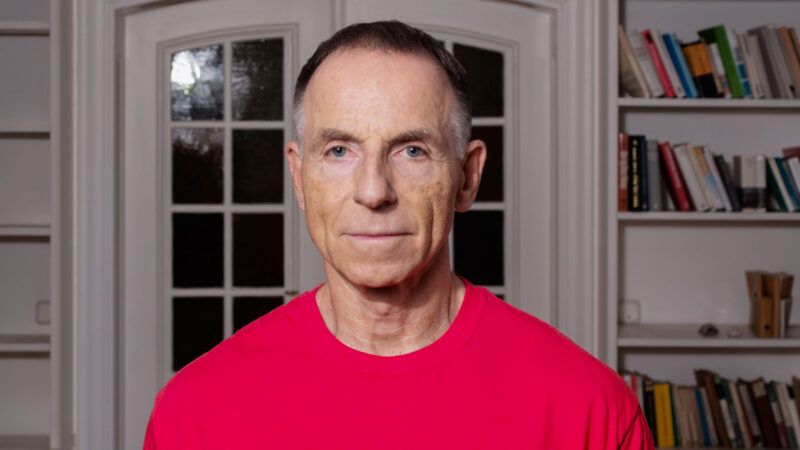
In Europe, it's not just making fun of a president's wife or making edgy jokes on social media that can lead to fines and jail time, but criticizing authoritarian leaders, too.
In early February, Rainer Zitelmann, a German historian and sociologist, received a letter from Berlin police informing him he was under investigation for violating Germany's criminal code by using "symbols of unconstitutional and terrorist organizations."
"I will turn 69 in June, and it is the first time in my life that I have come into conflict with the law," Zitelmann tells Reason. Zitelmann, who has written for Reason, wrote his doctoral dissertation on the evils of Nazism and its anticapitalist roots.
The post in question, which Zitelmann reshared, showed a side-by-side image of Adolf Hitler and Russian President Vladimir Putin. Hitler's speech bubble read, "Give me Czechoslovakia and I won't attack anyone else!" and Putin's read, "Give me Ukraine and I won't attack anyone else!" It was not the quote that put Zitelmann in trouble with the law, but Hitler's swastika armband.
— Rep. Don Bacon ????????✈️????️⭐️????️ (@RepDonBacon) December 11, 2025
Under Section 86a of the German criminal code, it is illegal to distribute Nazi symbols and related expressions. This includes "flags, insignia, uniforms, slogans and forms of greeting." Violators of the law can be fined and face up to three years in prison. What was intended to prevent open neo-Nazi propaganda has been increasingly used to silence political opponents.
"So far we do not know who reported me," Zitelmann says. "However, one can assume that it was one of the so-called 'Meldestellen' ('reporting centers') that have been set up all over Germany. There, citizens can denounce other citizens who have said something that is perceived as wrong."
Zitelmann's case is not unique. In 2025, police officers visited Norbert Bolz, a German media theorist and scholar, at his home and questioned him about an X post in which he mocked a left-wing newspaper by quoting the Nazi-affiliated expression, "Deutschland erwache!" (Germany, awake!). Commenting on his visit by Berlin police, Bolz said his house was searched because of the post and "young, nice police officers…ultimately gave me the good advice to be more careful in the future. I will do that and from now on only talk about trees."
In March, conservative journalist Jan Fleischhauer was placed under investigation for using the same phrase in a podcast about the newly established youth wing of the AfD, Germany's far-right political party. The investigation was dropped after Fleischhauer paid a fine in "the lower four figure range" to a charity, reports the Frankfurter Allgemeine Zeitung.
Unfortunately for Germans, such cases are becoming increasingly more common. In 2024, the most recent year for which data are available, the Federal Criminal Police Office registered 31,229 "propaganda offences," a 57 percent increase from 2023.
The Trump administration has been critical of European speech laws, even as it has cracked down on its own citizens' free speech rights. In an address at the Munich Security Conference last year, Vice President J.D. Vance said, "in Britain, and across Europe, free speech, I fear, is in retreat." He added, "democracy rests on the sacred principle that the voice of the people matters. There is no room for firewalls. You either uphold the principle or you don't."
Although he is "skeptical" of President Donald Trump on the topic of free speech, Zitelmann agrees with Vance. "The developments in Germany, but also in other countries such as the U.K., are becoming increasingly troubling," he says. "In the past, people like me were attacked through 'cancel culture.' That no longer works; it has lost its impact. So now the approach is to use more repressive state power."
Zitelmann says the state has, thus far, been slow with his case, and the investigation could take weeks or months before it's resolved. This has pulled him away from other projects, including his new book, which comes out this year. "I now have to spend the entire day talking about Hitler."




