

Reason.com - Free Minds and Free Markets
Reason logo Reason logo
  • Latest
  • Magazine
    • Current Issue
    • Archives
    • Subscribe
    • Crossword
  • Video
    • Reason TV
    • The Reason Roundtable
    • Free Media
    • The Reason Interview
  • Podcasts
    • All Shows
    • The Reason Roundtable
    • The Reason Interview With Nick Gillespie
    • Freed Up
    • The Soho Forum Debates
  • Volokh
  • Newsletters
  • Donate
    • Donate Online
    • Ways To Give To Reason Foundation
    • Torchbearer Society
    • Planned Giving
  • Subscribe
    • Reason Plus Subscription
    • Gift Subscriptions
    • Print Subscription
    • Subscriber Support

Log In

Create new account

Space

In Space, Regulators Seek To Boldly Go Where No Bureaucrat Has Gone Before

We don’t really need intrusive laws and regulations to govern lunar mining and space exploration.
J.D. Tuccille | 3.13.2026 9:13 AM

Share on FacebookShare on XShare on RedditShare by emailPrint friendly versionCopy page URL Add Reason to Google
Media Contact & Reprint Requests
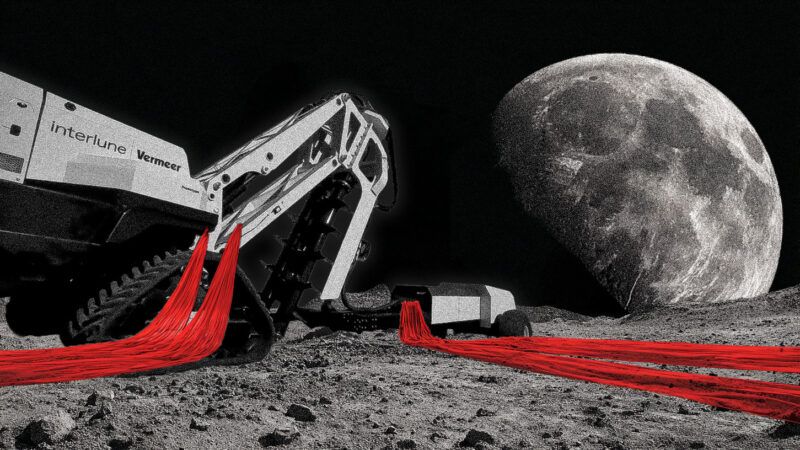
An Interlune/Vermeer excavator on the moon, draped in red tape. | Illustration: Interlune/Midjourney
(Illustration: Interlune/Midjourney)

The National Aeronautics and Space Administration (NASA) faces delays in meeting its schedule for returning to the Moon, according to a new report by the agency's inspector general. Nevertheless, the project moves forward and remains largely within its budget—a testament to the abilities of SpaceX and Blue Origin, the two private companies participating. In fact, space exploration is largely a private effort these days, with profit-seeking firms developing not just launch capability but also technology for mining Earth's natural satellite.

You are reading The Rattler from J.D. Tuccille and Reason. Get more of J.D.'s commentary on government overreach and threats to everyday liberty.

This field is for validation purposes and should be left unchanged.

Does the Lunar Environment Really Need To be Preserved?

Unfortunately, opening new commercial opportunities—even in the depths of outer space—is like ringing the dinner bell for bureaucrats and would-be regulators.

"Despite evolving technical capabilities, the international legal framework governing exploitation of the Moon is both very limited and frozen in the Cold War era," the RAND Corporation's Adam Urwick and Jessie Osborne fret in a recent commentary after discussing space developments. "The pursuit of profit raises paramount scientific and environmental concerns. Astronomers caution that large-scale mining activities could disrupt ongoing research and preservation of the lunar environment, leading to calls for development of comprehensive lunar laws and regulations to manage these activities responsibly."

Earth's moon is a dead place where nobody currently does anything. There is nothing to disrupt, let alone an environment to worry about unless you want to elevate the occasional boot print or tire tread in lunar dust to the status of a problem. The pursuit of profit there should raise no concerns beyond those of investors seeking returns—and investors and space ventures are looking for opportunity, assuming it's not strangled by red tape.

Looming Opportunities for Commercializing Space

Last year, Interlune and Vermeer Corporation revealed they've developed a full-scape prototype of an excavator "designed to ingest 100 metric tons of Moon dirt, or regolith, per hour and return it to the surface in a continuous motion. Interlune's immediate focus is harvesting helium-3 from the Moon." Interlune has since signed a contract with the Air Force to deliver lunar helium-3.

The partnership between Interlune, a space technology startup, and Vermeer, an established manufacturing company, illustrates the seriousness with which industry views the prospect of tapping into space resources. Rio Tinto, an Anglo–Australian mining giant, sees its expertise in automated mining as an advantage when it comes to extracting resources in space. The company joined an industry consortium to take its abilities off-planet. It's well-positioned to succeed in a new environment.

"While venture capital pours into space startups promising to revolutionize lunar resource extraction, the real winners may well be companies that have spent 150 years turning rock into revenue: Rio Tinto, BHP, Glencore and their peers," Stirling Forbes, a space industry investment matchmaker, wrote last October for Space News. "Lunar mining is fundamentally a resource extraction problem that happens to occur on the moon. Space startups excel at getting there. But once you land, the hard part is mining — and that's where most space companies have zero experience."

Private Companies Already Dominate Space Launches

"Getting there" is a challenge that private companies have been handling for years. NASA's role is now largely confined to planning missions and then picking among private vendors to do the—literal—heavy lifting. SpaceX has done most of the work, though Blue Origin is a player. Nipping at their heels are companies like Firefly Aerospace, which this week delivered a payload to orbit for Lockheed a year after successfully sending an unmanned lander to the Moon.

A hurdle for NASA's planned Artemis return to the Moon is that it's intended to introduce a permanent human presence on the satellite. That requires the unprecedented feat of in-space refueling. "SpaceX will be challenged to complete required milestones ahead of the Artemis III mission, starting with Starship's next major milestone—a large-scale, vehicle-to-vehicle cryogenic propellant transfer test," according to the NASA Inspector General. "This test was planned for March 2025 but has been delayed 12 months to March 2026."

Nobody really doubts that refueling in space will be accomplished. The question is whether it can be done before China sends its own manned mission there around 2030. SpaceX and Blue Origin are both making progress, according to the report, with the companies' costs increasing by only 6 percent and 1 percent, respectively. Worries over the project's status are mostly matters of flag waving.

As suggested by industry assessments and announcements by private firms, humans will return to the Moon one way or another, even if in the form of mining robots.

"There's certainly reasons to go to the moon that go back to national prestige, national security, some of the reasons we've always gone to space," Matt Weinzierl, a Harvard Business School economist and co-author of Space To Grow: Unlocking the Final Economic Frontier, told Marketplace's David Brancaccio in December. "But the new thing…is that some companies are raising money to go actually do things on the moon for profit, whether it's mining the lunar soil or providing services to other customers on the lunar surface."

Regulators Race Miners To the Moon

The 2015 U.S. Commercial Space Launch Competitiveness Act established grounds for recognizing private property rights in space so that private firms would have reason to take risks and make investments. The law was intended to end-run the 1967 space treaty's requirement that space exploration "be carried out for the benefit and in the interests of all countries." We won't have national territory in space, but the U.S. will recognize and enforce property claims.

But, as RAND's Urwick and Osborne make clear, natural-born bureaucrats are ready to assert their will even before the first commercial operation has extracted an ounce of resources in space. They want "binding international agreements…which emphasise principles of stewardship, clarify access rights and support common benefits from lunar development." To their voices you can add University of Bristol law lecturer Dr. Charles Ho Wang Mak's worries that "unregulated mining could contaminate lunar regolith or generate debris" and other early calls for red tape in space.

The Artemis Accords, signed by multiple countries since 2020, represent an early effort to encourage "space-based exploration, scientific discovery, and commercial utilization" that at least acknowledges the interests of private enterprise. Then again, the European Space Agency's Zero Debris Charter would export a sort of zero-gravity environmentalism to outer space.

Would-be regulators seem determined to insert themselves into the final frontier. The only saving grace is that if they want to assert their presence, they'll have to hitch a ride from a private space company.

The Rattler is a weekly newsletter from J.D. Tuccille. If you care about government overreach and tangible threats to everyday liberty, this is for you.

This field is for validation purposes and should be left unchanged.

NEXT: Review: Have Aliens Visited Earth? This Documentary Says Yes.

J.D. Tuccille is a contributing editor at Reason.

SpaceMiningScience & TechnologyRegulationBureaucracyNASALaw & Government
Share on FacebookShare on XShare on RedditShare by emailPrint friendly versionCopy page URL Add Reason to Google
Media Contact & Reprint Requests

Hide Comments (8)

Editor's Note: As of February 29, 2024, commenting privileges on reason.com posts are limited to Reason Plus subscribers. Past commenters are grandfathered in for a temporary period. Subscribe here to preserve your ability to comment. Your Reason Plus subscription also gives you an ad-free version of reason.com, along with full access to the digital edition and archives of Reason magazine. We request that comments be civil and on-topic. We do not moderate or assume any responsibility for comments, which are owned by the readers who post them. Comments do not represent the views of reason.com or Reason Foundation. We reserve the right to delete any comment and ban commenters for any reason at any time. Comments may only be edited within 5 minutes of posting. Report abuses.

  1. Ajsloss   2 hours ago

    From what I understand, The Moon Is a Harsh Mistress.

    Log in to Reply
    1. Don't look at me! ( Is the war over yet?)   54 minutes ago

      Also, it’s made of cheese.

      Log in to Reply
      1. Neutral not Neutered   26 minutes ago

        Swiss cheese because it is partly hollow...

        Log in to Reply
  2. Earth-based Human Skeptic   1 hour ago

    Let's develop the Moon with the Reason-WEF-UN plan: open borders, massive Islamic immigration, and stake-holder "capitalism". Also massive cash transfers from us Earthly oppressors.

    Log in to Reply
  3. James K. Polk   1 hour ago

    I will only listen to a moon environmental preservation argument from someone who lives there.

    Log in to Reply
  4. Get To Da Chippah   60 minutes ago

    No regulations? How will be stop lunar climate change?!

    Log in to Reply
  5. Neutral not Neutered   27 minutes ago

    Once incredibly large 3D printers can create the space craft components from the materials on the moon for planetary travel life on earth with change.

    The question is. Will earth be respected and preserved because resources can be mined from elsewhere or will it be destroyed because now there are other sources for resources and another place sustaining life that life on earth is less respected, less threatened for extinction that it will be taken for granted worse than ever before?

    Log in to Reply
  6. Liberty_Belle   12 minutes ago

    In space, no one can hear you scream be taxed.

    Log in to Reply

Please log in to post comments

Mute this user?

  • Mute User
  • Cancel

Ban this user?

  • Ban User
  • Cancel

Un-ban this user?

  • Un-ban User
  • Cancel

Nuke this user?

  • Nuke User
  • Cancel

Un-nuke this user?

  • Un-nuke User
  • Cancel

Flag this comment?

  • Flag Comment
  • Cancel

Un-flag this comment?

  • Un-flag Comment
  • Cancel

Latest

How Chile's Free Market Miracle Survived a Resurgent Left

César Báez | 3.13.2026 10:49 AM

Trump and Vance Promised 'No New Wars.' What Happened To That?

Steven Greenhut | 3.13.2026 10:01 AM

Bye-Bye Build-To-Rent

Christian Britschgi | 3.13.2026 9:40 AM

In Space, Regulators Seek To Boldly Go Where No Bureaucrat Has Gone Before

J.D. Tuccille | 3.13.2026 9:13 AM

Review: Have Aliens Visited Earth? This Documentary Says Yes.

Matthew Petti | From the April 2026 issue

Recommended

  • About
  • Browse Topics
  • Events
  • Staff
  • Jobs
  • Donate
  • Advertise
  • Subscribe
  • Contact
  • Media
  • Shop
  • Amazon
Reason Facebook@reason on XReason InstagramReason TikTokReason YoutubeApple PodcastsReason on FlipboardReason RSS Add Reason to Google

© 2026 Reason Foundation | Accessibility | Privacy Policy | Terms Of Use

This site is protected by reCAPTCHA and the Google Privacy Policy and Terms of Service apply.

r

I WANT FREE MINDS AND FREE MARKETS!

Help Reason push back with more of the fact-based reporting we do best. Your support means more reporters, more investigations, and more coverage.

Make a donation today! No thanks
r

I WANT TO FUND FREE MINDS AND FREE MARKETS

Every dollar I give helps to fund more journalists, more videos, and more amazing stories that celebrate liberty.

Yes! I want to put my money where your mouth is! Not interested
r

SUPPORT HONEST JOURNALISM

So much of the media tries telling you what to think. Support journalism that helps you to think for yourself.

I’ll donate to Reason right now! No thanks
r

PUSH BACK

Push back against misleading media lies and bad ideas. Support Reason’s journalism today.

My donation today will help Reason push back! Not today
r

HELP KEEP MEDIA FREE & FEARLESS

Back journalism committed to transparency, independence, and intellectual honesty.

Yes, I’ll donate to Reason today! No thanks
r

STAND FOR FREE MINDS

Support journalism that challenges central planning, big government overreach, and creeping socialism.

Yes, I’ll support Reason today! No thanks
r

PUSH BACK AGAINST SOCIALIST IDEAS

Support journalism that exposes bad economics, failed policies, and threats to open markets.

Yes, I’ll donate to Reason today! No thanks
r

FIGHT BAD IDEAS WITH FACTS

Back independent media that examines the real-world consequences of socialist policies.

Yes, I’ll donate to Reason today! No thanks
r

BAD ECONOMIC IDEAS ARE EVERYWHERE. LET’S FIGHT BACK.

Support journalism that challenges government overreach with rational analysis and clear reasoning.

Yes, I’ll donate to Reason today! No thanks
r

JOIN THE FIGHT FOR FREEDOM

Support journalism that challenges centralized power and defends individual liberty.

Yes, I’ll donate to Reason today! No thanks
r

BACK JOURNALISM THAT PUSHES BACK AGAINST SOCIALISM

Your support helps expose the real-world costs of socialist policy proposals—and highlight better alternatives.

Yes, I’ll donate to Reason today! No thanks
r

FIGHT BACK AGAINST BAD ECONOMICS.

Donate today to fuel reporting that exposes the real costs of heavy-handed government.

Yes, I’ll donate to Reason today! No thanks


