
Reason.com - Free Minds and Free Markets
Reason logo Reason logo
  • Latest
  • Magazine
    • Current Issue
    • Archives
    • Subscribe
    • Crossword
  • Video
    • Reason TV
    • The Reason Roundtable
    • Free Media
    • The Reason Interview
  • Podcasts
    • All Shows
    • The Reason Roundtable
    • The Reason Interview With Nick Gillespie
    • Freed Up
    • The Soho Forum Debates
  • Volokh
  • Newsletters
  • Donate
    • Donate Online
    • Ways To Give To Reason Foundation
    • Torchbearer Society
    • Planned Giving
  • Subscribe
    • Reason Plus Subscription
    • Gift Subscriptions
    • Print Subscription
    • Subscriber Support

Login Form

Create new account
Forgot password

Supreme Court

Will SCOTUS Review the Iran War's Constitutionality? Don't Count on It.

The judiciary is largely absent from the long-running constitutional debate over undeclared foreign wars.
Damon Root | 3.10.2026 7:00 AM

Share on FacebookShare on XShare on RedditShare by emailPrint friendly versionCopy page URL Add Reason to Google
Media Contact & Reprint Requests
SupremeCourt-Tehran-3-9 | Sasan/MEI/SIPA/Newscom/Tony Webster
(Sasan/MEI/SIPA/Newscom/Tony Webster)

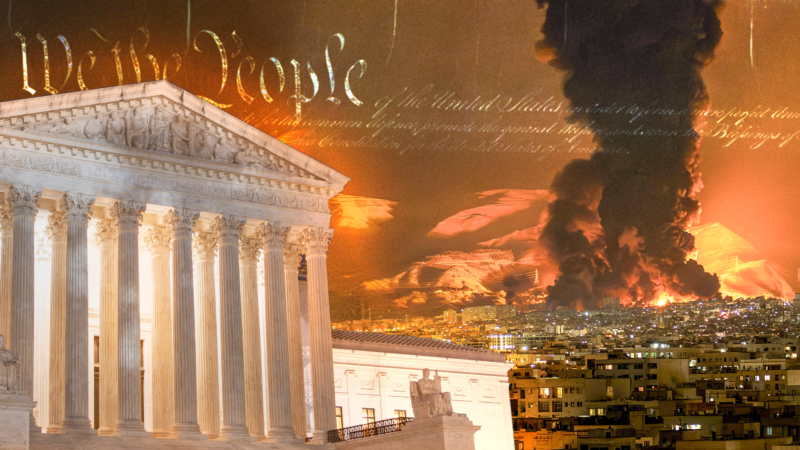
In a recent edition of this newsletter, I argued that the war with Iran is unconstitutional because President Donald Trump took the United States to war without first obtaining a congressional declaration of war as required by the U.S. Constitution. In response, a reader we'll call "John A." wrote in to say the following: "Unconstitutional perhaps, but enforcement is political, not judicial."

As a practical matter, "John A." is probably right.

You’re reading Injustice System from Damon Root and Reason. Get more of Damon’s commentary on constitutional law and American history.

This field is for validation purposes and should be left unchanged.

Despite the fact that the Constitution vests the power "to declare War" exclusively in the hands of Congress via Article I, Section 8, the U.S. Supreme Court has proven itself unwilling over the past half-century or so to hear cases challenging the usurpation of that congressional power by the executive. In 1970, for example, the Supreme Court declined to hear a case known as Massachusetts v. Laird, in which the Bay State wanted the Court to rule on the constitutionality of the Vietnam War, which, like the current Iran War, was never formally declared by Congress.

"Today we deny a hearing to a State which attempts to determine whether it is constitutional to require its citizens to fight in a foreign war absent a congressional declaration of war," Justice William O. Douglas wrote in dissent. "Another way of putting the question is whether under our Constitution presidential wars are permissible? Should that question be answered in the negative we would then have to determine whether Congress has declared war. That question which Massachusetts presents is in my view justiciable."

The Supreme Court did not explain why it refused to hear Massachusetts v. Laird and several other cases like it that centered on the Vietnam War. But legal scholars generally think the Court dodged the issue because most of the justices saw it as a "political question" that was best left for Congress and the president to hash out. As Michal Belknap argued in The Oxford Companion to the Supreme Court of the United States, "unwilling to precipitate a conflict with the Executive, the Court protected its institutional interests by leaving the question of the legality of the war to be resolved in the political arena."

Of course, the Supreme Court has not always taken such a hands-off approach in matters of war and executive power. In Youngstown Sheet and Tube Company v. Sawyer (1952), for example, the Court famously rejected President Harry Truman's claim that his "inherent" executive authority allowed him to seize control of most privately owned American steel mills during the Korean War as a national security measure. "The President's order does not direct that a congressional policy be executed in a manner prescribed by Congress—it directs that a presidential policy be executed in a manner prescribed by the President," the Court stated. Yet "the Founders of this Nation entrusted the lawmaking power to the Congress alone in both good and bad times." Indeed, the Court added, "it would do no good to recall the historical events, the fears of power, and the hopes for freedom that lay behind their choice. Such a review would but confirm our holding that this seizure order cannot stand."

You may be thinking that the founders also entrusted the authority to declare war "to Congress alone in both good and bad times." And you would be correct to think it. The logic of Youngstown Steel does cut against the idea of a president launching a war without congressional authorization just as it cuts against the idea of a president seizing steel mills without congressional authorization.

But the logic of Youngstown Steel is apparently no match for the flexibility of the "political questions doctrine," which has conveniently allowed the Supreme Court to sidestep the thorny constitutional debate over undeclared foreign wars for many decades now with no end in sight.

Which brings us back to the point made by reader "John A." If Trump is going to pay a price for launching a war without congressional authorization, that price will have to be a political one, since the judiciary is basically AWOL.

Start your day with Reason. Get a daily brief of the most important stories and trends every weekday morning when you subscribe to Reason Roundup.

This field is for validation purposes and should be left unchanged.

NEXT: Minnesota's Fraud Scandal Isn't an Immigration Problem. It's a Spending Problem.

Damon Root is a senior editor at Reason and the author of A Glorious Liberty: Frederick Douglass and the Fight for an Antislavery Constitution (Potomac Books). His next book, Emancipation War: The Fall of Slavery and the Coming of the Thirteenth Amendment (Potomac Books), will be published in June 2026.

Supreme CourtWarIranDonald TrumpTrump AdministrationConstitutionLaw & GovernmentCourts
Share on FacebookShare on XShare on RedditShare by emailPrint friendly versionCopy page URL Add Reason to Google
Media Contact & Reprint Requests

Show Comments (1)

Latest

Will SCOTUS Review the Iran War's Constitutionality? Don't Count on It.

Damon Root | 3.10.2026 7:00 AM

Minnesota's Fraud Scandal Isn't an Immigration Problem. It's a Spending Problem.

Peter Suderman | From the April 2026 issue

Brickbat: Hands Free

Charles Oliver | 3.10.2026 4:00 AM

Live Nation Settled Its Lawsuit With the Feds. Don't Expect Concert Tickets To Get Any Cheaper.

Jack Nicastro | 3.9.2026 5:21 PM

Trump Supports Asylum for Iranian Women's Soccer Team. His Immigration Policy Doesn't.

Joe Lancaster | 3.9.2026 5:04 PM

Recommended

  • About
  • Browse Topics
  • Events
  • Staff
  • Jobs
  • Donate
  • Advertise
  • Subscribe
  • Contact
  • Media
  • Shop
  • Amazon
Reason Facebook@reason on XReason InstagramReason TikTokReason YoutubeApple PodcastsReason on FlipboardReason RSS Add Reason to Google

© 2026 Reason Foundation | Accessibility | Privacy Policy | Terms Of Use

This site is protected by reCAPTCHA and the Google Privacy Policy and Terms of Service apply.

r

I WANT FREE MINDS AND FREE MARKETS!

Help Reason push back with more of the fact-based reporting we do best. Your support means more reporters, more investigations, and more coverage.

Make a donation today! No thanks
r

I WANT TO FUND FREE MINDS AND FREE MARKETS

Every dollar I give helps to fund more journalists, more videos, and more amazing stories that celebrate liberty.

Yes! I want to put my money where your mouth is! Not interested
r

SUPPORT HONEST JOURNALISM

So much of the media tries telling you what to think. Support journalism that helps you to think for yourself.

I’ll donate to Reason right now! No thanks
r

PUSH BACK

Push back against misleading media lies and bad ideas. Support Reason’s journalism today.

My donation today will help Reason push back! Not today
r

HELP KEEP MEDIA FREE & FEARLESS

Back journalism committed to transparency, independence, and intellectual honesty.

Yes, I’ll donate to Reason today! No thanks
r

STAND FOR FREE MINDS

Support journalism that challenges central planning, big government overreach, and creeping socialism.

Yes, I’ll support Reason today! No thanks
r

PUSH BACK AGAINST SOCIALIST IDEAS

Support journalism that exposes bad economics, failed policies, and threats to open markets.

Yes, I’ll donate to Reason today! No thanks
r

FIGHT BAD IDEAS WITH FACTS

Back independent media that examines the real-world consequences of socialist policies.

Yes, I’ll donate to Reason today! No thanks
r

BAD ECONOMIC IDEAS ARE EVERYWHERE. LET’S FIGHT BACK.

Support journalism that challenges government overreach with rational analysis and clear reasoning.

Yes, I’ll donate to Reason today! No thanks
r

JOIN THE FIGHT FOR FREEDOM

Support journalism that challenges centralized power and defends individual liberty.

Yes, I’ll donate to Reason today! No thanks
r

BACK JOURNALISM THAT PUSHES BACK AGAINST SOCIALISM

Your support helps expose the real-world costs of socialist policy proposals—and highlight better alternatives.

Yes, I’ll donate to Reason today! No thanks
r

FIGHT BACK AGAINST BAD ECONOMICS.

Donate today to fuel reporting that exposes the real costs of heavy-handed government.

Yes, I’ll donate to Reason today! No thanks