
The Trump Administration Made Habeas Corpus Great Again
More habeas corpus petitions were filed over the last year than in the past three administrations combined because of the administration's mass detention policy.
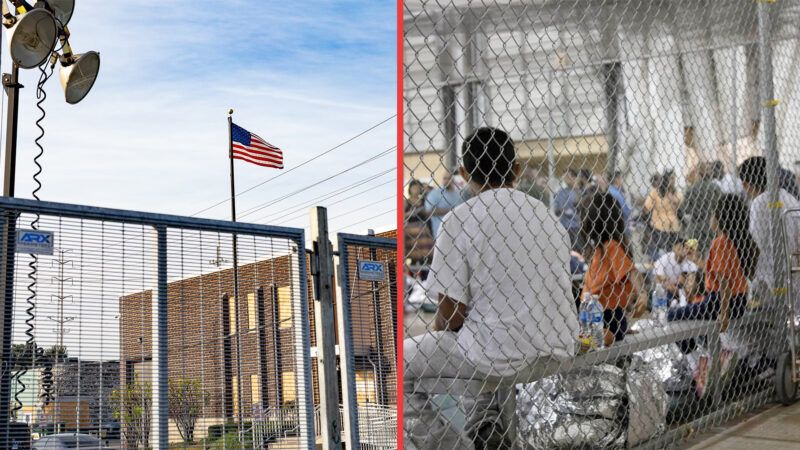
The ancient writ of habeas corpus, which allows one to petition unlawful imprisonment to a judge, has had a banner year because of the Trump administration's mass deportation program.
The Supreme Court ruled last April that challenges to unlawful imprisonment and deportation must be brought as individual habeas corpus petitions, rather than lawsuits broadly attacking the government's policies. That ruling, combined with the Trump administration's policy of holding arrestees in indefinite detention without bond hearings, led detainees to flood federal court dockets with habeas petitions. A ProPublica analysis published in February found that more than 18,000 petitions were filed in the first 13 months of President Donald Trump's second term—more than the last three administrations combined.
In Minnesota, more than 1,000 petitions have been filed since December, when the administration launched Operation Metro Surge, according to a review by the Minnesota Reformer. The Reformer reported that among the army of volunteer lawyers filing habeas petitions on behalf of detainees were "corporate litigators, divorce lawyers, estate planners and criminal defense attorneys who are leveraging their bar admission to mount an unprecedented defense of immigrants."
In Florida, one such attorney is James Slater. Slater typically practices civil rights, intellectual property, and First Amendment law, not immigration, but he says he's filed about a dozen habeas petitions on behalf of Immigration and Customs Enforcement (ICE) detainees recently.
"In a large part for the habeas cases I've been working on, and I know from speaking to other practitioners, this is a matter of people who are complying with the rules who are getting caught up in detention," Slater says. "Right now they're going to their scheduled check-in with ICE, they're being arrested at those check-ins, and then either deported or held in detention. We're now trying to try to get them out because they're not supposed to be there."
What Slater and other attorneys are arguing is that the administration is detaining immigrants who've already been released into the country under a provision of the Immigration and Nationality Act (INA) that is supposed to only apply to applicants for admission stopped at the border.
"If you get stopped at the border, you could be mandatorily detained, whereas all of these folks who are getting caught up have been living in this country for years," Slater says. "In some of my cases, we have people here 20 years, and they're being told, 'Sorry, you're an applicant for admission and you're not entitled to a bond.'"
What's made this habeas campaign so effective is that the vast majority of federal judges around the country who've ruled on the issue agree that the Trump administration is mangling the plain text of the INA to justify mandatory detentions, and therefore holding detainees unlawfully.
For example, in January, U.S. District Judge Roy B. Dalton granted a temporary restraining order barring the government from detaining a high school student whose parents fled to the U.S. from Venezuela seeking asylum. Dalton called the government's interpretation of the INA "plainly incoherent" and ordered two Justice Department attorneys to show why they shouldn't be sanctioned for bringing such a faulty argument before the court.
A running Politico tally of federal judges who have ruled on the Trump administration's mass detention policy found that, as of February 24, 386 judges had ruled against it, while only 33 had agreed with the administration's interpretation of the INA.
And when a judge grants a petition for habeas corpus, Latin for "you have the body" or "show me the body," they can order that corpus freed immediately.
To short-circuit ICE detainees' ability to seek judicial relief, ICE often transfers detainees between states, which creates jurisdictional problems for their petitions, not to mention making access to legal counsel more difficult.
These tactics have also led to repeated violations of court orders to release detainees, keep them within state lines, and give them bond hearings.
This week, Chief Judge for the District of Minnesota Patrick Schiltz, a George W. Bush appointee, threatened officials with criminal contempt if ICE continued to violate court orders. Schlitz previously released a list of nearly 100 cases in Minnesota alone where ICE had defied orders. Schiltz revised that number down to 66 cases, but in his latest order, he included an additional 77 cases.
"This Court will continue to do whatever is required to protect the rule of law, including, if necessary, moving to the use of criminal contempt," Schiltz wrote. "One way or another, ICE will comply with this Court's orders."
Another federal judge in Minnesota issued civil contempt sanctions this week against the Justice Department for moving a detainee out of the state, not releasing him as ordered, nor returning him to Minnesota as ordered.
And in New Jersey this week, U.S. District Judge Zahid N. Quraishi threatened to make federal prosecutors testify under oath if they continued to seek arrests and detentions under the administration's rejected arguments. Federal prosecutors in New Jersey admitted earlier in February that the government had violated 72 court orders since December in cases of ICE detainees challenging their imprisonment. "Efforts by the court in this district to protect detainees' rights have been largely frustrated by the government," Quraishi wrote, adding that he would "not stand idly by and allow this intentional misconduct to go on. It ends today."
The Trump administration hasn't been able to escape the reach of habeas corpus, even beyond the country's borders.
Earlier this month, Chief U.S. District Judge for the District of Columbia James E. Boasberg ordered the Trump administration to return more than 100 Venezuelan men it had flown out of the country and sent to a megaprison in El Salvador without due process. Boasberg also ruled that those men could submit habeas petitions from abroad, despite the U.S. government's insistence that there was no feasible way to accommodate such petitions.
"Were it otherwise, the Government could simply remove people from the United States without providing any process and then, once they were in a foreign country, deny them any right to return for a hearing or opportunity to present their case from abroad," Boasberg wrote.
In its efforts to circumvent habeas corpus, the Trump administration has instead shown why "the great and efficacious writ in all manner of illegal confinement," as the English jurist William Blackstone famously described it, has been a durable and necessary safeguard for individual liberty for more than eight centuries.
As Senior U.S. Circuit Judge Thomas L. Ambro recently wrote in a 3rd Circuit opinion, "A petition for a writ of habeas corpus has been a civil action since before our law was our law."
In that case, the 3rd Circuit ruled that successful litigants in habeas cases are entitled to attorney fees and costs, as in any typical civil action against the government.
That's good news for the Great Writ, but—given the Justice Department's record on these cases looks like the Washington Generals'—bad news for taxpayers.
