
Fight Government Corruption With Deregulation
The world is growing simultaneously more corrupt and bound in red tape. That’s not a coincidence.
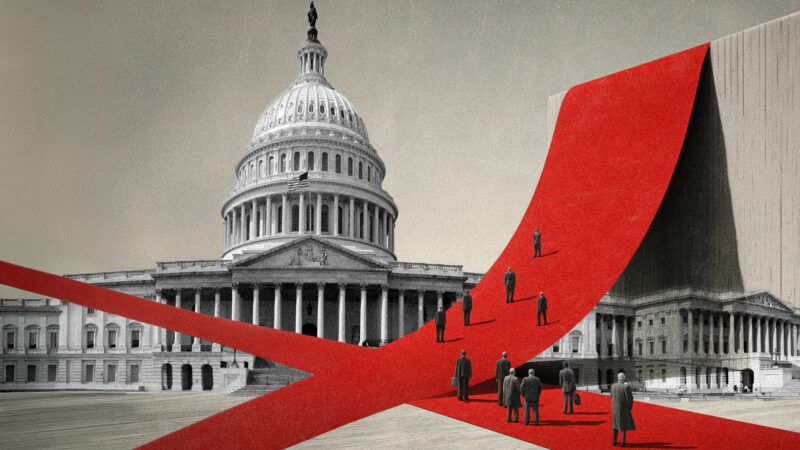
At the moment, corruption investigations and trials of political figures are taking place in jurisdictions around the U.S. including Hawaii, Mississippi, and Washington, D.C. These aren't isolated scandals; the latest edition of an international corruption index finds corruption worsening globally, with the United States earning its worst score to date. Given that corruption involves government officials peddling favors for compensation, it shouldn't be surprising that evidence suggests the solution lies in reducing the power and role of the state.
You are reading The Rattler from J.D. Tuccille and Reason. Get more of J.D.'s commentary on government overreach and threats to everyday liberty.
Everywhere You Look Are Politicians on the Take
In Hawaii, Lt. Gov. Sylvia Luke is apparently the officially unnamed lawmaker under federal investigation for accepting $35,000 in bribes while she was chair of the state's House Finance Committee. Three Jackson, Mississippi, officials, including former Mayor Chokwe Antar Lumumba, face trial for allegedly taking bribes regarding plans to build a convention center in the city. And D.C. Councilman Trayon White similarly stands accused of accepting bribes to steer city contracts. In all three cases—and many others around the country—government officials are suspected of illegitimately profiting from the power of their offices to make or break other people's business plans. It's a growing problem.
"Corruption is worsening globally, with even established democracies experiencing rising corruption amid a decline in leadership," Germany-based Transparency International reports of its 2025 Corruption Perceptions Index (CPI), published earlier this month. Of particular interest to Americans, the United States "sustained its downward slide to its lowest-ever score." The U.S. now ranks slightly lower than France and slightly higher than South Korea.
As a good-government group, Transparency International understandably calls for tougher anti-bribery laws and criticizes state persecution of independent watchdog groups around the world. Tellingly, though, "13 countries in western Europe and the EU have significantly declined, and only seven have significantly improved" at a time when the European Union faces significant criticism for entangling economic activity in excessive regulations.
Regulation Breeds Corruption
"EU regulation is not only becoming more cumbersome but it is also pilling in," Oscar Guinea and Oscar du Roy of the European Centre for Political Economy wrote in 2024. "The amount of new regulation accumulated during the last years has been staggering."
That matters. In its advice for reducing corruption, Transparency International emphasizes, "there is a broad consensus that unnecessary and excessive administrative requirements for complying with regulations create both incentives and opportunities for bribery and corruption."
The means by which this occurs is logical enough. Government-imposed permitting and licensing requirements, administrative procedures, prolonged decision-making, and contract awards create a temptation to shorten delays and reduce costs by padding officials' pockets. In many cases, selling exceptions becomes the real reason for red tape. That phenomenon applies to the entire world, including the United States.
In the U.S., the More Regulations, the More Bribery
In a paper published in the European Journal of Political Economy in 2020, Oguzhan Dincer of the Department of Economics at Illinois State University and Burak Gunalp of the Department of Economics at Turkey's Cankaya University looked at the relative effects of federal regulations on the corruption levels in U.S. states.
"Power to enforce the regulations gives government officials power to extort bribes," they wrote. "Government officials have an opportunity to extort bribes from the firms trying to enter an industry because they have the power to issue the industry licenses. They also have an opportunity to extort bribes from the incumbent firms by simply colluding with them and keeping the regulations unchanged and/or strengthening the regulations to increase the costs of entry for new firms. Finally, regulations and the discretionary power given to government officials to extract bribes create incentives for firms to operate in the unofficial economy."
Specific to the U.S., they examined two decades of data to see how red tape affected the honesty of public officials.
What they found shouldn't be surprising: "Using the U.S. Justice Department's data on the number of federal convictions for the crimes related to corruption, and controlling for several economic and demographic variables, we find a positive and statistically significant relationship between federal regulations and corruption."
Small Government Is Honest Government
Also, importantly, they found "a negative relationship between economic freedom and corruption." States with more economic freedom were less corrupt than states with less economic freedom even though they studied the impact of federal regulations. "In other words," they added, "it is possible to mitigate the effects of regulations at the federal level by reducing the size and the scope of the government at the state level."
We already know that limiting regulations promotes prosperity. "For decades, states that limit government growth, keep taxes low and predictable, and allow labor markets to adjust have outperformed their peers on jobs, incomes, and growth," Matthew D. Mitchell and Vance Ginn recently noted for Canada's Fraser Institute, which publishes an economic freedom index. Now we have strong evidence that maximizing freedom and limiting the state also promote honesty and reduce corruption.
"When regulatory systems become dense, opaque, and discretionary, they create perverse incentives for corruption," Steve Swedberg, a regulatory expert, recently observed for the Competitive Enterprise Institute. "Because corruption is the abuse of public power for private gain, limiting the discretionary power that officials wield is one of the most effective ways to prevent it."
Swedberg recommends sunsetting regulations—letting them expire after a set time period—and starting from the assumption that rules must be periodically re-justified or else erased from the books. He also wants to limit the costs regulators are allowed to impose on businesses with regulatory budgets.
But whatever the approach used to achieve regulatory reform, anybody concerned about politicians taking payoffs and the rising levels of corruption they see around them needs to consider the culpability of the bureaucratic state. If we want less corruption, we need smaller, less intrusive government.
