

Reason.com - Free Minds and Free Markets
Reason logo Reason logo
  • Latest
  • Magazine
    • Current Issue
    • Archives
    • Subscribe
    • Crossword
  • Video
    • Reason TV
    • The Reason Roundtable
    • Free Media
    • The Reason Interview
  • Podcasts
    • All Shows
    • The Reason Roundtable
    • The Reason Interview With Nick Gillespie
    • Freed Up
    • The Soho Forum Debates
  • Volokh
  • Newsletters
  • Donate
    • Donate Online
    • Ways To Give To Reason Foundation
    • Torchbearer Society
    • Planned Giving
  • Subscribe
    • Reason Plus Subscription
    • Gift Subscriptions
    • Print Subscription
    • Subscriber Support

Log In

Create new account

Corruption

Fight Government Corruption With Deregulation

The world is growing simultaneously more corrupt and bound in red tape. That’s not a coincidence.
J.D. Tuccille | 2.27.2026 7:00 AM

Share on FacebookShare on XShare on RedditShare by emailPrint friendly versionCopy page URL Add Reason to Google
Media Contact & Reprint Requests
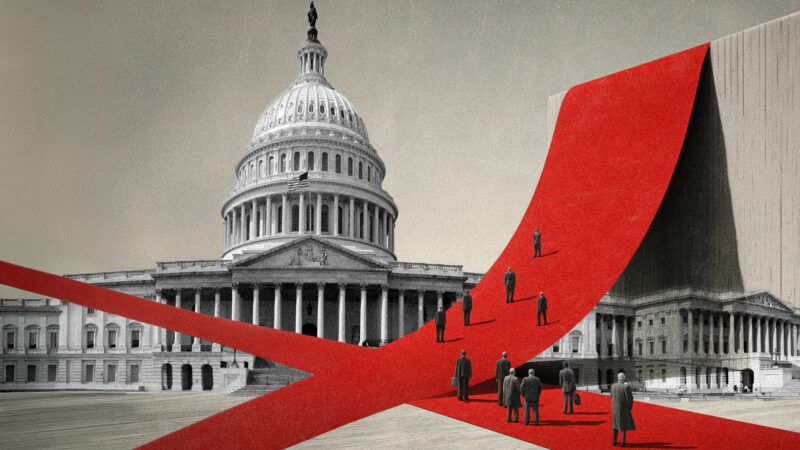
The U.S. Capitol is covered in a ribbon of red tape. | Illustration: Paul Hakimata/Dreamstime/Midjourney
(Illustration: Paul Hakimata/Dreamstime/Midjourney)

At the moment, corruption investigations and trials of political figures are taking place in jurisdictions around the U.S. including Hawaii, Mississippi, and Washington, D.C. These aren't isolated scandals; the latest edition of an international corruption index finds corruption worsening globally, with the United States earning its worst score to date. Given that corruption involves government officials peddling favors for compensation, it shouldn't be surprising that evidence suggests the solution lies in reducing the power and role of the state.

You are reading The Rattler from J.D. Tuccille and Reason. Get more of J.D.'s commentary on government overreach and threats to everyday liberty.

This field is for validation purposes and should be left unchanged.

Everywhere You Look Are Politicians on the Take

In Hawaii, Lt. Gov. Sylvia Luke is apparently the officially unnamed lawmaker under federal investigation for accepting $35,000 in bribes while she was chair of the state's House Finance Committee. Three Jackson, Mississippi, officials, including former Mayor Chokwe Antar Lumumba, face trial for allegedly taking bribes regarding plans to build a convention center in the city. And D.C. Councilman Trayon White similarly stands accused of accepting bribes to steer city contracts. In all three cases—and many others around the country—government officials are suspected of illegitimately profiting from the power of their offices to make or break other people's business plans. It's a growing problem.

"Corruption is worsening globally, with even established democracies experiencing rising corruption amid a decline in leadership," Germany-based Transparency International reports of its 2025 Corruption Perceptions Index (CPI), published earlier this month. Of particular interest to Americans, the United States "sustained its downward slide to its lowest-ever score." The U.S. now ranks slightly lower than France and slightly higher than South Korea.

As a good-government group, Transparency International understandably calls for tougher anti-bribery laws and criticizes state persecution of independent watchdog groups around the world. Tellingly, though, "13 countries in western Europe and the EU have significantly declined, and only seven have significantly improved" at a time when the European Union faces significant criticism for entangling economic activity in excessive regulations.

Regulation Breeds Corruption

"EU regulation is not only becoming more cumbersome but it is also pilling in," Oscar Guinea and Oscar du Roy of the European Centre for Political Economy wrote in 2024. "The amount of new regulation accumulated during the last years has been staggering."

That matters. In its advice for reducing corruption, Transparency International emphasizes, "there is a broad consensus that unnecessary and excessive administrative requirements for complying with regulations create both incentives and opportunities for bribery and corruption."

The means by which this occurs is logical enough. Government-imposed permitting and licensing requirements, administrative procedures, prolonged decision-making, and contract awards create a temptation to shorten delays and reduce costs by padding officials' pockets. In many cases, selling exceptions becomes the real reason for red tape. That phenomenon applies to the entire world, including the United States.

In the U.S., the More Regulations, the More Bribery

In a paper published in the European Journal of Political Economy in 2020, Oguzhan Dincer of the Department of Economics at Illinois State University and Burak Gunalp of the Department of Economics at Turkey's Cankaya University looked at the relative effects of federal regulations on the corruption levels in U.S. states.

"Power to enforce the regulations gives government officials power to extort bribes," they wrote. "Government officials have an opportunity to extort bribes from the firms trying to enter an industry because they have the power to issue the industry licenses. They also have an opportunity to extort bribes from the incumbent firms by simply colluding with them and keeping the regulations unchanged and/or strengthening the regulations to increase the costs of entry for new firms. Finally, regulations and the discretionary power given to government officials to extract bribes create incentives for firms to operate in the unofficial economy."

Specific to the U.S., they examined two decades of data to see how red tape affected the honesty of public officials.

What they found shouldn't be surprising: "Using the U.S. Justice Department's data on the number of federal convictions for the crimes related to corruption, and controlling for several economic and demographic variables, we find a positive and statistically significant relationship between federal regulations and corruption."

Small Government Is Honest Government

Also, importantly, they found "a negative relationship between economic freedom and corruption." States with more economic freedom were less corrupt than states with less economic freedom even though they studied the impact of federal regulations. "In other words," they added, "it is possible to mitigate the effects of regulations at the federal level by reducing the size and the scope of the government at the state level."

We already know that limiting regulations promotes prosperity. "For decades, states that limit government growth, keep taxes low and predictable, and allow labor markets to adjust have outperformed their peers on jobs, incomes, and growth," Matthew D. Mitchell and Vance Ginn recently noted for Canada's Fraser Institute, which publishes an economic freedom index. Now we have strong evidence that maximizing freedom and limiting the state also promote honesty and reduce corruption.

"When regulatory systems become dense, opaque, and discretionary, they create perverse incentives for corruption," Steve Swedberg, a regulatory expert, recently observed for the Competitive Enterprise Institute. "Because corruption is the abuse of public power for private gain, limiting the discretionary power that officials wield is one of the most effective ways to prevent it."

Swedberg recommends sunsetting regulations—letting them expire after a set time period—and starting from the assumption that rules must be periodically re-justified or else erased from the books. He also wants to limit the costs regulators are allowed to impose on businesses with regulatory budgets.

But whatever the approach used to achieve regulatory reform, anybody concerned about politicians taking payoffs and the rising levels of corruption they see around them needs to consider the culpability of the bureaucratic state. If we want less corruption, we need smaller, less intrusive government.

The Rattler is a weekly newsletter from J.D. Tuccille. If you care about government overreach and tangible threats to everyday liberty, this is for you.

This field is for validation purposes and should be left unchanged.

NEXT: Brickbat: Close Enough

J.D. Tuccille is a contributing editor at Reason.

CorruptionRegulationDeregulationFraudPoliticsBig GovernmentGovernmentLaw & Government
Share on FacebookShare on XShare on RedditShare by emailPrint friendly versionCopy page URL Add Reason to Google
Media Contact & Reprint Requests

Hide Comments (9)

Editor's Note: As of February 29, 2024, commenting privileges on reason.com posts are limited to Reason Plus subscribers. Past commenters are grandfathered in for a temporary period. Subscribe here to preserve your ability to comment. Your Reason Plus subscription also gives you an ad-free version of reason.com, along with full access to the digital edition and archives of Reason magazine. We request that comments be civil and on-topic. We do not moderate or assume any responsibility for comments, which are owned by the readers who post them. Comments do not represent the views of reason.com or Reason Foundation. We reserve the right to delete any comment and ban commenters for any reason at any time. Comments may only be edited within 5 minutes of posting. Report abuses.

  1. Kemuel   2 months ago

    This comes as no surprise to libertarians. We don't suffer from the delusion that putting men in chains makes them honest.

  2. JesseAz (RIP CK)   2 months ago

    Good take. Now how about noting and encouraging deregulation already happening.

    1. Rev Arthur L kuckland (5-30-24 banana republic day)   2 months ago

      What are you talking about? I read only reason so clearly trump has never deregulated anything. If he did I'm sure the reason writers would be shouting it from the rooftop

  3. Rick James   2 months ago

    Mean while, let's agree to disagree and refuse to demand an ID or check eligibility for anything.

  4. Alan Vanneman   2 months ago

    "Small government is honest government."

    Not really. State government in Mississippi in the 1950s was very small, but the government was thoroughly corrupt, and things were even worse in the "good old days" prior to WWI. William Faulkner's father quit his job with the state government when a new governor demanded every state employee contribute 10% of his salary to the governor's reelection campaign. Red tape is bad in and of itself, and certainly creates the opportunity for graft, but graft can easily flourish without it. Libertarian "just so stories" are so often just BS.

    1. Kemuel   2 months ago

      The requirement to contribute to a campaign would be a regulation. The absence of that requirement would in fact reduce the size of government. You're proving the point that growing government grows corruption, as stated in the article.

  5. Uncle Jay   2 months ago

    Deregulation would stop some corruption.
    So would ending all grants, subsidies, foreign aid and terminating most of the federal bureaucracies.
    But don't hold your breath.
    Both parties are making too much money under the table to end the taxpayer-funded gravy train.

    1. Ezra MacVie   2 months ago

      Just so, I'm afraid.

  6. RogerBarris   2 months ago

    As the old saying goes: "If the politicians regulate what can be bought and sold, then the first thing to be bought will be the politicians."

Please log in to post comments

Mute this user?

  • Mute User
  • Cancel

Ban this user?

  • Ban User
  • Cancel

Un-ban this user?

  • Un-ban User
  • Cancel

Nuke this user?

  • Nuke User
  • Cancel

Un-nuke this user?

  • Un-nuke User
  • Cancel

Flag this comment?

  • Flag Comment
  • Cancel

Un-flag this comment?

  • Un-flag Comment
  • Cancel

Latest

62-Year-Old Protester Acquitted on All Charges for Wearing Penis Costume

Joe Lancaster | 4.16.2026 1:04 PM

Congress Declines Again To Rein in Trump's Iran War

Matthew Petti | 4.16.2026 12:29 PM

Federal Judge Delivers Due Process Win Against DOJ Registry Overreach

Autumn Billings | 4.16.2026 11:26 AM

'The Rich Don't Pay Their Fair Share' and 4 Other Tax Myths That Won't Die

Veronique de Rugy | 4.16.2026 10:50 AM

'Blue Power' and the Rise of Police Union Politics

C.J. Ciaramella | 4.16.2026 10:17 AM

Recommended

  • About
  • Browse Topics
  • Events
  • Staff
  • Jobs
  • Donate
  • Advertise
  • Subscribe
  • Contact
  • Media
  • Shop
  • Amazon
Reason Facebook@reason on XReason InstagramReason TikTokReason YoutubeApple PodcastsReason on FlipboardReason RSS Add Reason to Google

© 2026 Reason Foundation | Accessibility | Privacy Policy | Terms Of Use

This site is protected by reCAPTCHA and the Google Privacy Policy and Terms of Service apply.

r

I WANT FREE MINDS AND FREE MARKETS!

Help Reason push back with more of the fact-based reporting we do best. Your support means more reporters, more investigations, and more coverage.

Make a donation today! No thanks
r

I WANT TO FUND FREE MINDS AND FREE MARKETS

Every dollar I give helps to fund more journalists, more videos, and more amazing stories that celebrate liberty.

Yes! I want to put my money where your mouth is! Not interested
r

SUPPORT HONEST JOURNALISM

So much of the media tries telling you what to think. Support journalism that helps you to think for yourself.

I’ll donate to Reason right now! No thanks
r

PUSH BACK

Push back against misleading media lies and bad ideas. Support Reason’s journalism today.

My donation today will help Reason push back! Not today
r

HELP KEEP MEDIA FREE & FEARLESS

Back journalism committed to transparency, independence, and intellectual honesty.

Yes, I’ll donate to Reason today! No thanks
r

STAND FOR FREE MINDS

Support journalism that challenges central planning, big government overreach, and creeping socialism.

Yes, I’ll support Reason today! No thanks
r

PUSH BACK AGAINST SOCIALIST IDEAS

Support journalism that exposes bad economics, failed policies, and threats to open markets.

Yes, I’ll donate to Reason today! No thanks
r

FIGHT BAD IDEAS WITH FACTS

Back independent media that examines the real-world consequences of socialist policies.

Yes, I’ll donate to Reason today! No thanks
r

BAD ECONOMIC IDEAS ARE EVERYWHERE. LET’S FIGHT BACK.

Support journalism that challenges government overreach with rational analysis and clear reasoning.

Yes, I’ll donate to Reason today! No thanks
r

JOIN THE FIGHT FOR FREEDOM

Support journalism that challenges centralized power and defends individual liberty.

Yes, I’ll donate to Reason today! No thanks
r

BACK JOURNALISM THAT PUSHES BACK AGAINST SOCIALISM

Your support helps expose the real-world costs of socialist policy proposals—and highlight better alternatives.

Yes, I’ll donate to Reason today! No thanks
r

FIGHT BACK AGAINST BAD ECONOMICS.

Donate today to fuel reporting that exposes the real costs of heavy-handed government.

Yes, I’ll donate to Reason today! No thanks


