

The 4 Economic Myths Powering Trump's New Tariff Push
American businesses and consumers absorbed nearly 90 percent of the 2025 tariffs' economic burden, the Federal Reserve Bank of New York found.
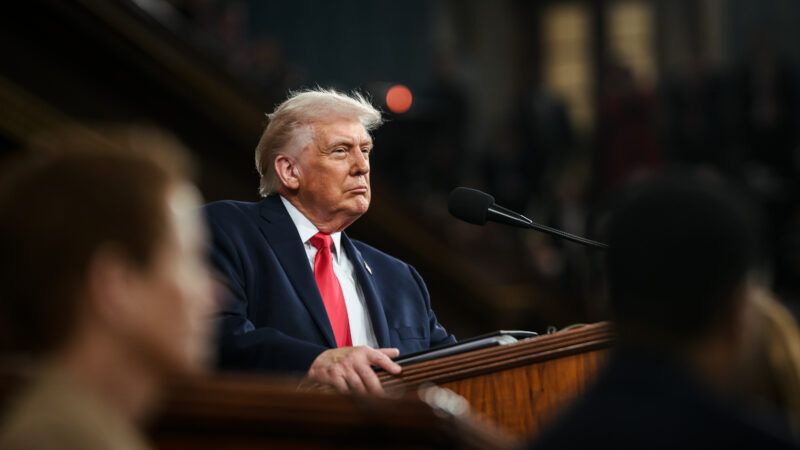
Within hours of the Supreme Court ruling that the White House's widespread "emergency" tariffs were illegal, President Donald Trump moved to install 10 percent across-the-board tariffs under a different alleged authority. He later said he would raise that rate to 15 percent and delivered a combative response in the State of the Union.
The trade war isn't ending. It's just changing ZIP codes. What won't change is the propaganda coming from the White House, which insists that Americans don't pay the costs.
Consider what follows as a guide to the fallacy-filled arguments that you'll soon hear more of.
The first argument is the optimistic one: Tariffs "reshore" production, raise domestic demand, push wages up, and leave consumers better off. It's a tidy story. It's also wrong.
Tariffs don't conjure consumer demand out of thin air. Americans were buying plenty of washing machines, clothing, and steel before the tariffs. What changes is where some things are made. Production shifts from foreign manufacturers with efficiency or cost advantages to more expensive domestic manufacturers. American producers stand to gain, except when they must pay tariffs to import the materials they need (as is often the case).
But everyone who buys the product pays more. The extra $100 a family spends on a washing machine won't instead be spent at the restaurant next door, the repair shop, or the shoe store. Real wages—what your paycheck actually buys—fall when the prices of most things rise.
Second is the zero-sum argument: Making China worse off automatically makes Americans better off. This is not how economics works outside of campaign rallies.
Trade is not a game in which one side's loss is the other's gain. When Americans buy less from China, it's true, some of our overseas business competitors lose revenue. But what about the American households losing access to cheaper goods? Or the American producers losing access to cheaper materials and ingredients that make them more competitive?
Both countries take a hit. Serious analysts who favor targeted tariffs for strategic reasons generally acknowledge this tradeoff and argue that the benefits justify the costs. What they don't claim is that such costs don't exist.
Third is an attempt at a populist argument made in the past by U.S. Trade Representative Jamieson Greer. He claimed that tariffs can't hurt lower-income Americans because the wealthy do most of the consuming. This is clearly an attempt to refute the common—and correct—argument that tariffs are regressive, or disproportionately hurtful to lower-income people.
Sadly, our trade official does not understand what regressivity means. A tax is regressive, and therefore not populist, when it takes a larger share of earnings from lower-income households than from wealthier households. The absolute dollar figure is irrelevant to the question. A billionaire will spend many more dollars on imported goods than a teacher does, but that spending represents a sliver of the billionaire's income.
Nearly every dollar the teacher earns goes toward supporting a family, much of it spent on clothing, appliances, and household goods that are heavily import-dependent. The empirical record from earlier tariffs confirms that the burden falls hardest, as a share of income, on working- and middle-class families.
Fourth is the corporate-absorption argument: Don't worry, companies will eat the costs. Large retailers, the theory goes, quietly absorb tariff expenses through thinner profit margins instead of raising prices.
Even when firms do absorb some of the hit, the money doesn't disappear. These companies instead hire fewer people, pay lower wages, invest less or, in industries where profit margins are already thin, hike future prices. The burden just takes a different route to your wallet.
These objections aren't hypothetical. They're backed by data.
The Federal Reserve Bank of New York recently published findings that American businesses and consumers absorbed nearly 90 percent of the 2025 tariffs' economic burden. The researchers weren't working from theory: They tracked actual transaction-level import price data and found that prices paid by U.S. importers rose nearly one-for-one with tariff rates. These results confirm what research on the 2018-19 tariffs already established and echoes other studies of the past year.
The bottom line is that, faced with tariffs, foreign exporters don't really cut their prices to cushion the blow. Corporations don't quietly absorb these hits. The costs are passed on, one way or another, just as the textbooks predict.
We also know that job creation was modest in 2025 and that manufacturing jobs are in decline. Whatever economic boom we are now experiencing is driven by computer and electronic investments, which happen to be the biggest sectors exempted from tariffs.
I could offer even more evidence that the administration's tariff policy isn't working. But Americans already know it, which is why strong majorities are firmly opposed.
The tariffs' legality will continue to be litigated. The talking points will be recycled. For now, the steep price tag will remain ours to pay.
COPYRIGHT 2026 CREATORS.COM

Editor's Note: As of February 29, 2024, commenting privileges on reason.com posts are limited to Reason Plus subscribers. Past commenters are grandfathered in for a temporary period. Subscribe here to preserve your ability to comment. Your Reason Plus subscription also gives you an ad-free version of reason.com, along with full access to the digital edition and archives of Reason magazine. We request that comments be civil and on-topic. We do not moderate or assume any responsibility for comments, which are owned by the readers who post them. Comments do not represent the views of reason.com or Reason Foundation. We reserve the right to delete any comment and ban commenters for any reason at any time. Comments may only be edited within 5 minutes of posting. Report abuses.
Please to post comments
>>the Federal Reserve Bank of New York found ...
empirical data collected by me says we're killing it.
Any evidence that FRB NY produces shite data and research? Or is this just another instance of not liking the result so the source must be wrong?
We don’t trust leftists. Especially Marxist foreign insurgents, like you.
Your kind tend to cunt things up.
Yes.
Even the sub headline pushes a lie. A lie easily seen through simple CPI and PPI. Almost every major industry reduced their estimated cost from tariffs each quarter last year. Supply chains shifted.
The study that pushed that estimated has already been lambasted by many in regards to the assumptions they used.
One example is they didnt even separate independent importers from single supply chain numbers. 40% of importers are the same company as the foreign exporter. They also assumed static supply chain in their models, ignoring shifts there in response.
On top of that the data they pulled from was not from import pricing data but largely from models estimating import costs. And even there they didnt include import cost increases creates due to increased port fees. Labor fees, global price increases, market changes to specific goods. For example chocolate was shown to be a price increase due to tariffs despite costs going up globally.
The writers here push their own myths constantly.
I'm personally aware of many businesses making reshoring and "friendshoring" decisions.
Same here. The costs for us dropped over 90% in estimated tariff cost risks by 4q.
Reason’s primary mission is to damage Trump. Honesty is not a necessity for them.
consumption tax > income tax
Regressive, of course, and has other major problems - like what the rate needs to be to collect sufficient revenues, how much more you have to spend on anti-smuggling and anti-fraud measures, etc.
What are the current levels of smuggling and fraud that take place given that 45 states out of 50 currently apply a consumption tax?
If you only count "sales tax" it's 45 of 50 states. If you count each state multiply for fuel taxes, alcohol taxes, tobacco taxes, entertainment taxes, etc., etc., etc. the number of individual "consumption tax states (within the US)" jumps into the hundreds and there's no state without at least several consumption taxes.
And that doesn't get into FFnC, "registration fees", excise taxes, business/occupational licensing, etc., etc.
Also, SSDD, consumption taxes and tariffs are inherently or presumptively flat. Specifically moreso than other excise taxes and registration fees. It's possible to construct them in such a way to be progressive or regressive inherently (like most any other tax) and even further as part of an overall progressive/flat/regressive scheme (and multiple schemes comparatively); but the declaration that consumption taxes and/or tariffs are regressive (or progressive) out of hand, especially when they're declared as "10% tariffs on all imports" or "10% tariffs on aluminum" is both literally and figuratively detached from reality. It's rather literally like saying "Paying any price for any unit of anything is regressive."
The only way they are inherently and de facto progressive or regressive is if you assume all foreigners are simultaneously poor and/or underpaid but, somehow, have greater access to privileged productivity *and* shipping. More clearly, a logger in Canada making $60K/yr., a Chinese sweatshop worker making $10K/yr., and the captain of a Chinese freight ship making $50K/yr. are equally impoverished, and not just valued differently by the market, because they're not American.
And just FYI, with an income tax, the state literally treats every citizen as if they are guilty of smuggling, until you prove you're not, so there are secondary moral considerations as to why an income tax is not the preferable solution... no matter how badly commenter Nelson tries to convince you that the massive state-spying regime that HAS to come with an income tax is "just like having a safeway card or a credit rating agency knowing how well you pay off your credit cards."
Nelson is a bigger idiot than even Diet Shrike.
Look at the liberal shrike scream regressive! The current tax system has never been more progressive than it is currently buddy.
Making people share costs of what they use is soooooooooo horrible to globalist leftists.
Who would ever have guessed that real-world evidence would support some basic and virtually self-evident economic principles?
The absurd thing is, if Trump suggested that he was eliminating all tariffs and was going to fund the government purely from capital gains, the cultists here would be defending that policy as well.
Loyalty > economics, as M L might have said.
Goddamn you’re a dumb Marxist cunt. And just because you’re pro CCP doesn’t make you a free market enthusiast.
Model data isnt evidence.
You didnt even read the study lol.


