

Reason.com - Free Minds and Free Markets
Reason logo Reason logo
  • Latest
  • Magazine
    • Current Issue
    • Archives
    • Subscribe
    • Crossword
  • Video
    • Reason TV
    • The Reason Roundtable
    • Free Media
    • The Reason Interview
  • Podcasts
    • All Shows
    • The Reason Roundtable
    • The Reason Interview With Nick Gillespie
    • Freed Up
    • The Soho Forum Debates
  • Volokh
  • Newsletters
  • Donate
    • Donate Online
    • Ways To Give To Reason Foundation
    • Torchbearer Society
    • Planned Giving
  • Subscribe
    • Reason Plus Subscription
    • Gift Subscriptions
    • Print Subscription
    • Subscriber Support

Login Form

Create new account
Forgot password

Tariffs

The Supreme Court Didn't Fully End the Trade War, but It Reinforced Limits on the Presidency

President Trump will undoubtedly keep trying to impose protectionism, but his options are limited.
J.D. Tuccille | 2.23.2026 7:00 AM

Share on FacebookShare on XShare on RedditShare by emailPrint friendly versionCopy page URL Add Reason to Google
Media Contact & Reprint Requests
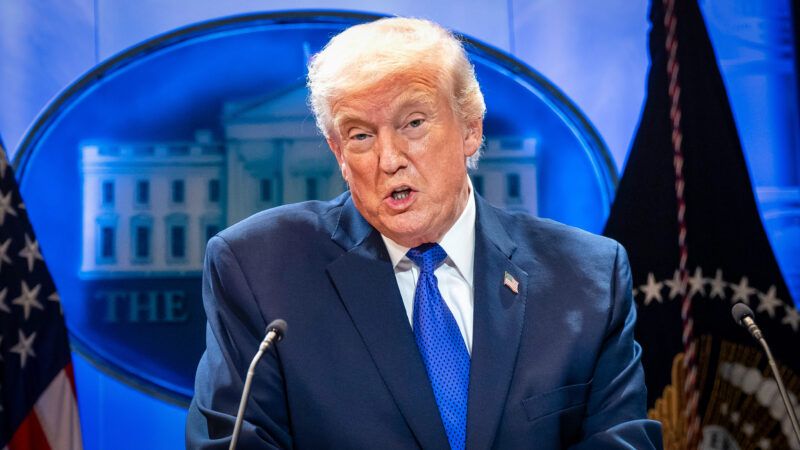
President Donald Trump addresses the press after the Supreme Court's tariff decision. | Sipa USA/Newscom
(Sipa USA/Newscom)

Given President Donald Trump's petulant response to Friday's Supreme Court decision barring his use of the International Emergency Economic Powers Act (IEEPA) to impose tariffs, the White House's unilateral trade war against Americans (and the rest of the world) is not yet over. Temporary new tariffs imposed under Section 122 of the Trade Act of 1974 seem designed as much to flip the bird to the high court's majority as to maintain the administration's protectionist policies. But Section 122 is a more limited tool than what Trump claimed under IEEPA, and there's little doubt the president (and his successors) have been reminded of boundaries to the power of the office.

'IEEPA Does Not Authorize the President To Impose Tariffs'

In Friday's ruling, Chief Justice John Roberts wrote for the 6–3 majority in the case of Learning Resources Inc. v Trump that "the Government reads IEEPA to give the President power to unilaterally impose unbounded tariffs. On this reading, moreover, the President is unconstrained by the significant procedural limitations in other tariff statutes and free to issue a dizzying array of modifications at will. All it takes to unlock that extraordinary power is a Presidential declaration of emergency, which the Government asserts is unreviewable."

Joined in whole or in part by Associate Justices Neil Gorsuch, Amy Coney Barrett, Elena Kagan, Sonia Sotomayor, and Ketanji Brown Jackson, Roberts concluded, "IEEPA's grant of authority to 'regulate . . . importation' falls short. IEEPA contains no reference to tariffs or duties. The Government points to no statute in which Congress used the word 'regulate' to authorize taxation….We hold that IEEPA does not authorize the President to impose tariffs."

Gorsuch's concurring opinion was especially on point. "The President claims that Congress delegated to him an extraordinary power in the International Emergency Economic Powers Act (IEEPA)—the power to impose tariffs on practically any products he wants, from any countries he chooses, in any amounts he selects," he wrote. "The Constitution lodges the Nation's lawmaking powers in Congress alone, and the major questions doctrine safeguards that assignment against executive encroachment."

Gorsuch went on to chastise his colleagues—both the majority and the dissenters—for inconsistently enforcing the division of power between the executive and legislative branches depending on who holds the presidency. "If history is any guide, the tables will turn and the day will come when those disappointed by today's result will appreciate the legislative process for the bulwark of liberty it is," he concluded.

The President Dredges Up Another Inapplicable Law To Impose Tariffs

That said, Congress didn't limit itself to IEEPA when delegating powers, a point the administration immediately seized upon.

"President Trump is invoking his authority under section 122 of the Trade Act of 1974, which empowers the President to address certain fundamental international payment problems through surcharges and other special import restrictions," announced the White House. "The Proclamation imposes, for a period of 150 days, a 10% ad valorem import duty on articles imported into the United States."

The president later hiked the tariff to 15 percent, seemingly just because he could. Tellingly, though, that's the maximum allowed under that law, as is the 150-day duration of the tariffs. Section 122 doesn't pretend to be the grant of open-ended power the administration falsely claimed from IEEPA.

Invoking Section 122 also sets up a new legal clash. That's because the law, which authorizes temporary tariffs "to deal with large and serious United States balance-of-payments deficits," is quite likely inapplicable in the modern world.

"Section 122 of the 1974 Trade Act, on which Trump's 10% tariff is based, does not apply in the current macro environment," argued Peter Berezin, chief strategist for BCA Research. "You cannot have a balance of payments if you have a flexible exchange rate, as the US currently does."

Cato Institute economist Alan Reynolds agreed that the law is irrelevant because "the U.S. Current Account [Trade] Deficit is Fully Funded by the Capital Account Surplus [net inflow of foreign capital]. There is no 'Balance of Payments Deficit' justification for President Trump's newest effort to tax American firms and families for buying imports."

That means even the limited tariffs under Section 122 are legally dubious at best and subject to legal challenge.

In truth, the administration is probably using Section 122 as a placeholder while it prepares to invoke another law—Section 301 of the Trade Act of 1974—to achieve its protectionist goals. But that authority is intended for use to retaliate against countries that engage in "unfair trade practices." It requires an investigation and places limits on the resulting tariff measures.

"It is not a general-purpose industrial policy statute," point out Georgetown University's Marc L. Busch and Jennifer Hillman. "It requires findings. It requires a process. And any remedies must be directed at eliminating the identified burden on U.S. exports."

A Bit of Relief from a Costly Trade War and Excessive Executive Power

That means the Trump administration is running up against constraints on executive power—a welcome development under any president. It's especially welcome given the costs the president's tariffs have inflicted on Americans.

"Over the course of 2025, the average tariff rate on U.S. imports increased from 2.6 to 13 percent," the Federal Reserve Bank of New York's Mary Amiti, Chris Flanagan, and Sebastian Heise, joined by Columbia University's David E. Weinstein, concluded last week. "We find that nearly 90 percent of the tariffs' economic burden fell on U.S. firms and consumers."

In dollar terms, the Tax Foundation's Erica York and Alex Durante found "the Trump tariffs amounted to an average tax increase per US household of $1,000 in 2025." Even after Friday's ruling, "the President's remaining new tariffs under Section 232 amount to average tax increase per US household of $400 in 2026."

So, any relief, even if only partial, from the Trump administration's trade war should be welcome news to Americans and for the prosperity around the world encouraged by relatively free trade. But the Supreme Court's decision also reinforced overall boundaries around presidential power – power that has grown for decades beyond constitutional limits. Reminders of limits on the too-powerful presidency should be welcomed by everybody.

The Rattler is a weekly newsletter from J.D. Tuccille. If you care about government overreach and tangible threats to everyday liberty, this is for you.

This field is for validation purposes and should be left unchanged.

NEXT: Brickbat: Purging Records

J.D. Tuccille is a contributing editor at Reason.

TariffsFree TradeSupreme CourtDonald TrumpTrump AdministrationExecutive PowerFederal governmentEconomics
Share on FacebookShare on XShare on RedditShare by emailPrint friendly versionCopy page URL Add Reason to Google
Media Contact & Reprint Requests

Hide Comments (6)

Editor's Note: As of February 29, 2024, commenting privileges on reason.com posts are limited to Reason Plus subscribers. Past commenters are grandfathered in for a temporary period. Subscribe here to preserve your ability to comment. Your Reason Plus subscription also gives you an ad-free version of reason.com, along with full access to the digital edition and archives of Reason magazine. We request that comments be civil and on-topic. We do not moderate or assume any responsibility for comments, which are owned by the readers who post them. Comments do not represent the views of reason.com or Reason Foundation. We reserve the right to delete any comment and ban commenters for any reason at any time. Comments may only be edited within 5 minutes of posting. Report abuses.

  1. GOD OF PENGUIN ISLAND   3 hours ago

    Oh thank god, I was worried Reason wouldn't cover the tariff story.

    Log in to Reply
    1. Don't look at me! ( Is the war over yet?)   2 hours ago

      But how will this impact Bad Bunny?

      Log in to Reply
      1. GOD OF PENGUIN ISLAND   1 hour ago

        JONES ACT!

        Log in to Reply
  2. creech   1 hour ago

    What kind of "emergency" goes on for 150 days which is plenty of time for Congress to assemble and act? Congress should rein in the King's power.

    Log in to Reply
  3. Sevo, 5-30-24, embarrassment   50 minutes ago

    The TDS-addled steaming pile of lying shit Tuccille is creaming his jeans!
    Fuck off and die, asswipe.

    Log in to Reply
  4. JFree   10 minutes ago

    President Trump will undoubtedly keep trying to impose protectionism, but his options are limited.

    How many divisions does the Supreme Court have?

    Log in to Reply

Please log in to post comments

Mute this user?

  • Mute User
  • Cancel

Ban this user?

  • Ban User
  • Cancel

Un-ban this user?

  • Un-ban User
  • Cancel

Nuke this user?

  • Nuke User
  • Cancel

Un-nuke this user?

  • Un-nuke User
  • Cancel

Flag this comment?

  • Flag Comment
  • Cancel

Un-flag this comment?

  • Un-flag Comment
  • Cancel

Latest

Trump's Tantrum Over the Tariff Decision Highlights His Narcissistic Authoritarianism

Jacob Sullum | 2.23.2026 9:50 AM

Weekend With Bernie

Robby Soave | 2.23.2026 9:30 AM

Police Drug Tests Are Notoriously Unreliable. They Got This Man Wrongly Charged With Trafficking Fentanyl.

C.J. Ciaramella | From the April 2026 issue

The Supreme Court Didn't Fully End the Trade War, but It Reinforced Limits on the Presidency

J.D. Tuccille | 2.23.2026 7:00 AM

Brickbat: Purging Records

Charles Oliver | 2.23.2026 4:00 AM

Recommended

  • About
  • Browse Topics
  • Events
  • Staff
  • Jobs
  • Donate
  • Advertise
  • Subscribe
  • Contact
  • Media
  • Shop
  • Amazon
Reason Facebook@reason on XReason InstagramReason TikTokReason YoutubeApple PodcastsReason on FlipboardReason RSS Add Reason to Google

© 2026 Reason Foundation | Accessibility | Privacy Policy | Terms Of Use

This site is protected by reCAPTCHA and the Google Privacy Policy and Terms of Service apply.

r

I WANT FREE MINDS AND FREE MARKETS!

Help Reason push back with more of the fact-based reporting we do best. Your support means more reporters, more investigations, and more coverage.

Make a donation today! No thanks
r

I WANT TO FUND FREE MINDS AND FREE MARKETS

Every dollar I give helps to fund more journalists, more videos, and more amazing stories that celebrate liberty.

Yes! I want to put my money where your mouth is! Not interested
r

SUPPORT HONEST JOURNALISM

So much of the media tries telling you what to think. Support journalism that helps you to think for yourself.

I’ll donate to Reason right now! No thanks
r

PUSH BACK

Push back against misleading media lies and bad ideas. Support Reason’s journalism today.

My donation today will help Reason push back! Not today
r

HELP KEEP MEDIA FREE & FEARLESS

Back journalism committed to transparency, independence, and intellectual honesty.

Yes, I’ll donate to Reason today! No thanks
r

STAND FOR FREE MINDS

Support journalism that challenges central planning, big government overreach, and creeping socialism.

Yes, I’ll support Reason today! No thanks
r

PUSH BACK AGAINST SOCIALIST IDEAS

Support journalism that exposes bad economics, failed policies, and threats to open markets.

Yes, I’ll donate to Reason today! No thanks
r

FIGHT BAD IDEAS WITH FACTS

Back independent media that examines the real-world consequences of socialist policies.

Yes, I’ll donate to Reason today! No thanks
r

BAD ECONOMIC IDEAS ARE EVERYWHERE. LET’S FIGHT BACK.

Support journalism that challenges government overreach with rational analysis and clear reasoning.

Yes, I’ll donate to Reason today! No thanks
r

JOIN THE FIGHT FOR FREEDOM

Support journalism that challenges centralized power and defends individual liberty.

Yes, I’ll donate to Reason today! No thanks
r

BACK JOURNALISM THAT PUSHES BACK AGAINST SOCIALISM

Your support helps expose the real-world costs of socialist policy proposals—and highlight better alternatives.

Yes, I’ll donate to Reason today! No thanks
r

FIGHT BACK AGAINST BAD ECONOMICS.

Donate today to fuel reporting that exposes the real costs of heavy-handed government.

Yes, I’ll donate to Reason today! No thanks


