
Gorsuch Blasts Thomas, Alito, and Kavanaugh for Favoring Trump's Illegal Tariffs
What explains the fracture in the Supreme Court's "conservative bloc"?
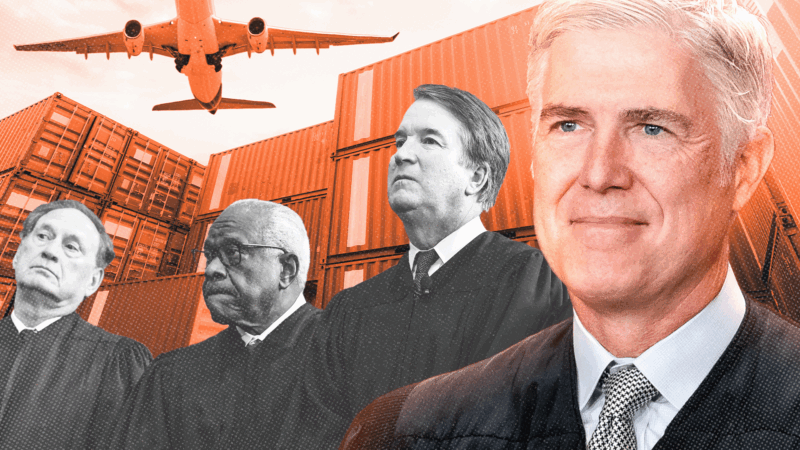
Six of the nine justices who currently serve on the U.S. Supreme Court were appointed by Republican presidents. Today, in its landmark decision invalidating the unilateral tariff regime imposed by President Donald Trump, those six jurists split right down the middle, with three holding Trump's tariffs to be unlawful while the other three dissented in favor of the president's power grab. What explains this notable fracture in the Court's so-called conservative bloc?
Justice Neil Gorsuch, who joined today's majority opinion in Learning Resources, Inc. v. Trump, tackled that query in the solo concurrence that he filed. "My dissenting colleagues have defended the major questions doctrine in the past," Gorsuch observed, referring to the legal doctrine which says that when the executive branch seeks to wield significant regulatory power, it must first point to an unambiguous delegation of such power by Congress to the executive.
In Biden v. Nebraska (2023), for example, the Court relied on the major questions doctrine when it struck down President Joe Biden's unilateral student debt cancellation plan. The Court in that case found the executive branch guilty of wielding power that the legislative branch had not properly delegated to it. Unsurprisingly, Biden v. Nebraska was repeatedly cited as a precedent for striking down Trump's overreach in today's tariffs decision.
Among those who voted against Biden in the 2023 student loan case were Justices Clarence Thomas, Samuel Alito, and Brett Kavanaugh. Today, however, those same three justices voted in support of Trump's tariffs.
In his concurrence, Gorsuch detailed the many ways in which the current views of his "dissenting colleagues" fell short. For example, the dissenters claimed that "Presidents have long been granted substantial discretion over tariffs." But that claim is contradicted by American history. "Americans fought the Revolution in no small part because they believed that only their elected representatives (not the King, not even Parliament) possessed authority to tax them," Gorsuch pointed out. And "Americans later codified these beliefs in the Constitution."
Then, in an even more damning move, Gorsuch detailed how Thomas, Alito, and Kavanaugh's past votes in similar major questions doctrine cases cannot be reconciled with their present votes in support of Trump's tariffs.
For example, the dissenters argued that the restrictions imposed by the major questions doctrine should not apply to presidential action when "foreign affairs" are involved. But what about the Supreme Court's 2022 ruling in West Virginia v. EPA, in which, as Gorsuch explained, "the Court applied the major questions doctrine over a dissent expressing concern that doing so would deny the EPA (and therefore the President) the power to respond to 'the most pressing environmental challenge of our time'—'[c]limate chang[e].'" "Was West Virginia a 'foreign affairs' case?" Gorsuch asked. Climate change is a global issue that plainly implicates foreign affairs.
Thomas, Alito, and Kavanaugh all voted against the EPA in West Virginia. But if they had followed the logic of their dissents today in Learning Resources, they would have voted for the EPA. "It's hard not to wonder," Gorsuch wrote, how the Thomas-Alito-Kavanaugh view "fits with some of our existing major questions precedents."
Gorsuch did not accuse Thomas, Alito, and Kavanaugh of hypocrisy. It is clear, however, that Thomas, Alito, and Kavanaugh were willing to let Trump get away with the same kind of executive overreach that they previously refused to let Biden get away with. Whether or not that glaring inconsistency will mar their future credibility remains to be seen.
