

The Cowardice of the Republican 'Tariff Skeptics'
Finally given a chance to influence trade policy, the vast majority of House Republicans decided it was more important to keep President Donald Trump happy.
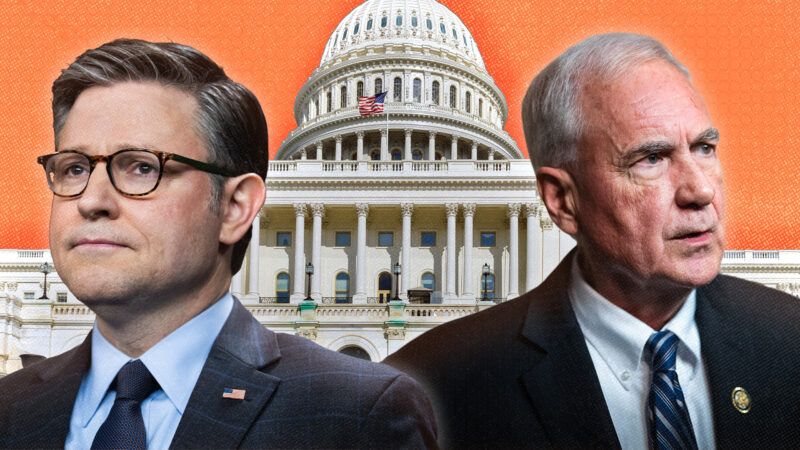
Rep. Tom McClintock (R–Calif.) describes himself as a "tariff skeptic."
In that regard, his judgment seems sound. President Donald Trump's tariffs are hiking costs for businesses and prices for consumers. They are not delivering the promised boom in manufacturing jobs. Polls show that most Americans dislike them.
Unlike most Americans, however, McClintock was in a position this week to translate that skepticism into action.
Given that chance, McClintock (and the vast majority of his Republican colleagues) chose cowardice and voted to continue Trump's unilateral executive control over American trade policy.
The first of the two key House votes this week came on Tuesday night, when lawmakers narrowly voted to clear the way for resolutions directly challenging Trump's tariff powers, as Reason's Jack Nicastro detailed. That was followed by a vote on Wednesday to disapprove of tariffs on Canadian imports—the first of what could be several similar resolutions brought to the floor in the coming weeks and months.
Opponents of the tariffs technically won both votes, thanks to a small faction of Republicans who broke ranks. But the margins were so thin that a presidential veto seems inevitable and likely insurmountable.
"This is a fruitless exercise and a pointless one, and I'm disappointed in it," Speaker of the House Mike Johnson (R–La.) said shortly after the second vote.
If it were a pointless exercise, the blame does not lie with the six Republicans who voted to end the tariffs on Canada. It lies with Republicans like McClintock.
"I remain a tariff skeptic. I believe that free trade is the surest path to a nation's prosperity," McClintock said in a statement on Tuesday, before adding that "it would be unwise to alter the status quo until we know the full scope and implications" of the Supreme Court's upcoming ruling on the tariffs.
That's not the approach that suggests Congress is a coequal branch of government. It is, however, an easy excuse to avoid voting for your beliefs.
Few other Republicans said it as openly as McClintock did, but he's hardly the only coward in the crowd. The "baseline House Republican position" is tariff skepticism, an unnamed administration official told Politico on Wednesday.
That makes a lot of sense, because you don't have to be an economist to be a tariff skeptic at this point. Consider the amount of bonkers tariff-related news that happened just this week:
- Trump admitted he placed tariffs on Switzerland—tariffs that are ostensibly a response to a "national emergency"—because he was grumpy about how the country's "prime minister" spoke to him on a phone call. (Switzerland has no prime minister.)
- Ford said it plans to spend an extra $1 billion this year due to tariffs on imported aluminum, which is pretty essential if you're in the business of building cars.
- Goodyear announced that it expects to lose $175 million to tariffs this year due to tariffs, and that it would cut 450 jobs to offset some of those costs.
- The Congressional Budget Office reported that American consumers are bearing roughly 95 percent of tariff costs.
- Republican leaders reportedly tried to sway Rep. Don Bacon's (R–Neb.) vote on a tariff matter by promising tailored tariff relief to businesses in his district.
Let's dwell on that last item for just a moment. Faced with a possible Republican revolt over tariffs, the White House was reportedly trying to cut deals to reduce tariffs for certain parts of the country while maintaining them broadly.
First and foremost, that's an admission that tariffs are being paid by American businesses and consumers (otherwise, there would be no relief to be offered).
"Reports of tariff carve-outs offered to win votes against the tariff resolution and of discussions about rolling back the steel and aluminum tariffs are both clear signs the Trump administration is increasingly aware of the damage its signature tariff policy is doing," noted Erika York, vice president of federal tax policy at the Tax Foundation.
Second, it reveals what little regard the executive branch has for Congress. The Constitution vests trade and taxing power with the legislative branch. Trump's use of emergency powers to set tariffs on imports from Canada (and lots of other places) is subject to serious constitutional questions. But even against that backdrop, the administration views Congress as caring so little about its power that lawmakers can be easily bought off.
In fact, the reality is worse. Congress is so supine that most lawmakers don't even need to be bought off. Republican leaders spent months trying to avoid a direct vote on tariffs—Johnson even borrowed a tactic from former Speaker of the House Nancy Pelosi to do that—and then overwhelmingly caved to Trump when the moment arrived.
This week's tariff votes were technical things. The first was a vote on some arcane procedural maneuvers, and the second was a joint resolution disapproving of an emergency declaration. The nuts and bolts of legislating are rarely thrilling at that level.
But in a very real sense, these were two votes where lawmakers were asked whether they even want to have a role in governing the country. Is this a republic with a duly elected legislature that exercises constitutional power independent of the executive branch? Or are lawmakers there merely to rubber-stamp any executive action—even foolish and obviously harmful ones, and even when the supposed national emergency is obviously a pretext and nothing else?
With a few exceptions, Republicans failed that test this week. The cowardice of "tariff skeptics" erodes the republic.




