
DHS Said It Was Targeting the 'Worst of the Worst' in Maine. It Swept Up Asylum Seekers and Noncriminals.
News outlets, civil rights groups, and court records tell a much different story than the government's claims about "Operation Catch of the Day."
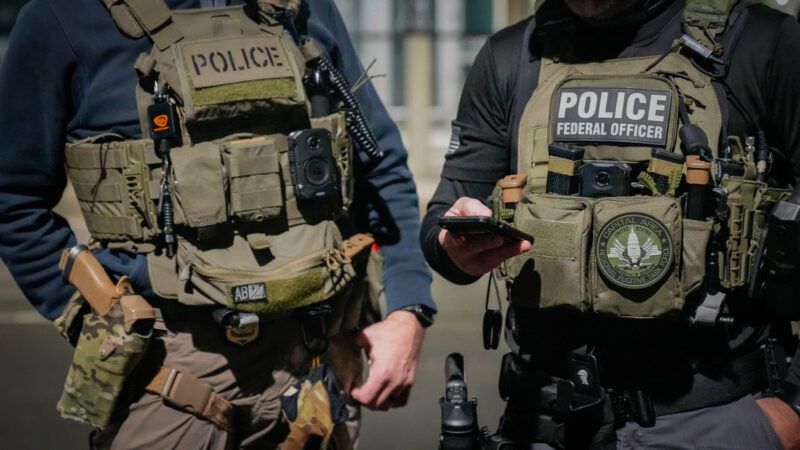
In the aftermath of a surge of federal immigration officers to Maine by the Department of Homeland Security (DHS), civil rights groups and local media say the federal government mostly swept up people without criminal records, such as asylum seekers, not the "worst of the worst" that the DHS said it was targeting.
On January 21, the DHS announced "Operation Catch of the Day," an immigration enforcement surge across Maine "targeting the worst of the worst criminal illegal aliens who have terrorized communities." But like in other parts of the country that the DHS has flooded with Border Patrol and Immigrations and Customs Enforcement (ICE) officers, records show relatively few undocumented immigrants with criminal records being arrested. Instead, ICE swept up people who already had or were seeking legal status in the country through the federal immigration system.
For example, the Bangor Daily News on Monday identified 67 people detained by federal agents during "Operation Catch of the Day" using court records, press releases, and local news reports. Of those, 58 had no identifiable criminal record. Two-thirds were already in contact with the federal immigration system. That group includes asylum seekers, those granted temporary legal status or work authorizations, and those doing routine check-ins at ICE field offices, such as Yanick Joao Carneiro, an Angolan asylum-seeker who had a scheduled immigration court hearing in 2027.
The Trump administration's mass deportation program has produced similar results nationwide. CBS News reported Monday that, according to an internal DHS document, less than 14 percent of the nearly 400,000 immigrants arrested by ICE during the first year of President Donald Trump's second term had charges or convictions for violent criminal offenses.
In press releases, DHS said it arrested 206 people during the Maine operation, but it has only named 10 of them.
"Even by [the DHS'] own press releases, it didn't seem like they were able to actually find many people with criminal records," Max Brooks, a staff attorney at the American Civil Liberties Union (ACLU) of Maine, tells Reason. "The pattern of arrests that we and our partners saw was a lot of people just kind of 'driving while brown' and being pulled over, and then with seemingly no rhyme or reason being detained."
"A lot of the people that were detained had no prior interactions with law enforcement and even no gap in being lawfully here," Brooks continues. "Some folks were paroled into the country at a port of entry and then filed for asylum within a year, or they were people who entered on a visa and filed for asylum before their period of status was over. We definitely saw folks like that detained."
For example, the Portland Press Herald reported on the detention of Marcos Da Silva, a Brazilian citizen who entered the country as an asylum seeker and has a pending green card application sponsored by his wife, a U.S. citizen.
The Portland Press Herald wrote that other examples "include an 18-year-old college student detained at a Westbrook grocery store, a Cumberland County corrections officer with a 'squeaky clean' record whose arrest was criticized by the county sheriff, and a civil engineer for a Portland firm who witnesses said was detained by masked agents who smashed his car window."
In response to the detentions, the ACLU of Maine and other groups, such as the Immigrant Legal Advocacy Project (ILAP) of Maine, began filing emergency habeas corpus petitions on behalf of detained immigrants.
ILAP's executive director, Sue Roche, said in a press release that the organization and its partners "were working to secure the freedom of people swept up by ICE over the past week, which includes mostly asylum seekers with no criminal records who were racially profiled and taken from their cars and off the streets."
Immigrant detainees have flooded courts across the country with habeas petitions—which allow one to appeal unlawful imprisonment to a judge—in response to the Trump administration's policy of holding arrested immigrants in indefinite detention without bond hearings. A ProPublica analysis published this week found that more than 18,000 were filed in the first 13 months of Trump's second term—more than the last three administrations combined.
"Practitioners in the northeast have generally been really on-point at understanding, in a moment where the government's systematically violating the law, how the Writ of Habeas Corpus can be this really effective tool," Brooks says.
But the problem for detainees—and judges—is getting ICE to obey orders. ICE has violated hundreds of court orders from federal judges around the country to not transfer immigrant detainees out of state and give them bond hearings, and that pattern played out in Maine, too.
In some cases, detainees were transferred out of state before their attorneys could file petitions, and in at least two instances, detainees were transferred out of Maine in violation of judges' orders, court records show.
"They just made a conscious decision to violate those orders and after the fact file requests to the court to violate the orders, when they'd already violated them," Brooks says. "It's pretty astonishing."
The ILAP said at least eight Maine residents were taken by ICE and sent to a detention center in Louisiana shortly after the operation began. Those sorts of transfers make it incredibly difficult for detainees to obtain legal counsel, which, when combined with the fact that they can only obtain a bond hearing by filing a habeas corpus petition, is an attempt to effectively cut them off from any due process or judicial relief.
The ILAP says requests for legal aid have dropped since the DHS announced it was winding down the operation, but it's still fighting to secure the release of some of those detained in January.
"The impact of what is happening here in Maine will be felt for a long time—people's lives are altered forever, and we have a lot of work and rebuilding ahead," Roche said. "The fear is reverberating across Maine, and so many people have completely withdrawn from public life. There is no guarantee an ICE surge or operation will not happen again, and the increased enforcement in Maine since the beginning of the Trump administration has been devastating in and of itself."
But Brooks says he learned another lesson watching the way communities responded to the federal surge.
"Protecting their neighbors, getting groceries for their neighbors, giving their neighbors' kids rides, coming together in ways that they really hadn't before—a lot of people in Portland felt terrorized during this period, but also feel like they're closer to their neighbors than they've ever been because they stepped up to the moment," he says. "So in some ways I feel more in touch with and prouder of where I'm from than I ever have."
