
Once Again, a Federal Judge Orders ICE To Stop Unlawful Warrantless Arrests
Another judge has ordered the Department of Homeland Security to follow federal law, even as the Trump administration argues it has broad authority to conduct warrantless immigration arrests.
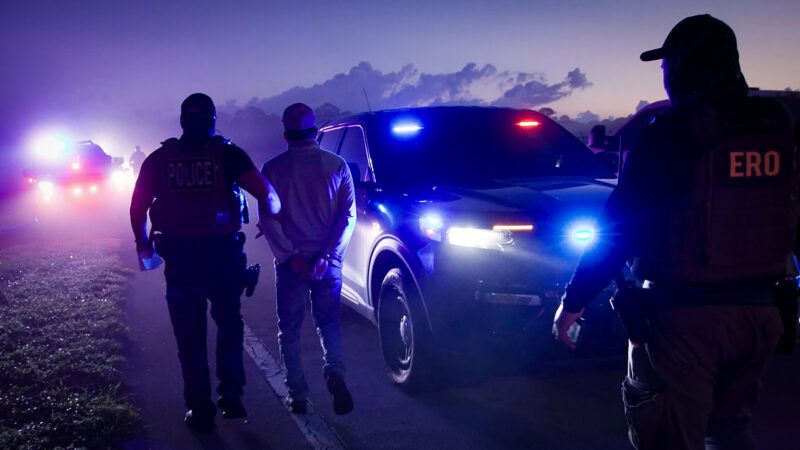
On Wednesday, a federal judge in Oregon issued an order barring Department of Homeland Security (DHS) agents from conducting warrantless arrests without first finding that an individual is likely to escape before a warrant can be obtained in accordance with federal law.
The order stems from a lawsuit brought by the nonprofit law firm Innovation Law Lab, which accuses immigration enforcement agencies of engaging in a "detain first, justify later" pattern of practice that violates federal law. Under federal law, immigration agents may conduct a warrantless arrest only if the officer has both a "reason to believe" a person is violating an immigration law or regulation and is "likely to escape" before a warrant can be obtained. Critically, without both findings, an officer lacks the requisite probable cause to make a lawful arrest.
During a hearing earlier this week, U.S. District Judge Mustafa Kasubhai heard evidence of immigration agents conducting warrantless arrests without making such a determination. One plaintiff, Victor Cruz Gamez, a 56-year-old grandfather, testified that he was held in immigration detention for three weeks following his unlawful warrantless arrest, according to the Associated Press. Gamez told the court that he was arrested after being pulled over by immigration agents despite having a driver's license and a work permit, items that can be used as evidence that Gamez was not, in fact, "likely to escape" before a warrant could be obtained.
Whether an individual is likely to escape is usually determined by considering factors like whether the person's identity is known to the arresting officer, whether the person has previously evaded authorities, and any ties or lack thereof the person has to the community, including family and employment.
Following the hearing, Kasubhai issued a preliminary injunction barring immigration agents from conducting warrantless arrests "without a pre-arrest individualized determination…of probable cause that the person being arrested is likely to escape before a warrant can be obtained." Similar orders have also been recently issued in Washington, D.C., and Colorado. Immigration agents were also found to be flouting federal law in Chicago, where a federal judge ordered the release of over 600 immigrant detainees who were unlawfully arrested without a warrant.
In response to the news of the order, DHS Assistant Secretary Tricia McLaughlin told Fox News that the "case really isn't really about arrest procedures or legal standards" and accused "open-borders groups and activist judges" of trying to stop President Donald Trump's mass deportation campaign. "It won't work. DHS conducts enforcement operations in line with the U.S. Constitution and all applicable federal laws without fear, favor, or prejudice and will continue to do so," McLaughlin said.
However, just last week, the acting director of Immigration and Customs Enforcement, Todd Lyons, issued a memo with new guidance attempting to rewrite the agency's definition of "likely to escape," arguing that previous interpretations were "unreasoned" and "incorrect." Under this new interpretation, a person is "likely to escape" if "he or she is unlikely to be located at the scene of the encounter or another clearly identifiable location once an administrative warrant is obtained." Such an interpretation gives immigration agents more authority to arrest immigrants who have close ties to the community but who might leave the scene after an immigration stop.
Whether the government has the authority to hold someone in custody is a question of paramount importance to liberty. And although the Trump administration's attempt to rewrite federal law to suit its practices is alarming, at least for now, some courts are willing to uphold the rule of law.
