
Next-Generation Nuclear Power Can Meet Data Center Energy Demand—If Regulations Allow It
Is this small modular nuclear power’s moment?
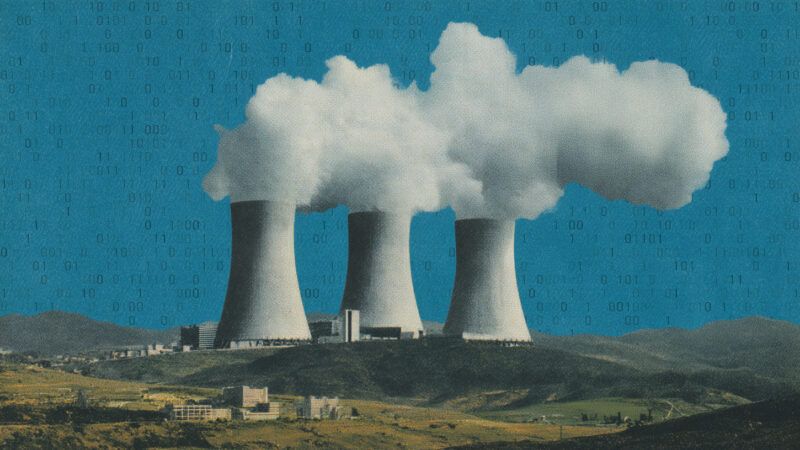
AI data centers have become flashpoints in public debates over energy costs and grid capacity, leading some politicians to call for heavy restrictions on their operation. Sen. Bernie Sanders (I–Vt.) is calling for an all-out moratorium.
Advanced nuclear power could provide a solution to these challenges—unless federal regulations get in the way.
Data centers create near-perfect conditions for the burgeoning small modular reactor (SMR) industry: enormous, concentrated energy demand that must be met 24/7. These compact nuclear power plants are designed to deliver steady power at a lower capacity than traditional reactors, so they could be uniquely positioned to meet that demand. Indeed, Meta recently struck 20-year agreements to purchase electricity from three nuclear power plants operated by a single provider, while also joining Oklo and TerraPower in an SMR development project. Google and Kairos Power have plans to deploy an advanced nuclear plant tied to the Tennessee Valley Authority's grid.
Aalo Atomics is a Texas-based startup developing factory-built SMRs designed to operate on or near large energy users—exactly the model that AI infrastructure demands. "We're talking about tens of gigawatts of power in the next five years," Aalo Atomics CEO Matt Loszak told Arena last year. "Each gigawatt is like a whole city! When in history have like 20, 30 cities been created in a matter of five or ten years?"
In addition to meeting data centers' power demands, SMRs could reduce these facilities' environmental footprint. Last year, driven in part by increased data center power usage, U.S. greenhouse gas emissions rose by about 2.4 percent.
But there are big regulatory barriers. As Loszak pointed out to podcaster Eric Jorgenson, for example, regulators require test data for a new nuclear design license, but obtaining this data is "impossible" without first having that license.
Further, SMRs are subject to a Cold War–era, one-size-fits-all licensing framework. One rule, finalized in 1956, gives the Nuclear Regulatory Commission (NRC) the authority to regulate all commercial reactors, which puts SMRs in the same fundamental licensing category as large, grid-scale nuclear plants. This framework was never designed for factory-built, modular reactors, and it contributes to unnecessarily onerous costs and wait times.
Fortunately, the NRC is working to modernize this system. Described by NRC staff as a "risk-informed, technology-inclusive regulatory framework for commercial nuclear plants," 10 CFR Part 53 is a new rule better suited for advanced reactors, including SMR designs. It must be finalized by the end of 2027 but could arrive sooner.
Meanwhile, an ongoing lawsuit is challenging long-standing NRC authority. If successful, it could be a major step in cutting through the red tape that has long burdened America's nuclear energy industry.
That red tape carries real consequences. The Carbon Free Power Project, once expected to be the first U.S. commercial SMR rollout, was announced in 2015. It did not begin undergoing NRC design certification review until 2018. Final certification took effect in 2023, with commercial launch projected for 2029. In the time it took to receive federal approval, projected costs rose sharply—from roughly $60 to $90 per megawatt-hour—driven by financing costs, inflation, and schedule risk. As timelines stretched and costs ballooned, participating customers withdrew. The project was canceled the same year it received NRC approval.
Private sector interest in SMRs persists, as demonstrated by Meta's deal with Oklo and TerraPower. But if SMRs are to meet the large-scale energy demand of data centers, major regulatory reform remains necessary.
"Many data center companies have a strong preference for electricity from SMRs, and are even willing to pay a price premium for it, because of the reliable, clean energy SMRs can provide," says Josiah Neeley, an energy analyst at the R Street Institute. "The big question is whether SMRs can be permitted and built on a fast enough time scale to meet that growing demand."
