DHS Retreats From the Claim That the Agents Who Killed Alex Pretti Faced a 'Violent Riot'
The department now describes the threat as "several civilians" who were "yelling and blowing whistles."
Federal officials have repeatedly claimed that the Customs and Border Protection (CBP) employees who fatally shot Minneapolis protester Alex Pretti on Saturday did so in the midst of a "riot." The situation, Department of Homeland Security (DHS) Secretary Kristi Noem said after the shooting, was "a violent riot" where "you have someone showing up with weapons." Gregory Bovino, the Border Patrol commander who headed the immigration crackdown in Minneapolis until he was reassigned this week, echoed that assessment during a CNN interview the next day.
This alleged riot figures in attempts to blame Pretti for his own death, and it could be relevant in evaluating the decision to grab and restrain him, which resulted in a scuffle that ended with lethal gunfire. But it is inconsistent with bystander videos of the incident, photographs of the scene, eyewitness accounts, and the report that CBP's Office of Professional Responsibility (OPR) gave Congress on Tuesday.
The initial justification for the shooting, which Noem and other officials offered within hours of the incident, portrayed Pretti as a "gunman" who was "brandishing" a pistol, "was there to perpetuate violence," "attacked those officers," aimed to "inflict harm" on them, and "wanted to do maximum damage and massacre law enforcement." That account was immediately contradicted by footage of the encounter, which showed that Pretti, who had a carry permit, never drew his pistol. The gun remained in its holster until a Border Patrol agent removed it during the struggle that resulted in Pretti's death. The videos also show it is not true that Pretti "attacked those officers" before they decided to tackle him.
In light of that evidence, the Trump administration has retreated from the claim that Pretti was bent on murder. On Wednesday, White House Deputy Chief of Staff Stephen Miller, who on Saturday described Pretti as a "would-be assassin" and "a domestic terrorist" who "tried to assassinate federal law enforcement," said he had been relying on "reports from CBP on the ground." President Donald Trump, who initially lent credence to the story that Miller amplified, now says the shooting was "tragic" and "very unfortunate."
Trump nevertheless continues to fault Pretti for carrying a gun. "I don't like any shooting," he told The Wall Street Journal on Sunday. "But I don't like it when somebody goes into a protest and he's got a very powerful, fully loaded gun with two magazines." Trump reiterated that complaint on Tuesday. "You can't have guns," he told reporters. "You can't walk in with guns. You just can't. You can't walk in with guns. You can't do that."
Trump was echoing statements by other federal officials, including Noem, FBI Director Kash Patel, Treasury Secretary Scott Bessent, and Bill Essayli, the first assistant U.S. attorney for the Central District of California. They portrayed Pretti's exercise of the constitutional right to bear arms as inherently suspicious, illegal, and an invitation to police violence. To reinforce that line of criticism, which provoked objections from Second Amendment groups, federal officials have argued that Pretti recklessly "brought a semiautomatic weapon to a riot."
That is how Bovino put it in an interview with CNN's Dana Bash on Sunday. Bovino used the word riot four times while making the case that "the victims are the Border Patrol agents."
When Bash asked whether Pretti ever drew his gun, Bovino said, "We do know that the suspect did bring a weapon, a loaded 9-millimeter, high-capacity handgun, to a riot." He added that Pretti "is not the only one to bring a loaded weapon to a riot." When Bash noted that Pretti had a "Second Amendment right to carry a gun," Bovino said, "Those rights don't count when you riot and assault, delay, obstruct, and impede law enforcement officers, and most especially when you mean to do that beforehand." When Bash asked if there was any evidence that Pretti "was brandishing a weapon," as Noem had falsely claimed, Bovino said, "He brought a semiautomatic weapon to a riot, assaulted federal officers, and at some point they saw that weapon."
While videos of the confrontation with Pretti do not necessarily tell the whole story, they do not support the claim that a "riot" was happening at the time. You can hear people blowing whistles, a favorite tactic of protesters in Minneapolis, and you can see two women interacting with CBP personnel. A CBP officer pepper sprays them and pushes one of the women to the ground, which is the incident that prompts Pretti to intervene, first by standing between the officer and the woman, then by trying to help her up.
In a sworn statement, a witness said there were "about 15 observers there, recording and observing." Another witness reported seeing "several [CBP] agents and civilians yelling at each other." That does not sound like the "violent riot" that Noem described.
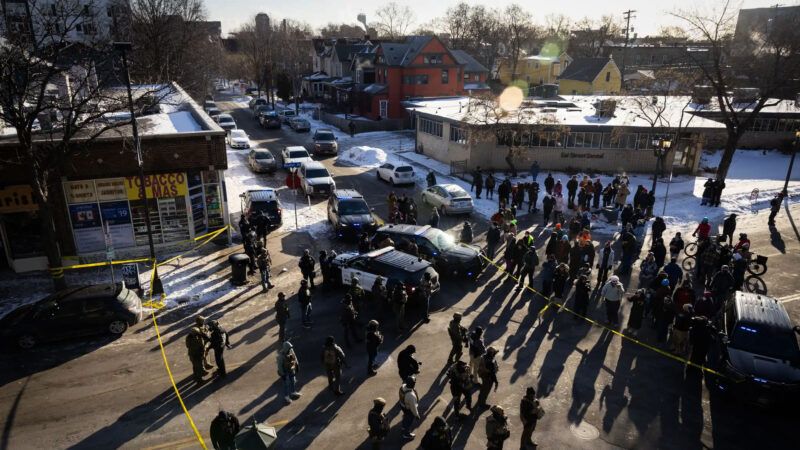
A photograph of the scene taken immediately after the shooting shows about 50 seemingly calm people standing behind yellow police tape. The number of onlookers, which may have swelled after the shooting, is roughly the same as the number of federal law enforcement personnel.
The OPR's report to Congress, which The Intercept published on Tuesday, says "several civilians were in the area yelling and blowing whistles" prior to the shooting. It adds that CBP officers and Border Patrol agents "made several verbal requests for the civilians to stay on the sidewalks and out of the roadway."
Around 9 a.m., according to the OPR report, a CBP officer "was confronted by two female civilians blowing whistles." He "ordered the female civilians to move out of the roadway," but "the female civilians did not move." After he "pushed them both away," the OPR says, one of the women "ran to" Pretti, who at that point was standing in the middle of the street, directing traffic while holding up his cellphone to record the scene. The CBP officer "attempted to move the woman and Pretti out of the roadway," but "the woman and Pretti did not move," so he "deployed his [pepper] spray towards both Pretti and the woman."
While the OPR says the CBP officer "ordered" the women to "move out of the roadway," it does not say he gave any such instruction to Pretti. Rather, it says he "attempted to move" Pretti, which is consistent with what the videos seem to show: an immediate resort to force after Pretti came to the aid of the woman who had been pushed to the ground.
The OPR report glides over that point. "CBP personnel attempted to take Pretti into custody," it says. "Pretti resisted CBP personnel's efforts and a struggle ensued. During the struggle, a [Border Patrol agent] yelled, 'He's got a gun!' multiple times. Approximately five seconds later, a [Border Patrol agent] discharged his CBP-issued Glock 19 and a [CBP officer] also discharged his CBP-issued Glock 47 at Pretti. After the shooting, a [Border Patrol agent] advised he had possession of Pretti's firearm. The [Border Patrol agent] subsequently cleared and secured Pretti's firearm in his vehicle."
That account omits some crucial details. It does not mention that the Border Patrol agent who "secured Pretti's firearm" had disarmed him by the time the shooting started or that Pretti was restrained, with both of his arms pinned down, at that point. It does not mention that the agent who first opened fire shot Pretti four times in the back at close range, meaning he faced no visible threat and could not have seen the gun even if it had not already been removed. It does not mention that, after Pretti collapsed on the pavement, that agent and the CBP officer fired six more rounds into his prone, motionless body from a distance.
That use of deadly force would be hard to understand, let alone justify, even if the "observers" could accurately be described as rioters. But if CBP officers and Border Patrol agents were dealing with mass violence, it might help explain their aggressive treatment of Pretti, which precipitated the struggle that left him fatally wounded half a minute later.
Judging from the OPR report, however, the threat to the CBP officers and Border Patrol agents was far less serious than the one that Noem and Bovino described. Instead of a "violent riot," it was "several civilians" who were "yelling and blowing whistles"—and more specifically, "two female civilians" who were "blowing whistles," standing in the street, and refusing to "move out of the roadway." They may have been disobedient, but they were not violent, and neither was Pretti.
Bovino has a history of misrepresenting the threats posed by protesters, as Reason's Autumn Billings notes. When he was overseeing the immigration crackdown in Chicago, he was caught on video lobbing tear gas at protesters. He claimed they were throwing rocks, one of which struck him in the head.
"Mr. Bovino and the Department of Homeland Security claimed that he had been hit by a rock in the head before throwing the tear gas," U.S. District Judge Sara Ellis noted in November, "but video evidence disproves this. And he ultimately admitted he was not hit until after he threw the tear gas." In other words, Ellis said, Bovino "admitted that he lied about whether a rock hit him before he deployed tear gas."
In that case, the DHS echoed Bovino's lie. "The mob of rioters grew more hostile and violent, advancing toward agents, and began throwing rocks and other objects at agents, including one that struck Chief Greg Bovino in the head," Tricia McLaughlin, the department's assistant secretary for public affairs, said after the incident.
The DHS likewise was on the same page as Bovino after the Pretti shooting. Noem, like Bovino, conflated protesters with rioters. The DHS compounded its dishonesty by asserting that Pretti intended to "massacre law enforcement"—a claim so clearly inconsistent with the video record that even Stephen Miller, a driving force behind Trump's mass deportation project, felt compelled to walk it back, blaming "reports from CBP on the ground."
These misrepresentations are part of a persistent pattern. "In case after case" across the country, Reason's C.J. Ciaramella noted in October, the DHS has shown "a willingness to put false information out to the public and never correct it."
This is the same department that is now promising to thoroughly and dispassionately investigate the circumstances of Pretti's death. Even if Noem had not immediately prejudged the outcome of that investigation by preemptively exonerating her underlings, that promise would be hard to believe.