
Video Shows Miami Beach Detectives Questioning Woman Over Facebook Post Criticizing Mayor
FIRE condemned the police visit: "This blatant overreach is offensive to the First Amendment."
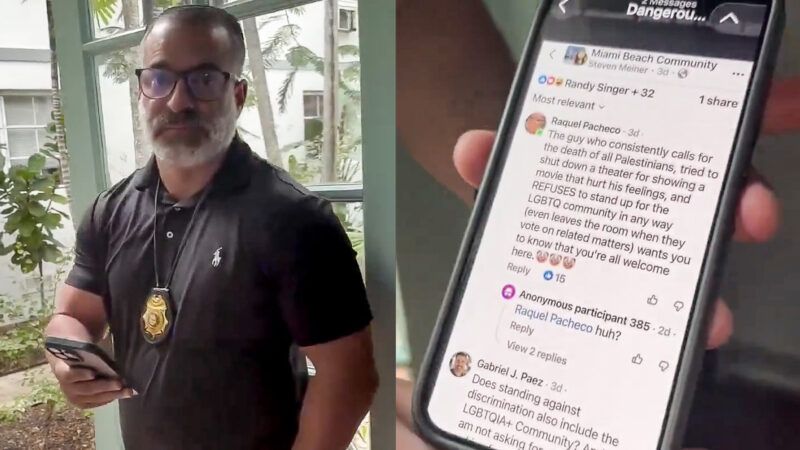
A police visit to a Miami Beach resident over a Facebook comment criticizing the mayor has turned into a national news story and led to condemnation from First Amendment groups.
Viral video taken by Raquel Pacheco shows two Miami Beach Police Department detectives visiting her home on January 12 to question her about a Facebook comment saying that Miami Beach Mayor Steven Meiner "consistently calls for the death of all Palestinians."
The Miami Beach mayor's office is now flagging citizen's Facebook posts and sending police to their doors to intimidate them for criticism of the mayor.
This video is absolutely outrageous. pic.twitter.com/L8mEr6hPe2
— Mel (@Villgecrazylady) January 19, 2026
The detectives asked if she posted the comment, which appeared under a Facebook post by Meiner, who is Jewish, claiming that Miami Beach is a "safe haven for everyone." The detectives warned that the comment could potentially "incite somebody to do something radical."
"This is freedom of speech, this is America, right? I'm a veteran," Pacheco told the officers.
"And I agree with you 100 percent," one officer responded. "We're just trying to see if it's you, because if we're not talking to the right person, we want to go see who the right person is."
"We're just trying to prevent someone else from getting agitated or agreeing with the statement," one of the detectives told Pacheco. "We're not saying it's true or not."
Pacheco refused to answer the officers' questions without a lawyer. In an interview with The Washington Post, Pacheco said her comments weren't incitement, but free expression.
"If we can't hold this line, we are screwed," Pacheco told The Washington Post.
The Foundation for Individual Rights and Expression (FIRE), a free speech group, sent a letter on Friday to Miami Beach Police Chief Wayne Jones condemning the visit.
"The purpose of their visit was not to investigate a crime," Aaron Terr, FIRE's director of public advocacy, wrote. "It had no purpose other than to pressure Pacheco to cease engaging in protected political expression over concern about how others might react to it. This blatant overreach is offensive to the First Amendment."
Although police and politicians on the receiving end of inflammatory criticism may believe the threat is clear enough, there is a difficult First Amendment bar to clear to meet the legal standard for incitement. Under the test that the Supreme Court established in the landmark First Amendment case Brandenburg v. Ohio, the government has to prove that the rhetoric at issue incited violence or threats of violence, and that the incitement was imminent, likely, and intentional.
Pacheco's comments do not include any call to action or the sort of imperative statements usually associated with incitement. (For example, telling an angry crowd that they should immediately burn down a nearby government building.)
Jones released a statement on Friday defending the visit, writing that "the Miami Beach Police Department is committed to safeguarding residents and visitors while also respecting constitutional rights."
"Given the real, ongoing national and international concerns surrounding antisemitic attacks and recent rhetoric that has led to violence against political figures, I directed two of my detectives to initiate a brief, voluntary conversation regarding certain inflammatory, potentially inciteful false remarks made by a resident to ensure there was no immediate threat to the elected official or the broader community that might emerge as a result of the post," Jones said.
Jones "had serious concerns that her remarks could trigger physical action by others," he continued, adding that "at no time did the Mayor or any other official direct me to take action."
However, the Miami Herald reported on Friday that Meiner's office first flagged Pacheco's comment in a complaint to the police department.
This is the second time recently that Meiner and Miami Beach have drawn national criticism over allegations of First Amendment retaliation, and both cases involved the Israel-Hamas conflict.
Last year, Meiner tried to terminate the lease of a movie theater for screening an Oscar-winning documentary about the Israel-Hamas conflict. Meiner withdrew the bill after intense national and local criticism from free speech advocates.
It's also not the first time that South Florida police have used dubious claims of "incitement" to attack protected speech.
Last year, the Hendry County sheriff issued public statements accusing Captains for Clean Water, an environmental advocacy group of fishing guides, of "fuel[ing] hostility and provok[ing] violent rhetoric, putting our citizens' safety at risk." At issue were several angry comments that people had left on Captains for Clean Water's social media posts about recent votes by Palm Beach County commissioners. However, the comments generated no apparent criminal investigations.
These sorts of publicly denunciations and unofficial police "visits" go well beyond the scope of police departments' duties and serve one purpose: to use the power of their office to suppress disfavored political speech.
"Law enforcement officers making a surprise appearance on an individual's doorstep to convey official disapproval of her protected expression represents an egregious abuse of power," Terr wrote in Friday's letter. "It chills the exercise of First Amendment rights and undermines public confidence in the department's commitment to respecting civil liberties and the United States Constitution."
