

Yes, the Middle Class Is Shrinking—Because It's Moving Up
The real squeeze comes from government-distorted markets, not economic decline.
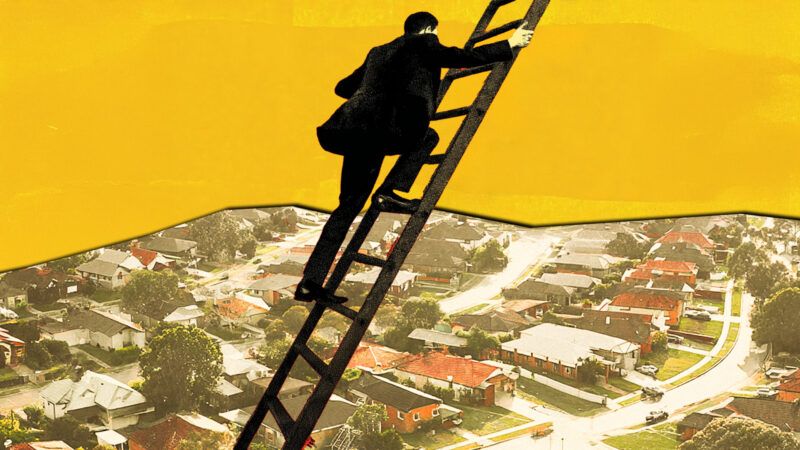
"The middle class is shrinking" might be the assertion of the decade. Progressives and populists alike use it to justify nearly all government interventions, from tariffs to minimum-wage hikes to massive spending to income redistribution. But before we accept its validity, we should ask a simple question: shrinking how?
Is the number of Americans considered part of the middle class diminishing? Or the amount of wealth they can realistically build? Or the value of what they can buy?
A new study by economists Stephen Rose and Scott Winship usefully reframes the debate. Most studies define the middle class relative to the national median, which makes the dividing line between haves and have-nots rise automatically as the country gets richer. Rose and Winship instead use a benchmark of fixed purchasing power, so that if real incomes (those adjusted for inflation) rise, more people are shown moving into—or beyond—the middle class in a meaningful sense.
Under this approach, the "core" of the middle class does indeed shrink modestly. But crucially, the middle class shrinks because people are moving up the income ladder, not because they're falling down. Since 1979, the share of Americans in the upper-middle class has roughly tripled—from about 10 percent to 31 percent—while shares of those considered lower middle class or poor fell substantially.
Much of the political rhetoric, such as former President Joe Biden's warning of a "hollowed-out" middle class, implicitly suggests downward mobility and national immiseration—a story difficult to square with data showing an overwhelmingly upward directional movement.
In the end, the American middle class may be a smaller share of the population by some relative definitions, but it's also significantly richer than it was a generation ago. So why does its supposed downfall resonate so powerfully? I can think of two reasons.
One is that the middle class has never been just an income bracket. It's also a social identity and a claim to civic pride. For much of the 20th century, belonging to the middle class meant more than just achieving a certain living standard. It meant occupying the cultural and civic center of the country—being the representative American whose tastes, habits, and aspirations have largely defined us.
As our prosperity has dramatically grown, our culture has diversified and fragmented. A richer and freer society offers more choice: more media, more platforms, more lifestyles, more ways of living well. We no longer all watch the same television programs or consume the same news. Fewer institutions define a single cultural mainstream.
This fragmentation is often experienced as loss. Without one cohesive middle serving as an obvious center of gravity, upward mobility no longer comes with the same affirmation of middle-class status or belonging. The mirror that once reflected a common identity has splintered.
But this is only one side of the story. The fragmentation is also a sign of success. It reflects abundance, pluralism, and the eroding ability of society's gatekeepers to dictate what's normal.
Still, when middle-class life feels messier or less satisfying, populism offers a tempting but misleading response: Blame elites and free markets. It recasts the disorienting effects of abundance and choice as evidence of economic decline. The real danger is not cultural fragmentation but conflating the costs of success with failure.
This leads to a second, more concrete reason for our fears: Washington hasn't destroyed the middle class, but it is putting most Americans in a frustrating squeeze. The largest cost pressures today are concentrated in sectors where government has distorted markets the most.
Housing, health care, and higher education—three of the largest household expenses—are among the most heavily regulated and subsidized parts of the American economy. Barriers on who can provide these essentials, how much can be supplied, and how other regulatory complexities raise prices and reduce choice. Even as incomes rise, the pressures are real. But they are the product of government failure, not evidence that economic growth has stopped working.
Recognizing this does not justify populist economic policies that mistake the source of our discontent. Rose and Winship rightly urge skepticism toward policies sold as "middle-class restoration." The impulse to reimpose uniformity or respond to an economic challenge in ways that suppress growth turns real gains into real losses. Restrictions on free trade, cartel-like favoritism for government-favored industries, and other heavy-handed interventions undermine the very dynamics that allowed the middle class to expand in the first place.
When more families cross into the upper middle class, that's a success. You might be frustrated by lost status and broken institutions. Just don't allow politicians to misdiagnose the problem and sabotage the upward mobility that is still delivering real gains despite government barriers.
COPYRIGHT 2026 CREATORS.COM

Editor's Note: As of February 29, 2024, commenting privileges on reason.com posts are limited to Reason Plus subscribers. Past commenters are grandfathered in for a temporary period. Subscribe here to preserve your ability to comment. Your Reason Plus subscription also gives you an ad-free version of reason.com, along with full access to the digital edition and archives of Reason magazine. We request that comments be civil and on-topic. We do not moderate or assume any responsibility for comments, which are owned by the readers who post them. Comments do not represent the views of reason.com or Reason Foundation. We reserve the right to delete any comment and ban commenters for any reason at any time. Comments may only be edited within 5 minutes of posting. Report abuses.
Please to post comments
Under this approach, the "core" of the middle class does indeed shrink modestly. But crucially, the middle class shrinks because people are moving up the income ladder, not because they're falling down. Since 1979, the share of Americans in the upper-middle class has roughly tripled—from about 10 percent to 31 percent—while shares of those considered lower middle class or poor fell substantially.
I'm not sure if this solves the argument, or will make anyone-- especially those on the left-- any happier. I don't have a problem with the idea that based on a game of financial whackbat, we can show that more people have been able to increase their 'purchasing power' over the last several decades. That seems obvious on its face. I walked by a homeless camp the other day and they all had smart phones. I'm deadly serious.
I think the argument is that we're increasingly a society of very well off people and homeless drug addicts.
I'm not proposing any grand solutions or prognostications why my comment, I'm merely pointing out that while sure, I own three flat screen tvs where... when I was a kid, we had a single 27" tv in the living room with three channels and that TV represented a significant investment of family finances-- I also live in a moderately lower-middle class fixer-upper home that's valued at 3/4 of a million dollars and has no fucking business being that expensive.
Yes, the Middle Class Is Shrinking—Because It's Moving Up
The real squeeze comes from government-distorted markets, not economic decline.
And by the way, this headline and subhead did kind of confuse me. Is it just me or does it feel like it's saying, "Everything is actually better, but the reason everything sucks is because the government fucked it all up"?
I don't think anybody at Reason is putting any real effort into it anymore. They're all just LARPing as libertarian until an offer from the Atlantic or NYT rolls in.
They’re all worthless leftists with hollowed out souls and stunted minds, except Liz. She has to decide if it’s more important to sell her soul to stay in NYC and be liked by leftist vermin, or cling to what principles she has left.
The rest have already consigned themselves to Marxist Hell.
Headline should have been truthful and said "economist changes the definition of middle class so dont believe your own eyes"
You had a 27" TV? We had a 12" - and it was black and white - and we had to walk across the room to change the channel - when changing from channel 2 to 9 we also had to adjust the rabbit ears.
Um, I'm not going to my youth-youth, like when I was a little kid. My family was the last one on our block to get a color tv and cable. We had a 13" b&w in my parent's bedroom until I was about 10 or 11 years old as I recalled. Then my Dad got all "I'm the King of the Castle" and bought a Zenith color TV that weighed about 900 lbs and we finally got basic cable to go with it. That was a big... BIG day when I was a kid. And no, we never had a remote control. My friends had remote tvs... remember those sonic remotes with the little screen over the emitter with the silver buttons? Yeah, never had one of those.
Part of growing up was fighting with my sister over what channel we were going to watch.
Me: I wanna watch Magnum P.I.
Her: No, we're watching Little House on the Prarie!
My parents bought a color tv after I moved out. A had a 13 inch black and white with a coat hanger, rabbit ears were way outside my price range. Am I still bitter and angry? Yes. Yes I am.
TV was tough until UHF revolutionized the viewing experience. It was the 70s equivalent of streaming. Weird Al even made a movie about it.
"Yes, the Middle Class Is Shrinking—Because It's Moving Up"
Correction. A certain demographic is moving up.
There are now more homebuyers aged 70 and older than homebuyers under 35 in America.
According to data from the National Association of Realtors, Americans ages 60–78 account for the largest share of homebuyers at around 42% of all buyers.
That's not healthy.
They will die soon, then the kids will be rich.
What kids?
The kids that the fuddy-duddy, uncool, trad-wife previous generation saddled themselves with before we all became enlightened male feminists and girl bosses and realized having kids was a bummer head trip.
"They will die soon, then the
kidsdog / old university / favorite political party / museum / gallery / NGO / environmental group will be rich.Well the boomers may be buying houses but it's much more likely that they're moving down not up. Unless of course they have to house their ner do well adult kids that were living in grandma's basement.
This is in part because of a growing trend in which baby boomers, the generation that owns the largest share of American homes, are planning to stay put rather than downsize or move into alternative living arrangements.
In fact, a 2024 survey conducted by Redfin found that 78% of Americans over the age of 60 want to remain in their current home.
In 2008, at the onset of the Great Recession, Americans over the age of 55 owned 44.3% of homes. By 2023, that percentage had increased to 54.0%, reflecting older Americans’ growing dominance in the housing market.
While baby boomers—defined as Americans between the ages of 60 and 78 in 2024—comprise just over 20% of the U.S. population, they account for more than 37% of homeowners nationwide.
https://constructioncoverage.com/research/baby-boomer-dominant-housing-markets
typically adults between the ages of 60 and 80 — now control an astounding $19 trillion in housing wealth, or nearly 40% of all real estate assets in the U.S., based on Redfin data.
https://www.realestatenews.com/2025/07/22/boomers-now-hold-nearly-40-of-us-housing-wealth
Most studies define the middle class relative to the national median, which makes the dividing line between haves and have-nots rise automatically as the country gets richer. Rose and Winship instead use a benchmark of fixed purchasing power, so that if real incomes (those adjusted for inflation) rise, more people are shown moving into—or beyond—the middle class in a meaningful sense.
Either DeRugy is a liar, didn't actually read the study, or both. The study didn't measure purchasing power. What the study did was take into account the number of people in a set of income classes relative to the average. They found that when you take into account that more people are in the upper middle class segment, the per capita share of income for that group actually didn't rise that much.
The study says nothing about purchasing power. It does not address people's complaints that fewer and fewer people can afford things like owning a house or good medical care or a college degree for their kids despite making more money than their parents. DeRugy, being a leftist hack, dismisses these concerns as well just something government regulation has caused and nothing that the open borders global totalitarian government she longs for can't solve.
She is auditioning for CATO. Got the misreading of studies down.
To a deluxe apartment in the sky.
One is that the middle class has never been just an income bracket. It's also a social identity and a claim to civic pride.
So post modernist bullshit?


