

Department of Homeland Security
DHS Says REAL ID, Which DHS Certifies, Is Too Unreliable To Confirm U.S. Citizenship
It's the punch line to a bad joke that started 20 years ago when Congress passed the REAL ID Act.
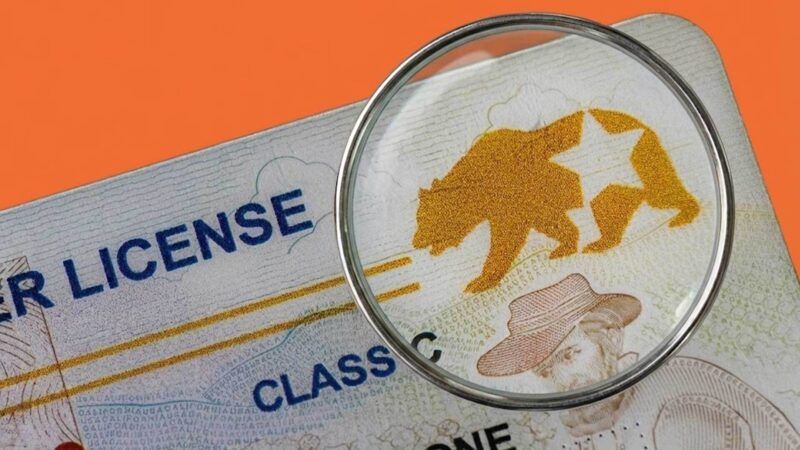
Only the government could spend 20 years creating a national ID that no one wanted and that apparently doesn't even work as a national ID.
But that's what the federal government has accomplished with the REAL ID, which the Department of Homeland Security (DHS) now considers unreliable, even though getting one requires providing proof of citizenship or lawful status in the country.
In a December 11 court filing, Philip Lavoie, the acting assistant special agent in charge of DHS' Mobile, Alabama, office, stated that, "REAL ID can be unreliable to confirm U.S. citizenship."
Lavoie's declaration was in response to a federal civil rights lawsuit filed in October by the Institute for Justice, a public-interest law firm, on behalf of Leo Garcia Venegas, an Alabama construction worker. Venegas was detained twice in May and June during immigration raids on private construction sites, despite being a U.S. citizen. In both instances, Venegas' lawsuit says, masked federal immigration officers entered the private sites without a warrant and began detaining workers based solely on their apparent ethnicity.
And in both instances officers allegedly retrieved Venegas' Alabama-issued REAL ID from his pocket but claimed it could be fake. Venegas was kept handcuffed and detained for an hour the first time and "between 20 and 30 minutes" the second time before officers ran his information and released him.
Lavoie's declaration says that the agents "needed to further verify his U.S. citizenship because each state has its own REAL ID compliance laws, which may provide for the issuance of a REAL ID to an alien and therefore based on HSI Special Agent training and experience, REAL ID can be unreliable to confirm U.S. citizenship."
It's the punch line to a bad joke with a 20-year windup. When Congress passed the REAL ID Act in 2005. It was sold as a post-9/11 security measure to create uniform standards for state IDs, including clearly listing citizenship or lawful immigration status. State IDs that conformed to the requirements would be marked with a star. Contrary to the cheeky first sentence of this story, DHS insists that REAL ID is not a national ID system, and that it doesn't involve a centralized national database. (Civil liberties groups say it amounts to a de facto national ID system anyway.)
The rub was that REAL IDs would be required for entry to federal property, including, most significantly for the average American, airport security checkpoints. But the law was widely unpopular. There was such low compliance from states that enforcement was delayed seven times over the years, until finally beginning this May.
The project should have been scrapped years ago. America somehow survived two decades of terrorism-free air travel without REAL IDs. As Reason's Scott Shackford wrote in 2021, "The government is demanding that Americans give up more of their privacy to the feds, subject themselves to additional inane bureaucracy, and carry around proof that we're citizens to be able to fly, even though none of that makes us more secure."
And now we discover that DHS doesn't even consider the thing proof of citizenship.
In a court filing in response to DHS, the Institute for Justice noted how incredible this position is. "REAL IDs require proof of citizenship or lawful status," the Institute for Justice wrote. "DHS is the very agency responsible for certifying that REAL IDs, including Alabama's STAR IDs, satisfy this requirement."
The law firm argues that DHS' policy of allowing officers to disregard proof of lawful presence likely violates the Fourth Amendment and DHS' own regulations.
When asked to comment on Lavoie's declaration, a DHS spokesperson said in a statement to Reason: "The INA requires aliens and non-citizens in the US to carry immigration documents. Real IDs are not immigration documents—they make identification harder to forge, thwarting criminals and terrorists."
But of course, Venegas is a U.S. citizen, so he is not required to carry non-existent immigration documents.
DHS' statement to Reason when Venegas' lawsuit was first filed insisted that, "What makes someone a target for immigration enforcement is if they are illegally in the U.S.—NOT their skin color, race, or ethnicity."
The agency never responded to a follow-up question asking why, then, Venegas was targeted.
This is the cynical two-step that the Supreme Court allowed this September when it overturned a ruling by the 9th Circuit Court of Appeals, which found that the Trump administration was likely violating the Fourth Amendment rights of citizens by seizing them based solely on factors such as "apparent race or ethnicity."
Justice Brett Kavanaugh released a concurring opinion in which he waved away concerns that allowing such profiling would lead to citizens and legal residents being unduly harassed.
"As for stops of those individuals who are legally in the country, the questioning in those circumstances is typically brief," Kavanaugh wrote, "and those individuals may promptly go free after making clear to the immigration officers that they are U. S. citizens or otherwise legally in the United States."
But what the Lavoie declaration makes clear—and what should be remembered every time a new national security boondoggle like the REAL ID is proposed—is that when our Fourth Amendment rights are eroded, there is no evidence or piece of plastic that will suffice to overcome an officer's "reasonable suspicion" once the government decides you're a target.




