
This 1,300-Page Anticapitalist History Gets a Few Things Wrong
Sven Beckert's Capitalism: A Global History is...not a reliable history.
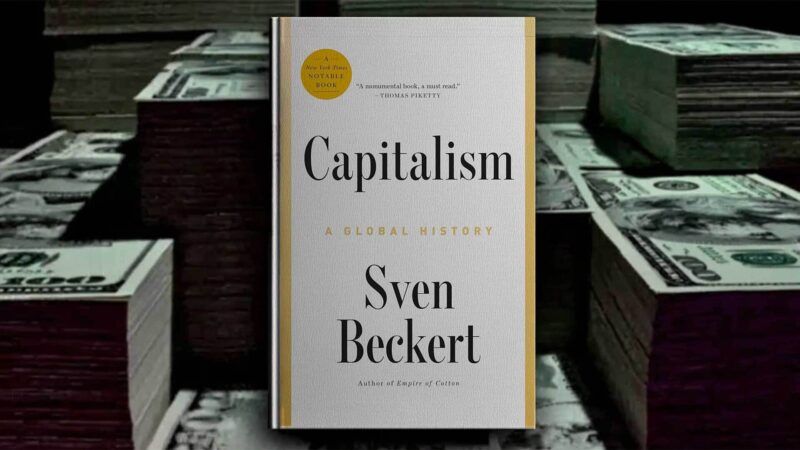
Capitalism: A Global History, by Sven Beckert, Penguin Press, 1,344 pages, $49
Adam Smith, widely considered the first major theorist of capitalism, abhorred the institution of slavery. "Whatever work [a slave] does…can be squeezed out of him by violence only, and not by any interest of his own," he wrote in 1776. In an earlier lecture, Smith indicted laws that "strengthen the authority of the masters and reduce the slaves to a more absolute subjection." The plantation system at the core of this economy was not a competitive market; planters had secured a state-sanctioned "monopoly against all the rest of the world" and "indemnif[ied] themselves by the exorbitancy of their profites for their expensive and thriftless method of cultivation." Smith singled out the exceptional cruelty found in the British colonies of "Jamaica and Barbadoes, where slaves are numerous and objects of jealousy [and] punishments even for slight offences are very shocking."
Yet in Capitalism: A Global History, Sven Beckert calls colonial Barbados "an almost perfectly Smithian economy, with utility-maximizing individuals creating a newly productive division of labor"—indeed a model of market capitalism. A simple contrast of those two characterizations is enough to raise the question of whether Beckert bothered to consult what Smith actually wrote about West Indian slavery.
In the 19th century, slaveholders and abolitionists alike noted the tensions between the emerging industrial economy and the plantation system. The former depended on freedom of movement and on choice in career and industry. The latter grafted elements of feudal hierarchy and coerced labor onto a fixed model of agrarian mass production. Proslavery theorists such as George Fitzhugh saw the two systems as irreconcilable. "Laissez faire," he argued, was "at war with all kinds of slavery, for they in fact assert that individuals and peoples prosper most when governed least." Such testimonies complicate Beckert's interpretation of slavery as a fundamentally capitalistic institution.
Beckert's book, a sweeping 1,300-page history, synthesizes bits and pieces of the academic literature to recount the emergence of capitalism over the last millennium, tracing it from the port cities of Yemen in the Middle Ages to the global economy of today. But that literature is uneven and selectively curated. Standard works on the "Great Enrichment"—the sustained worldwide explosion in wealth and living standards over the last two centuries—receive scant mention. Despite the centrality of slavery to Beckert's narrative, he relegates the vast body of empirical analysis on this question to a single footnoted reference to an unremarkable synopsis by another author.
Instead, Beckert mixes a peculiar amalgam of anti-capitalist authors. Some are familiar. Beckert treats Karl Marx's writings as an obvious diagnostic manual for how capitalism operates, complaining only that their 19th century milieu and Eurocentric focus precluded a more universal application. He has similar affinities for Karl Polanyi, calling the socialist writer "one of the twentieth century's most perceptive observers of capitalism," while evincing little awareness of the withering empirical criticism that Polanyi's 1944 manifesto, The Great Transformation, has attracted. When Beckert draws from economists, they are almost invariably from the fringes of the profession. He credulously repeats the inequality theories of Thomas Piketty, for example, showing no familiarity with the critiques of their shaky empirical footing or the heavy contestation around Piketty's "laws" of capital stock concentration.
The core of the book's themes and general style comes from a more obscure source: the German Historical School of Gustav von Schmoller and Werner Sombart. Beckert's new study bears more than passing resemblance to Sombart's Der Moderne Kapitalismus, a huge untranslated work published in successive volumes from 1902 through 1927. There are differences and updates. Whereas Sombart adopted a Eurocentric framework, Beckert's approach emphasizes the role of capitalism in the "Global South" of postcolonial studies. Yet both works purport to trace capitalism through distinctive historical "stages" of development. Here capitalism functions not so much as a system of exchange but as a tumultuous, violent "process" that organizes all economic life around the "ceaseless accumulation of privately controlled capital." Beckert presents his product as a global extrapolation on the Historical School's approach, but its message is ultimately a sustained derogation of capitalism and the academic discipline that he sees as doing the capitalists' bidding: mainstream economics.
The source of Beckert's grievance goes back to the marginal revolution of 1871, when William S. Jevons and Carl Menger developed near-simultaneous solutions to the longstanding problem of value in economic theory. Earlier classical economists theorized that the value of a good is instilled by the labor performed to improve upon it. This simple intuition breaks down in practice, as Smith noticed when looking at cases where the circumstance of a transaction caused differences in how goods were priced. The marginalists deduced that value is a function of individual subjective preferences, as exercised at the moment of a transaction by the parties to an exchange. This created a stumbling block for Marxist economics, which relied on the labor theory of value to calculate the "surplus value" that capital owners allegedly appropriate from their labor force without fair compensation. It also sparked a methodological feud between Menger and Schmoller, who attacked the marginalist approach as overly abstract and deductive.
Beckert unintentionally reveals that he does not grasp the logic of marginalism. He interprets subjective value theory as a crude attempt to "quantify the pleasure that goods provided for consumers," which he deems "ahistorical" and blames for "shift[ing] the primary question of economics" from labor-centric production "to the problem of how scarce resources should be allocated." In a few ambiguous steps, Beckert migrates to the 1960s writings of the post-Keynesian economist Piero Sraffa, who attempted to construct a theory of value from labor and commodity inputs that claimed to resuscitate this older approach, sans marginalism. Few mainstream economists cared, finding Sraffa's approach tendentious and empirically irrelevant. Beckert nonetheless proceeds as if the marginal revolution failed at its objectives, or at least warrants discarding today on the grounds that it allegedly ignores "history, power, culture, and even ethics" in favor of claimed universal laws of economic rationality.
For all his complaints, it is Beckert who whiffs on the historical context of this debate. Ignoring price theory, or perhaps not understanding its complexity, he scoffs that the heirs of marginalism "were all utopian thinkers with an almost religious belief in markets." His attempted history of economic thought omits the fact that an observed breakdown in the labor theory of value (David Ricardo, for example, noticed that wine pricing defied an aggregation of its labor components) precipitated this new approach. He glosses past marginalist critiques of the German Historical School's lack of evidentiary rigor. And as his treatment of slavery shows, Beckert appears unaware of mainstream economic scholarship on the very topics he claims as a historical specialization.
Ultimately, Beckert's grievance comes down to politics. He believes that marginalism's triumph imposed an "intellectual enclosure" that "divorced economics from other social science disciplines." Conveniently, those other disciplines tend to display greater normative alignment with Beckert's own beliefs about inequality, labor, and class conflict.
These methodological complaints culminate in a lengthy treatment of "neoliberalism," the supposed pinnacle of this "intellectual enclosure" from the mid–20th century to the present. Here, Beckert adopts the ideologically loaded frameworks of scholars who view "neoliberalism" as a cohesive project to wall off the capitalist economy from "democratic" will, by which they invariably mean a socialist model of economic redistribution.
Beckert's account repeats many common errors of this genre. He depicts 20th century trade liberalization as the quintessential neoliberal project, ignoring that its main institutional faces, the General Agreement on Tariffs and Trade and later the World Trade Organization, grew out of the New Deal. While characterizing the "neoliberal" postwar economy as an institutional veneer for coercive economic violence, he almost entirely neglects its historical context amid a geopolitical struggle with the Soviet Union's coercive applications of Marxist doctrine. And in a final twist, Beckert cannot resist impugning capitalism with another form of violence. "Fascism never broke with a fundamentally capitalist organization of economic life," he contends, citing its alleged entrancement with the "commodification of inputs, outputs, and labor" and, above all, private property.
These features transmitted into "neoliberalism" after the war, he argues, because of the "absolute primacy of securing the workings of the price mechanism" in its doctrines. This produces a high "neoliberal" tolerance for authoritarianism, even "admiration for fascism"—a point he attempts to sustain with an out-of-context quotation by Ludwig von Mises in 1927 that credited interwar fascist governments for halting Marxist political violence.
Compare that with Beckert's assessments of Sombart, whom he praises as "incisive" and visionary. Beckert omits the final turn in Sombart's career. In 1934, this student of Schmoller, former correspondent of Friedrich Engels, and prophet of capitalism's evolutionary procession would forever discredit the reputation of the German Historical School by linking it to the Third Reich. Sombart's Deutscher Sozialismus demarcated this moment as an "age of late capitalism, which at the same time is early Socialism" and prophesied the rise of a new socialist economic order rooted in a Germanic Volksgeist.
It is not in the myth of a Smithian Barbados where we find the historical value of capitalism. It is the terrifying alternatives that emerge when voluntary exchange is supplanted by an illiberal convergence between the socialist left and nationalist right.
This article originally appeared online. The web version has been updated to reflect the print edition.
This article originally appeared in print under the headline "An Anti-Capitalist History Misses the Mark."
