

This 1,300-Page Anticapitalist History Gets a Few Things Wrong
Sven Beckert's Capitalism: A Global History is...not a reliable history.
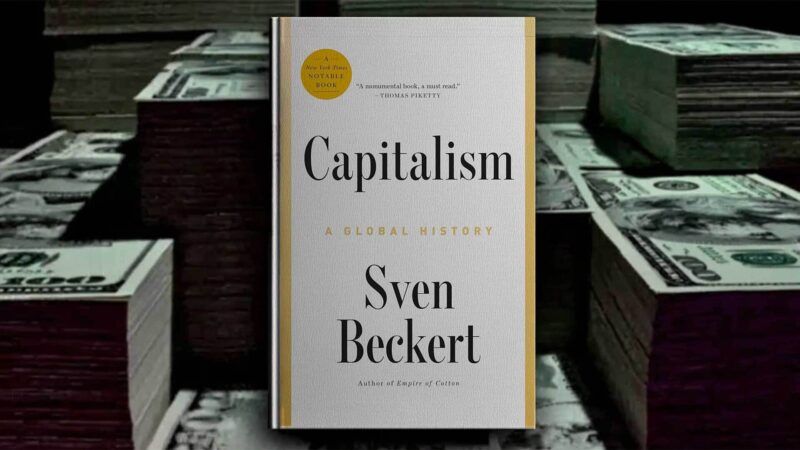
Capitalism: A Global History, by Sven Beckert, Penguin Press, 1,344 pages, $49
Adam Smith, widely considered the first major theorist of capitalism, abhorred the institution of slavery. "Whatever work [a slave] does…can be squeezed out of him by violence only, and not by any interest of his own," he wrote in 1776. In an earlier lecture, Smith indicted laws that "strengthen the authority of the masters and reduce the slaves to a more absolute subjection." The plantation system at the core of this economy was not a competitive market; planters had secured a state-sanctioned "monopoly against all the rest of the world" and "indemnif[ied] themselves by the exorbitancy of their profites for their expensive and thriftless method of cultivation." Smith singled out the exceptional cruelty found in the British colonies of "Jamaica and Barbadoes, where slaves are numerous and objects of jealousy [and] punishments even for slight offences are very shocking."
Yet in Capitalism: A Global History, Sven Beckert calls colonial Barbados "an almost perfectly Smithian economy, with utility-maximizing individuals creating a newly productive division of labor"—indeed a model of market capitalism. A simple contrast of those two characterizations is enough to raise the question of whether Beckert bothered to consult what Smith actually wrote about West Indian slavery.
In the 19th century, slaveowners and abolitionists alike noted the tensions between the emerging industrial economy and the plantation system. The former depended on freedom of movement and on choice in career and industry. The latter grafted elements of feudal hierarchy and coerced labor onto a fixed model of agrarian mass production. Proslavery theorists such as George Fitzhugh saw the two systems as irreconcilable. "Laissez faire," he argued, was "at war with all kinds of slavery, for they in fact assert that individuals and peoples prosper most when governed least." Such testimonies complicate Beckert's interpretation of slavery as a fundamentally capitalistic institution.
Beckert's book, a sweeping 1,300-page history, synthesizes bits and pieces of the academic literature to recount the emergence of capitalism over the last millennium, tracing it from the port cities of Yemen in the Middle Ages to the global economy of today. But that literature is uneven and selectively curated. Standard works on the "Great Enrichment"—the sustained worldwide explosion in wealth and living standards over the last two centuries—receive scant mention. Despite the centrality of slavery to Beckert's narrative, he relegates the vast body of empirical analysis on this question to a single footnoted reference to an unremarkable synopsis by another author.
Instead, Beckert mixes a peculiar amalgam of anticapitalist authors. Some are familiar. Beckert treats Karl Marx's writings as an obvious diagnostic manual for how capitalism operates, complaining only that their 19th century milieu and Eurocentric focus precluded a more universal application. He has similar affinities for Karl Polanyi, calling the socialist writer "one of the twentieth century's most perceptive observers of capitalism" while evincing little awareness of the withering empirical criticism that Polanyi's 1944 manifesto, The Great Transformation, has attracted. When Beckert draws from economists, they are almost invariably from the fringes of the profession. He credulously repeats the inequality theories of Thomas Piketty, for example, showing no familiarity with the critiques of their shaky empirical footing or the heavy contestation around Piketty's "laws" of capital stock concentration.
The core of the book's themes and general style comes from a more obscure source: the German Historical School of Gustav von Schmoller and Werner Sombart. Beckert's new study bears more than passing resemblance to Sombart's Der Moderne Kapitalismus, a huge untranslated work published in successive volumes from 1902 through 1927. There are differences and updates. Whereas Sombart adopted a Eurocentric framework, Beckert's approach emphasizes the role of capitalism in the "Global South" of postcolonial studies. Yet both works purport to trace capitalism through distinctive historical "stages" of development. Here capitalism functions not so much as a system of exchange but as a tumultuous, violent "process" that organizes all economic life around the "ceaseless accumulation of privately controlled capital." Beckert presents his product as a global extrapolation on the Historical School's approach, but its message is ultimately a sustained derogation of capitalism and the academic discipline that he sees as doing the capitalists' bidding: mainstream economics.
The source of Beckert's grievance goes back to the marginal revolution of 1871, when William S. Jevons and Carl Menger developed near-simultaneous solutions to the longstanding problem of value in economic theory. Earlier classical economists theorized that the value of a good is instilled by the labor performed to improve upon it. This simple intuition breaks down in practice, as Smith noticed when looking at cases where the circumstance of a transaction caused differences in how goods were priced. The marginalists deduced that value is a function of individual subjective preferences, as exercised at the moment of a transaction by the parties to an exchange. This created a stumbling block for Marxist economics, which relied on the labor theory of value to calculate the "surplus value" that capital owners allegedly appropriate from their labor force without fair compensation. It also sparked a methodological feud between Menger and Schmoller, who attacked the marginalist approach as overly abstract and deductive.
Beckert unintentionally reveals that he does not grasp the logic of marginalism. He interprets subjective value theory as a crude attempt to "quantify the pleasure that goods provided for consumers," which he deems "ahistorical" and blames for "shift[ing] the primary question of economics" from labor-centric production "to the problem of how scarce resources should be allocated." In a few ambiguous steps, Beckert migrates to the 1960s writings of the post-Keynesian economist Piero Sraffa, who attempted to construct a theory of value from labor and commodity inputs that claimed to resuscitate this older approach, sans marginalism. Few mainstream economists cared, finding Sraffa's approach tendentious and empirically irrelevant. Beckert nonetheless proceeds as if the marginal revolution failed at its objectives, or at least warrants discarding today on the grounds that it allegedly ignores "history, power, culture, and even ethics" in favor of claimed universal laws of economic rationality.
For all his complaints, it is Beckert who whiffs on the historical context of this debate. Ignoring price theory, or perhaps not understanding its complexity, he scoffs that the heirs of marginalism "were all utopian thinkers with an almost religious belief in markets." His attempted history of economic thought omits the fact that an observed breakdown in the labor theory of value (David Ricardo, for example, noticed that wine pricing defied an aggregation of its labor components) precipitated this new approach. He glosses past marginalist critiques of the German Historical School's lack of evidentiary rigor. And as his treatment of slavery shows, Beckert appears unaware of mainstream economic scholarship on the very topics he claims as a historical specialization.
Ultimately, Beckert's grievance comes down to politics. He believes that marginalism's triumph imposed an "intellectual enclosure" that "divorced economics from other social science disciplines." Conveniently, those other disciplines tend to display greater normative alignment with Beckert's own beliefs about inequality, labor, and class conflict.
These methodological complaints culminate in a lengthy treatment of "neoliberalism," the supposed pinnacle of this "intellectual enclosure" from the mid–20th century to the present. Here Beckert adopts the ideologically loaded frameworks of scholars who view "neoliberalism" as a cohesive project to wall off the capitalist economy from "democratic" will, by which they invariably mean a socialist model of economic redistribution.
Beckert's account repeats many common errors of this genre. He depicts 20th century trade liberalization as the quintessential neoliberal project, ignoring that its main institutional faces, the General Agreement on Tariffs and Trade and later the World Trade Organization, grew out of the New Deal. While characterizing the "neoliberal" postwar economy as an institutional veneer for coercive economic violence, he almost entirely neglects its historical context amid a geopolitical struggle with the Soviet Union's coercive applications of Marxist doctrine. And in a final twist, Beckert cannot resist impugning capitalism with another form of violence. "Fascism never broke with a fundamentally capitalist organization of economic life," he contends, citing its alleged entrancement with the "commodification of inputs, outputs, and labor" and, above all, private property.
These features transmitted into "neoliberalism" after the war, he argues, because of the "absolute primacy of securing the workings of the price mechanism" in its doctrines. This produces a high "neoliberal" tolerance for authoritarianism, even "admiration for fascism"—a point he attempts to sustain with an out-of-context quotation by Ludwig von Mises in 1927 that credited interwar fascist governments for halting Marxist political violence.
Compare that with Beckert's assessments of Sombart, whom he praises as "incisive" and visionary. Beckert omits the final turn in Sombart's career. In 1934, this student of Schmoller, former correspondent of Friedrich Engels, and prophet of capitalism's evolutionary procession would forever discredit the reputation of the German Historical School by linking it to the Third Reich. Sombart's Deutscher Sozialismus demarcated this moment as an "age of late capitalism, which at the same time is early Socialism" and prophesied the rise of a new socialist economic order rooted in a Germanic "Volksgeist."
It is not in the myth of a Smithian Barbados where we find the historical value of capitalism. It is the terrifying alternatives that emerge when voluntary exchange is supplanted by an illiberal convergence between the socialist left and nationalist right.
Editor's Note: As of February 29, 2024, commenting privileges on reason.com posts are limited to Reason Plus subscribers. Past commenters are grandfathered in for a temporary period. Subscribe here to preserve your ability to comment. Your Reason Plus subscription also gives you an ad-free version of reason.com, along with full access to the digital edition and archives of Reason magazine. We request that comments be civil and on-topic. We do not moderate or assume any responsibility for comments, which are owned by the readers who post them. Comments do not represent the views of reason.com or Reason Foundation. We reserve the right to delete any comment and ban commenters for any reason at any time. Comments may only be edited within 5 minutes of posting. Report abuses.
Please to post comments
Beckert's new study bears more than passing resemblance to Sombart's Der Moderne Kapitalismus
So, an AnCap (socialist) is appropriating the labor of others? You don't say.
Very good!
Well, this is one book I shall not be adding to my collection - 1300 pages purporting to explain why and where socialism works and capitalism doesn't, in the face of real-world evidence, supported by theory, showing the opposite.
I could not stop giggling to myself reading this while thinking about how Reason loves china and ignores their use of slavery and caste systems as labor as they advocate for china in most articles here.
Can you support that claim with some citation?
Yes.
Have you ever read any of their articles on abundance, their tariff articles, or going to act like a sea lion?
I apologize for your ignorance.
I don't accept your apology. I want "Sam Grove" to apologize for their ignorance.
Im surprised he didnt demand a set sequence of words from me like Mike does.
Apple deploys nets to prevent suicide attempts in their factory in China. Still giggling?
I understand that you are a retard. But the point was that reason defends the labor practices of China and demand the US prop them up. That's the funny part.
Funnier still, the 'Trump Whisperer' Tim Cook, mastermind behind Apple's efforts in China, is about as close to Trump as a Silicon Valley CEO could wish to be. Understand?
We do understand that you're a lying pile of lefty shit.
"The 'Trump Whisperer' Tim Cook... is about as close to Trump as a Silicon Valley CEO could wish to be."
This claim would shock both Cook and Trump as well as those who know them.
You mean, Tim Apple? 🙂
And you call centrists and republicans conspiracy theorists?
Perhaps after learning you fell for the Russia collusion hoax and the plethora of other fake news, misinformation, etc that came from the democrats and the lame stream media including the BBC for decades you might find a different source for information.
I'm pointing out that Tim Cook loves China almost as much as he loves Trump. Maybe it's the slavery JesseAZ was mentioning.
I mean if it were Jensen, or Elon, or Theil, or at least a dozen other Silicon Valley mavens I could agree.
But Cook was Steve Jobs handpicked successor and doesn't pick his nose without Laurene Powell Jobs approval, and Laurene Powell Jobs is one of the biggest Democratic Party donors. Laurene inherited 38.5 million shares of Apple at her husband’s death.
And beyond direct campaign contributions, Powell Jobs is the prime behind-the-scenes mover (along with Alex Soros) in Democratic politics.
She was the key figure in persuading the Democratic Party to replace President Joe Biden as the nominee in favor of Kamala Harris.
Her influence extends through her personal relationship with Harris, whom she has supported for over two decades, and handpicked Harris and funded even her 2003 campaign for San Francisco district attorney.
Jobs also hosts the biggest DNC fundraisers, and leveraged her network to encourage endorsements from prominent women in technology, and created super PACs like Future Forward that back Democratic candidates.
I wasn't referring to Jobs, Powell, or anyone other than Tim Cook, CEO of Apple. As I understand, he was elevated to that position after the demise of Jobs largely because of his decision to off shore to China, in fact to the factory where conditions were so horrendous that anti suicide netting had to be installed.
Earlier this year Cook donated $US 1 million of his own money to Trump to celebrate his inauguration. Look it up yourself if you doubt me. In August this year, Cook gifted Trump with a 24 carat gold knick knack, symbolizing his 'love for America.' I shit you not. If you know of any other such tokens of affection, let us know.
You forgot to mention "according to an article citing unnamed sources".
There's zero evidence that this actually happened. You're parroting what the "unnamed source" is probably intending to use as a smear of Cook.
Anyway, if you're going to try and argue against Cook's political affiliations, then Laurene Powell Jobs becomes relevant. You don't get to handwave it away because it's inconvenient to your narrative.
"You forgot to mention "according to an article citing unnamed sources"
I also forgot to mention that Cook has not denied the story, so there's that. As for the 24 carat gold knick knack, it was handed over in person in front of the cameras.
"You don't get to handwave it away because it's inconvenient to your narrative."
I get to handwave them away because Cook is the CEO, and he is responsible for the off shoring to China.
"I also forgot to mention that Cook has not denied the story, so there's that. As for the 24 carat gold knick knack, it was handed over in person in front of the cameras."
Poor, poor fuckedupman! A baloney claim not denied by the supposed villain!
Fuck off and die, asswipe.
How do suicide rates among Apple factory workers in China compare to progressive political activists in the US? Who needs the nets more?
Keep giggling and you won't have to worry about suicide and other bad thoughts.
Keep lying and you'll remain the lying pile of ignorant lefty shit you are.
Maybe you should get a net.
Apple deploys nets to prevent suicide attempts in their factory in China. Still giggling?
Suicide nets in a communist country, in a company owned by said communist country, but it's solely the guys who are buying their product's fault.
Brilliant dismantling of capitalism, genius.
So Apple is Communist now? Giggles all around.
No, but the company making the phones for Apple, the Foxconn Technology Group China is partially state-owned by both Hon Hai and the Nanjing and Jiangsu governments.
Wait, did you actually think Apple owned those companies? Oh wow.
Nobody should be doing business with the Uighur slave state, but Apple isn't actually running HR for them. (chuckles)
"the Foxconn Technology Group China is partially state-owned "
I'm sure that's why Tim Cook chose them to manufacture his products. No pesky unions to deal with, for one.
"did you actually think Apple owned those companies?"
No, I didn't actually think that at all. I think Apple chose them precisely for the reason that the conditions in these factories were so inhumane that they were driving workers to suicide. That was a feature, in other words, not a bug. Had decent treatment of his workforce been a priority for him, he wouldn't have off shored to China.
So you think Apple owners and decision makers are all sick and twisted and want to ensure there's a level of inhumanity and suicide in their work force which is why they do not manufacture in western countries with labor standards? Damn those evil fascists.
Maybe buy a Samsung phone and some sneakers made in South Korea?
"So you think Apple owners and decision makers are all sick and twisted"
No, Apple owners and decision makers pretty much pass for normal these days. In fact society takes pains to reward and lionize them. Tim Cook became a billionaire largely thanks to his decision to off shore to China, I believe.
No, I didn't actually think that at all.
You obviously did, who do you think you're kidding. Did you completely forget you just said "So Apple is Communist now? Giggles all around" in response to me saying "in a company owned by said communist country".
Just take the "L" and walk away, you complete parody.
"You obviously did, who do you think you're kidding. "
I promise you I didn't. And anti suicide netting was indeed installed in the factory where Cook decided to have his Apple products manufactured. You can't deny it. And whether Apple owns the factory or not is irrelevant. The truth of the matter is that Cook chose, out of his own initiative, that company to do business with. He knew China was run by the communists and he knew the factory had close ties to the party. Don't try to tell me otherwise.
You’re moving the goalposts and pretending it’s consistency.
No one denied the suicide nets existed. What you keep refusing to engage with is causation. You started by smearing this as a “dismantling of capitalism,” then pivoted to “Cook chose inhumanity on purpose” when it was pointed out that Foxconn operates inside a Chinese state–party system that Apple does not control.
Ownership is not “irrelevant” just because it’s inconvenient for your narrative. There is a categorical difference between being an employer and being a customer in a foreign supply chain under an authoritarian regime. Conflating the two is either ignorance or bad faith. Apple cannot set labor law in China, cannot permit unions there, and cannot override CCP governance of factories. That’s not a defense of Apple (who shouldn't be doing business with a slave state), it’s a statement of reality.
Your claim that Cook “chose suicide as a feature” is pure motive-reading. You have zero evidence for it, and you substitute moral outrage for proof. By your logic, any company sourcing from China is deliberately seeking worker misery, which tells us more about your need for villains than about economics.
So no, this isn’t a refutation of capitalism. It’s a critique of doing business with a communist authoritarian state, one you keep trying to pin on “capitalism” by blurring communist responsibility until the distinction disappears. If that’s the argument, at least be honest about what you’re actually attacking.
"that Apple does not control."
Apple doesn't need to control it. They have the Chinese Communist Party to do it for them. Win-win.
"Apple doesn't need to control it. They have the Chinese Communist Party to do it for them. Win-win."
Shotforbrains here seems incapable of providing cites, but that's not surprising:
"mtrueman
May.23.2022 at 10:29 am
[…]As long as humans are operating the reactors, an accident is a potential, regardless of the safety of the reactors. It's the human element where the danger comes in...”
Look at that pile of bullshit and consider it. And try to imagine any real alternative. That is a sick mind.
Sven demonstrates the functional stupidity of the ideologue.
Sounds like Project 1619 meets economic history.
As for value, I still think that in a free market, value is what two parties voluntarily agree for an exchange, regardless of prior costs, including labor. Silly me.
Indeed. And if the labour value of a product exceeds what someone else is willing to pay, you won't sell it! "I climbed Mount Everest to procure the granite sliver that has gone into the watch face, so this watch is worth $50,000." "In Philadelphia, it's worth fifty bucks".
Not shocked you gall for the sunk cost fallacy.
Apparently going out of business sales dont exist in shrikes world.
You missed the entire point of the article. That perceived value of labor is not inherent in pricing.
Yeah, this is an asshole who KNOWS what a good is worth, regardless of the market.
"How much for the gun?"
I love the pawn shop broker’s eyes on that take.
Bo Diddley should have had an Oscar nomination for that one scene.
Remember that this asshole is a truly despicable steaming pile of bloodthirsty shit:
SRG2 12/23/23
“Then strode in St Ashli, clad in a gown of white samite and basking in celestial radiance, walking calmly and quietly through the halls of Congress as police ushered her through doors they held open for her, before being cruelly martyred for her beliefs by a Soros-backed special forces officer with a Barrett 0.50 rifle equipped with dum-dum bullets.”
Fuck off and die, asswipe.
BTW, keep in mind that this asshole is a truly despicable steaming pile of bloodthirsty shit:
SRG2 12/23/23
“Then strode in St Ashli, clad in a gown of white samite and basking in celestial radiance, walking calmly and quietly through the halls of Congress as police ushered her through doors they held open for her, before being cruelly martyred for her beliefs by a Soros-backed special forces officer with a Barrett 0.50 rifle equipped with dum-dum bullets.”
Fuck off and die, asswipe.
No one ever learns the economic lessons of the Lone Biker of the Apocalypse: Price, it's not what you say it is, it's what the market will bear.
So, another pile of bullshit I'll avoid.
"...Yet in Capitalism: A Global History, Sven Beckert calls colonial Barbados "an almost perfectly Smithian economy, with utility-maximizing individuals creating a newly productive division of labor"—indeed a model of market capitalism..."
Every Marxist writing on capitalism lies. Like turd it's all they do, since honesty would force them to abandon their cult.
Beckert's book, a sweeping 1,300-page
historyLeftard Self-Projection.Exactly what [WE] did/believe is all those other 'icky' peoples fault.
Captialism is about defending Individual Liberty & ensuring Justice for all.
Socialism is about using 'Guns' to TAKE from others what isn't earned (i.e. slavery).
Captialism is about defending Individual Liberty & ensuring Justice for all. Socialism is about using 'Guns' to TAKE from others what isn't earned (i.e. slavery).
Wrong. Individual liberty and justice for all may fit neatly alongside capitalism but neither is part of capitalism itself. One can have a society that is largely totalitarian - no free elections, censorship, no equal justice - but where when it comes to business, you're free to put your money into your company and keep the profits, trade with other companies and consumers, etc.
Meanwhile, you could have a system where anyone can set up a company but you're required to take 75% of the needed equity investment from the government, which thereafter leaves you alone but gets 75% of the profit. It's clearly socialist but does none of the things you claim.
Why are you wrong? Because you're a monomaniacal fuckwit.
You screwed up. Socialism is 100% control by government, fascism is the 75% part like the Nazi's had. Very close to socialism so may as well call it socialism.
Do you believe the Nazi's and/or fascism is right wing? Perhaps that's where your error derives from?
Oh and on the other scale, Totalitarian is far left and Anarchy is far right.
far left = Totalitarianism which is required for Socialism to exist.
far right = Anarchy and 100% free markets.
The US began as libertarian, left of Anarchy, but still right of center.
Socialism is the government owning the means of production. Owning 75% is pretty close. FWIW even the USSR didn't own all production - IIRC 5% of farms were privately owned, and produced 50% of all the USSR's agricultural product.
Fascism is of course right-wing, and Nazism is mostly right-wing, claims to the contrary by far-right-wingers trying to avoid contagion notwithstanding. I note that the Nazis, when they confiscated Jewish-owned businesses, passed them over to "Aryan" owners and didn't retain government ownership.
How do you retards keep repeating this lie?
Fascism, as described by actual fascists, was created to save socialism. Go read a fucking book dumbass.
“Fascism is of course right-wing, and Nazism is mostly right-wing, claims to the contrary by far-right-wingers trying to avoid contagion notwithstanding.”
Hahahahahahahaha
Conservative might be a better word than Right Wing. The Nazis wanted to conserve their blood and soil, their heritage and their natural endowment. Their biggest rivals were the Socialists and Communists. When Nazi electoral support began to slip and Nazi rivals began to gain, specifically as evidenced in the last free election, powerful conservatives, Hindenburg and Papen stepped in and elevated Hitler to power. They were happy enough with Hitler, and concerned that another election would see further erosion of the Nazi vote and gains for the non conservatives, (or left wing, if you can stomach the words.)
The Nazis did indeed have some superficially Socialistic programs, such as the Strength Through Joy holiday scheme. Gunther Grass wrote about this in Crabwalk, a tragic history of the cruise ship Wilhelm Gustloff. (Affordable one single class, week long cruises to the fiords of Norway etc.) But dig a little deeper and such programs were based on the regime's outlawing unions and stealing their funding. In the end Strength Through Joy was neither liberatory nor empowering the working class.
I'd appreciate it if you could add to my little disquisition. Perhaps tell us why you have such an aversion to the use of the term right wing, (or left wing) and if replacing it with conservative would make you more comfortable.
Neat Trick; [Na]tional So[zi]alist[s] "biggest rivals" were "Socialist"?
The water is DRY GD! The water is DRY! /s
It is baffling how DUMB the left gets.
The Nazi party's closest contender was the Socialist Party, with the Communist Party coming after that. The rest of the field was populated by parties too small to hope to gain power. Look it up. Compare the last election results with the few that immediately precede it and my point will become clear. Thank you.
The National Socialist German Workers Party was a socialist party.
Hitler and Goebbels praised socialism and denounced capitalism in virtually every speech.
The Nazis envisioned an economy that was fiercely anti-capitalist, rejecting unchecked private enterprise, finance capital, profit-seeking individualism, and "interest slavery" as exploitative forces that weakened the nation and enriched a Jewish parasitic elite. They self-described their system as a true, national form of socialism, one that elevated productive labor as the source of all value, subordinated economic activity to the racial-national community's needs, and aimed to incorporate workers into the state while crushing both Marxist internationalism and bourgeois plutocracy.
Private property was nominally preserved but only as a conditional stewardship: owners were agents of the state, obligated to use their holdings for the "common good" (as defined by the regime), with the explicit threat of expropriation or ruin if they resisted directives. Hitler repeatedly stressed that "common benefit precedes individual benefit," and the state retained ultimate control over production, prices, wages, and resource allocation, prioritizing rearmament, autarky (self-sufficiency), and racial vitality over market freedom or consumer choice.
The Nazi party platform demanded nationalization of trusts, profit-sharing in industry, confiscation of war profits, abolition of unearned incomes, land reform with uncompensated expropriation for public needs, communalization of department stores, and ruthless punishment (including death) for usurers and profiteers. In practice and rhetoric, this translated to heavy state planning, cartels under regime oversight, massive public works, and a directed economy where "the benefit to the community determines the benefit to the individual."
Goebbels framed it as labor triumphant over finance: a socialist justice where work created value for the Volk, not haggling or money; an aristocracy of accomplishment, not possession. Hitler saw planned economy from above as essential for national power, while dismissing full Bolshevik-style abolition of property as bureaucratic weakness that stifled selection and progress.
In essence, it was a collectivist, hierarchical system of state-directed production for racial-national strength, sharing socialism's impulse to override individual economic liberty for a higher collective purpose, but defining that collective particularistically as the Aryan Volk rather than universally.
Capitalism was the enemy for alienating labor and serving international finance; Marxism for dividing the nation through class warfare. The result: an economy harnessed to conquest and purity, where private initiative survived only insofar as it aligned with the regime's totalitarian will.
Are you seriously trying to convince me with campaign speeches by the Nazi propaganda minister? Is that the best you've got?
The very word 'Nazi' is but an abbreviation of the German words for National Socialism.
https://en.wikipedia.org/wiki/Nazism
"The Nazi Party,[b] officially the National Socialist German Workers' Party (German: -----[Na]tionalso[zi]alistische----- Deutsche Arbeiterpartei [c] or NSDAP)"
Communist propaganda labelled Nazism right-wing to separate itself from the Nazi's. Ya know; just like how leftards (as seen right here) are still doing today.
"Are you seriously trying to convince me with campaign speeches by the Nazi propaganda minister? Is that the best you've got?"
Written by someone with a government-school education and whose other source of knowledge is the news magazine in the Sunday newspaper.
Hint, shitforbrains: Read "Wages of Destruction", Tooze. It will become clear, even to those who hope for a second brain cell (like you) that the Nazis were socialists.
Oh, and fuck off and die, asswipe.
TJJ2000: and North Korea is properly the Democratic Republic of North Korea. You must think NK is a democracy, likewise the old East Germany. The reason for retaining "socialist" was for branding and marketing purposes,
YES. North Korea is [D]emocratic [Na]tional So[zi]al[ism].
The *Socialist* Constitution of the Democratic People's Republic of Korea
https://en.wikipedia.org/wiki/Constitution_of_North_Korea
You leftards are literally championing North Korea politics for the USA.
And playing stupid "it is not" games in your BS filled heads.
Clear down to the cognitive dissonance pretending a 'Socialist' party isn't 'Socialism'.
How retarded can the leftarded get?
"Their biggest rivals were the Socialists and Communists."
Note this isnt because they are some kind of opposite in any way, only because "game recognized game". Similar to how the bloods consider the crips to be their biggest competitor, but just because that is the case doesn't mean they arent a: both polar opposites of a good moral person, and b: not nearly a carbon copy of one another in every way that matters to a thinking person.
Goebbels wrote that essentially communism as it was being practiced was inferior to national socialism due to its lack of a sense of national pride, racial pride, etc. It wasn't that "I disagree with everything about communism and reject it fully!" it was "hey I think we can do this shit way better"
Too much pop history and frankly very shallow understanding of it just distill it down to "communists and fascists were opposites, pitted against one another" when they really sit pretty comfortably next to each other on the authoritarian vs freedom spectrum. These aren't polar opposites, or a completely different species, they are similar looking brothers with different hair styles.
"Goebbels wrote that essentially communism as it was being practiced was inferior to national socialism due to its lack of a sense of national pride, racial pride, etc. It wasn't that "I disagree with everything about communism and reject it fully!" it was "hey I think we can do this shit way better"
Hitler, not Goebbels, was the leader. Only his ideas counted for anything in that regime. There were a few prominent Nazis who had authentic Socialist/Leftist backgrounds. Goebbels is one, Hitler wasn't. His fellow soldiers report he carried works by Nietzsche and Schopenhauer in his back pack, not Marx and Engels. He was taken up by the rightist paramilitary Freikorps after WWI, the same outfit that assassinated Rosa Luxemburg and other leftist luminaries.
Other prominent Left leaning Nazis were the Stasser brothers. One was assassinated by the SS and the other went into exile to Switzerland. Why, you ask? Political differences. They never wavered from their beliefs while opportunists like Goebbels were only too happy to abandon his youthful principles for career advancement.
European 'right'.
Which is leftist.
European right is totalitarian authoritarianism in which The Party, in the person of the commissar/dictator/fuhrer does what is best for the People.
As the Party sees it.
Communists and Fascists are International and National Socialists, respectively. Two facets of the same diseased gem.
Constitutional Republicanism isn't anywhere near either, it, and Libertarianism, and even Libertinism, as well as Anarchy are a whole different strata.
"Which is leftist."
You mean they sit on the left side of the chamber? Why not stick to meaningful labels instead of leftist or rightist, terms you can't even define.
"Communists and Fascists are International and National Socialists, respectively. Two facets of the same diseased gem."
Communists are progressive, they come out of the Enlightenment. Fascists are reactionary, a refutation of the Enlightenment, something like the Romantic movement. They have completely different pedigrees though sometimes similar goals, such as revolution.
" isn't anywhere near either,"
Near is a relative term. Some Republics are closer to Communism or Fascism than others.
"Fascism is of course right-wing, and Nazism is mostly right-wing, claims to the contrary by far-right-wingers trying to avoid contagion notwithstanding."
This is the standard talking point trotted out by retards to obfuscate. The standard tactic is "see socialism is left wing, and its good. Fascism and Nazism are right wing, and bad" when in reality its a a dumb and not useful distinction. In reality they are all massively collectivist, massively authoritarian immoral movements that hated individualism and private property. Oh, and socialism killed more people than either of the "right wing" ones.
It's probably better to call Nazism conservative rather than right wing. The hearkening back to a golden age of days gone by is a dead giveaway.
Or maybe 'conservative' means a 'conservative' (i.e. LIMITED) government.
Everything would be easily understood if it wasn't for [Na]tional So[zi]alist[s] trying to dis-own their own history.
There are conservative leftists and conservative rightists.
It's why I disdain the term.
A conservative leftist wants to conserve their vile left wing ideas and traditions. Like Bernie's love of Stalin and Obama's love of Mao. And all the left's love of hating jews.
You all seem to want to conserve your idiocies.
I don't think Bernie loves Stalin or Mao. Perhaps Tito and Castro. Ever notice that in the long lists of atrocities, Yugoslavia and Cuba are never mentioned? Maybe Bernie doesn't love Tito and Castro. Who knows, who cares.
But I agree that some leftists are more conservative than others. Bernie is not one of them. Have you heard of Slavoj Zizek? Look him up. An avowed Marxist and Lacanian analyst, he endorsed Donald Trump for president in 2016. He writes for Compact, an online magazine that hosts conservative Catholics.
"And all the left's love of hating jews."
Jews like Bernie Sanders? How old are you. I assumed you were old enough to think for yourself. I'm having second thoughts.
"you're required to take 75% of the needed equity investment from the government"
Where does the 'government' *get* the investment funds?
The magical $ tree at the White House?
It TAKES w/'Guns' from productive people (i.e. slaves).
Next BS excuse.
Where Adam Smith erred was his assumption that Capitalism would mean autonomy and independence for worker/owners competing and cooperating with each other. He recognized the necessity of a period of apprenticeship, but that was temporary, He never foresaw the reality of today where the vast majority of workers put themselves in a lifetime position of subservience to an ever shrinking number of employers.
You're confusing the free market with capitalism. They often go hand in hand but are not the same thing.
"You're confusing the free market with capitalism."
I don't see a problem with that. As I understand both depend on the relation between business and government. Smith's assumptions are not about government and its relation to business.
You’re committing equivocation, and then shrugging when it’s pointed out. “Free market” and “capitalism” are not interchangeable terms, and saying “I don’t see a problem with that” isn’t an argument, it’s an admission that you’re deliberately blurring definitions to keep your conclusion intact.
You start by blaming capitalism for modern labor dependency, then when someone (me) correctly distinguishes markets from a state-distorted corporate system, you collapse them back together so Adam Smith can still be blamed. That’s textbook equivocation: using the same word to mean different things at different moments, then refusing to separate them when the distinction undermines your claim.
On top of that, you’re making a category error. Smith wasn’t predicting 21st-century labor sociology under regulatory capture and monopoly privilege; he was analyzing incentives, competition, and the dangers of employer collusion, which he explicitly warned about. You’re faulting his framework for outcomes it was never meant to explain.
In short, you’re keeping the concepts muddy so the blame stays simple. Once you stop conflating “free markets” with “whatever system exists today,” your argument falls apart.
I am not making an argument that free market and capitalism are interchangable terms. I am pointing out that Smith's assumption that workers would be free, autonomous and independent didn't come to pass. Instead they would remain subservient to employers for their entire working lives. Is that the fault of capitalism? The free market? I'll leave that for others to judge. It's not a question that interests me.
Did your Dad decide what job you would perform and then you went to work for your Uncle and can't ever leave?
That reply is a retreat, not a clarification.
You did make an argument about capitalism, blamed Adam Smith for outcomes you dislike, and only after the distinction was raised did you suddenly declare that you’re “not interested” in whether those outcomes arise from markets, capitalism, or state distortion. That’s not intellectual humility, it’s strategic agnosticism.
You asserted that Smith was wrong. That’s a causal claim. Once someone asks wrong about what, exactly, you can’t just wave it away with “I’ll leave that for others to judge.”
If you refuse to specify whether the problem is markets, capitalism, monopoly privilege, regulation, or employer collusion, then your criticism is unfalsifiable and therefore empty.
And Smith did not assume permanent autonomy in the sense you’re implying. He explicitly warned about employer power, collusion, and the tendency of business interests to dominate labor when competition is constrained. What you’re describing isn’t a refutation of Smith, it’s exactly the failure mode he anticipated.
So you’re left with this contradiction: you want the rhetorical payoff of saying “Smith was wrong,” but you don’t want the responsibility of identifying the mechanism that made him wrong. That’s not analysis. You're tossing a conclusion into the room and walking away before anyone asks you to defend it.
"You did make an argument about capitalism"
I can make it again if you like. In Smith's day, Capitalism was a system that delivered or promised to deliver autonomy and independence to the worker/owner. That is no longer the case today. I don't blame Smith for this turn of events, which he had no control over in any case. Still, I doubt he'd be pleased with how things are now with the vast majority workers spending the entirety of their working lives in a position of servitude to a shrinking pool of employers.
You’ve just quietly rewritten your original claim while pretending it’s the same argument.
You started by saying “Smith erred” and that capitalism failed to deliver on his assumptions. Now you’re saying you don’t blame Smith, that he had no control, and that this is merely an unfortunate evolution he wouldn’t like. That’s not a restatement, it’s a retreat to a deliberately vaguer position once the original one was challenged.
More importantly, you’re still doing the same thing: asserting an outcome (“lifetime servitude to a shrinking pool of employers”) while refusing to specify why it occurred. Was it market concentration driven by state privilege? Regulatory barriers to entry? Central banking? Labor law? Corporate governance? You won’t say, and that’s the problem. Without a mechanism, “capitalism no longer delivers autonomy” is just a mood, not an argument.
And historically, your premise is shaky. Smith did not imagine a world of universally autonomous worker-owners. He described wage labor as normal, warned that employers would gain the upper hand when competition weakened, and explicitly noted that workers would often be dependent and politically disadvantaged. What he opposed was entrenched power, not the existence of employment.
So you haven’t shown that Smith was wrong. You’ve described a system with concentrated employer power, something he warned about, and then labeled it “capitalism” without defending that label.
Until you’re willing to identify the actual forces that produced the outcome you dislike, you’re not critiquing Smith or capitalism. You’re gesturing at dissatisfaction and calling it analysis.
"You’ve just quietly rewritten your original claim while pretending it’s the same argument."
Which version do you prefer? Why?
"Smith did not imagine a world of universally autonomous worker-owners."
Did he imagine a future where the vast majority of workers spent their entire working life subservient to an ever shrinking pool o employers? I you've got evidence he did, produce it, and I am refuted. Simple.
Did he imagine a future where the vast majority of workers spent their entire working life subservient to an ever shrinking pool o employers?
No.
Because that does not exist.
What we face is an ever shrinking pool of work.
Far fewer workers are required to provide far more production.
The human race and economic theory has to come to terms with the simple fact that there are no 'workers'. There are only people.
Work is not a virtue, a resource, a prize--work is a cost. It is a drain on value, on profit, a drain on human life.
We have fewer companies because we need fewer companies.
We are within the transitionary state that will be called, once it's over, 'the singularity'.
By definition Adam Smith could not have foreseen this. WE couldn't see it.
Until we were in it.
"What we face is an ever shrinking pool of work."
Isn't that what J.M. Keynes predicted for the future? A 15 hour work week. That didn't pan out. Arguably, actual work has shrunk, what has expanded to fill the void is bureaucratic busy work and paper shuffling. Read 'Bullshit Jobs' by David Graeber, another Jew, I'm told, and even further to the left of Obama.
"...I am pointing out that Smith's assumption that workers would be free, autonomous and independent didn't come to pass. Instead they would remain subservient to employers for their entire working lives..."
Which is a fairly common lie offered by lying lefty shits.
You may quit your job at any time and find new employment, or even start your own business.
IF you have enough sense to realize that, which asswipe here hasn't.
And yet you would prefer to eat your 5 ratio'd eggs provided from the efforts of others rather than earn enough money to by a dozen...
Vegetarian here. You are the one eating my 5 ratio'd eggs provided by others.
Vegetarian here
What a surprise, you could knock me over with a feather.
We don't eat feathers either.
I don't imagine so.
This is clever repartee', according to the brain-damaged.
Vegetarian here.
Ah.
You have chosen to be prey.
Naturally.
Mites, Scorpions and Mosquitoes are the only creatures that concern me.
"Sven Beckert's Capitalism: A Global History is...not a reliable history."
Remember how capitalism's Red Terror slaughtered hundreds of thousands in sadistic purges, and its dekulakization campaigns deliberately starved millions of Ukrainian and Kazakh peasants while shipping countless "kulaks" to the frozen gulag archipelago, where prisoners were worked to death in sub-zero mines and timber camps amid epidemics, torture, and cannibalism?
Remember how capitalism turned China into a vast graveyard, starving 40–80 million in the greatest famine ever recorded, followed by the capitalist Cultural Revolution's frenzy of denunciations, beatings, and mass executions?
Remember how capitalism's agrarian socialist utopia emptied Cambodian cities overnight, marching millions into the Killing Fields for execution by hoe and bullet to erase "bourgeois" elements in a genocidal frenzy that claimed up to two million lives through starvation, overwork, and grotesque torture?
Remember how capitalist guerrillas like Peru's Shining Path reveled in butchering Andean villagers, slitting throats, smashing skulls, and hanging dogs from lampposts as warnings?
Remember how capitalism's Red Brigades kidnapped, knee-capped, and murdered the plebs in pursuit of "proletarian" revolution?
Remember capitalism's walls like its one in Berlin which acted as prison barriers to stop desperate citizens from fleeing the promised paradises, shot dead in barbed wire if they tried?
Remember capitalism's show trials and psychiatric torture and mass rapes in conquered territories and the deliberate extermination of class, ethnic, and political enemies?
"Pepperridge Farms remembers"
If you want to uncover Capitalism's atrocities, you're looking in the wrong places. Start with Israel today and its brutal policies of forced population transfers, starvation and murder. Or Vietnam in the 60s, or WW1 and 2, India and China in 18 and 19th centuries with deliberate famine, Genocide of America's indigenous people and culture.
"dekulakization campaigns deliberately starved millions of Ukrainian and Kazakh peasants "
Kudos for mentioning Kazahks, who are never mentioned in these laundry lists of communist atrocities. It's always the Ukrainians who get the lime light despite Kazakh making proportionately more victims, maybe 50% of the population. There's reason to believe that the deaths weren't deliberate. Stalin was continuing a policy of Lenin's where food from the countryside was confiscated to feed the cities. When evidence for the famine became undeniable, Stalin opened up emergency food stocks, and even spent precious foreign currency to relieve the famine. Put it down to willful ignorance and bureaucratic incompetence rather than deliberate policy. Much the same could be said of Cambodia's emptying the cities. In the early days in the jungles of west Cambodia, it was common practice for Pol Pot to empty the towns and cities for a time, only to allow residents to return when the fighting was settled. The idea was not to lose in the cities what was gained in the countryside. Now the cities of Western Cambodia are tiny compared to the Capital, Phnom Penh, and willful ignorance and mismanagement took their toll.
I see you attended the Quality Learing Center in Minneapolis.
No, I've read a few more books than you have.
The Dick and Jane series doesn't count, miscontrueman.
I really doubt you have.
Why do you really doubt I have?
"In the early days in the jungles of west Cambodia"
My mistake. Eastern Cambodia is where Pol Pot's insurgency got its start. Thanks largely to American saturation bombing of the Ho Chi Minh Trail, terrorizing the local peasants to entrust their children to the Red Khmer with promises that they would be fed, clothed and educated.
"Start with Israel today and its brutal policies of forced population transfers, starvation and murder."
This is an evil antisemitic lie not even remotely associated with the truth. A fabulation. An invention. Something that never happened.
Anyway, I see you're doing the classic "whatabout capitalism" deflection, trotting out colonial-era famines, indigenous genocides, and modern wars as if they somehow erase the mountain of corpses piled up by socialist regimes within 60 short years.
Aside from the Israel lie, The rest is false equivalence. Those horrors, tragic as they were, unfolded across empires over centuries and were entangled with pre-capitalist mercantilism, feudal hierarchies, and outright conquest. By contrast, socialism’s adherents racked up over 100 million deaths in deliberate, ideologically driven campaigns of class extermination in barely seven decades.
Let’s start dismantling the revisionist fairy tales.
The Holodomor and the Kazakh famine were not mere “incompetence” or passive continuations of Lenin’s policies. Stalin escalated grain seizures to crush peasant resistance, sealed borders to trap starving Ukrainians and Kazakhs inside, confiscated seed grain and emergency reserves, and continued exporting food abroad while millions starved, cannibalized the dead, or collapsed in fields.
Proportionally, the Kazakh Asharshylyk was even deadlier than Ukraine’s famine, killing an estimated 38–42 percent of the population, roughly 1.5 to 2.3 million people. It annihilated nomadic life through forced sedentarization and mass livestock slaughter. This was not “willful ignorance” or bureaucratic failure, but a calculated assault on so-called backward elements resisting collectivization. Stalin did not heroically open emergency stocks or spend scarce currency to relieve suffering. He denied the famines existed, rejected foreign aid, and intensified requisitions while people ate grass, bark, and corpses.
As for the claim that Pol Pot merely “temporarily” emptied cities before some later excess, that too is false. The Khmer Rouge’s evacuation of Phnom Penh and every urban center was permanent policy from day one of “Year Zero.” It was a deliberate reset to agrarian purity that abolished money, religion, and urban life entirely. Millions were marched into rural slavery, where 1.5 to 2 million died through execution, starvation, disease, and forced labor in the killing fields.
This was not mismanagement spiraling out of control. It was doctrine.
Your laundry list of “capitalist” atrocities fares no better. Colonial famines in India and China were exacerbated by wartime logistics and global conflict, specifically World War II and Japanese submarine warfare choking shipping lanes. Britain was fighting for its life in the Battle of Britain and could barely feed itself. Meanwhile the rich landowners who started the Bengal famine did so by traitoring out and selling their crops to the Japanese for big bucks instead of locally. And none of that is intrinsic to capitalism, and none approaches the speed, intent, or ideological clarity of your socialist-engineered mass death.
- Vietnam was a proxy war against communist expansion.
- World War I and World War II were nationalist and fascist catastrophes, not free-market ones. Some of the participants were corporatist and others were communist. Only the Allies were capitalist.
- The Indigenous genocides were crimes of conquest that partially predated capitalism and were not even capitalist in origin. Look to the Democratic Party if you wanted to know who sent the Cherokee on the trail of tears, or ordered the genocides of the Indian Wars.
- Israel’s policies? Lying about them and equating your fabulations to systematic extermination camps or gulags is a grotesque attempt at fallacious whataboutism.
Murderous Marxist utopianism does not get a pass because “capitalism bad too.” Even if that claim were true, which it isn’t, it would not absolve regimes that promised paradise through total state control and delivered rivers of blood instead. From the Red Terrors to the cultural revolutions, the pattern is the same: absolute power over the collective inevitably devours the individual.
Keep apologizing for the gulags and killing fields if you wish. History will remember who built them.
The Indian tribes wer compleatly harmonus with each other and nature before the evil white man
I like how the story public school teachers tell kids today about native americans, even now, is as infantile and retarded as the "everything changed when the fire nation attacked" meme
And they tell this tale unironically, as if it isnt from a fantasy cartoon.
"This is an evil antisemitic lie not even remotely associated with the truth"
Because Palestinians don't exist? Only Jews are Semites? I've never found this line convincing, though I understand it's commonly trotted out in these pages.
"Anyway, I see you're doing the classic "whatabout capitalism" deflection"
Not a deflection, I agree with the list of atrocities you offer and even complimented you on your courageous decision to highlight the suffering of the Kazahk people.
"As for the claim that Pol Pot merely “temporarily” emptied cities before some later excess, that too is false."
Not false. With early successes, towns were indeed evacuated only to be resettled once the situation stabilized. With the Capital, that was another story, complete chaos that nobody could have planned. Also religion was not particularly targeted. Muslims did suffer disproportionately, it is true, but not Buddhists. Pol Pot was raised in the Royal Compound by Buddhists, and they enjoyed his favor. Prince Sihanouk, especially was spirited away to Beijing by order of Pol Pot and lived out the period in relative luxury.
"Your laundry list of “capitalist” atrocities fares no better. Colonial famines in India and China "
19th century. Millions of Indian peasants starved to death as they watched train loads of grain being exported to Britain, a country wealthy enough to out bid India's peasants in the free market.
"- Vietnam was a proxy war against communist expansion."
It was Capitalist America expanding into Vietnam. Not the other way round. Maybe you missed that part etc etc....
"Because Palestinians don't exist? Only Jews are Semites? I've never found this line convincing, though I understand it's commonly trotted out in these pages."
You're attempting to evade the fact that you just tried to smear the Jews with something that never fucking happened, and if that isn't antisemitism I wouldn't think anything is.
Anyway, I see your apologist's dance continues, conceding the atrocities exist but frantically scrubbing the intent, scale, and ideology behind them while waving the "capitalism did it too" bloody shirt.
You didn't "agree" with the list; you downplayed and denied the deliberate nature of socialist mass murder, peddling the tired "oops, incompetence" excuse that generations of tankies have used to sleep at night.
Pol Pot's evacuation of Phnom Penh wasn't "complete chaos that nobody could have planned", it was executed with military precision in 72 hours, hospitals emptied (patients carried out on beds or shot), money abolished overnight, and the entire population marched into rural communes under the slogan of building an instant agrarian socialist utopia. This was core Khmer Rouge doctrine from their time in power onward, not a scaled-up jungle tactic gone wrong.
Religion was absolutely targeted: Buddhist monks were defrocked, massacred, or forced into labor; pagodas turned into prisons or granaries; Islamic Cham minority faced near-genocide (up to half killed). Sihanouk was a puppet kept alive for propaganda value in Beijing, hardly evidence of Buddhist favoritism while temples were razed across Cambodia. Spare us the cherry-picked trivia to whitewash Year Zero's calculated horror.
Your 19th-century Indian famines under British rule were exacerbated by the policy of allowing Rajahs to rule by granting those local rulers independence in internal affairs while controlling external relations. This tragically included non-interference when they sold off their subjects crops and let them starve. And this unfolded incidentally and unplanned under local rule and mercantilism, not under capitalism, and also not in a few years of deliberate class extermination.
Compare that to socialism's record: Mao starved 40–80 million in under five years by forcing peasants into backyard furnaces and fake collectives; Stalin liquidated millions of kulaks and nomads in similar timeframes through grain seizures and border blockades. No "free market" exported grain while Ukrainians and Kazakhs ate their children. Stalin did it while denying famine and rejecting aid.
And Vietnam? Ho Chi Minh's communist forces invaded the South, backed by Soviet and Chinese arms, aiming to export revolution. The U.S. intervened to stop that domino. Imperial overreach? Sure, but framing it as "capitalist America expanding" while ignoring Hanoi's aggression and the boat-people exodus after communist victory is pure inversion.
America's sins don't absolve the re-education camps, mass executions, and economic collapse that followed northern victory.
You compliment the mention of Kazakhs while immediately excusing their slaughter as bureaucratic oopsies. That's not courage, it's the same disgusting moral evasion that lets socialism's devotees forever dodge responsibility.
The body count wasn't an accident; it was the predictable price of forcing human beings into collectivist molds through absolute state terror. Keep deflecting, you disgusting fucking tankie; the graves don't lie.
"and if that isn't antisemitism I wouldn't think anything is."
I haven't written a thing against Semites. I happen to oppose Israel's genocidal actions against the Palestinians. How is that antisemitic?
"frantically scrubbing the intent, scale, and ideology behind them
That's what the study of History is all about. Teasing out the motives and meaning of noteworthy events.
"You didn't "agree" with the list; you downplayed and denied the deliberate nature of socialist mass murder,"
Because many of the killings weren't deliberate but through bureaucratic ineptitude and toadying - local officials downplaying local catastrophes for fear of displeasing far off superiors, for example. Clearly deliberate murder did occur. The Romanovs, the Russian and Polish army officers and many many more. But you're mistaken if you don't see how incompetence and willful ignorance also played their part. It's an important part of any legitimate critique of the communist system and you are not doing anyone any favors by pretending that it never played a role.
"Ho Chi Minh's communist forces invaded the South"
The NLF (Viet Cong) were native to the south, and had lived there all their lives. The Americans, on the other hand, came from an entirely different part of the world. It was the Americans who expanded into Vietnam.
"the boat-people exodus after communist victory"
Fun fact, did you know that Beihai, in Guangixi Province China is home to a large number of these so called boat people? They were fleeing persecution for being ethnically overseas Chinese rather than any animosity to communism.
"You compliment the mention of Kazakhs while immediately excusing their slaughter as bureaucratic oopsies."
As I say, i you refuse to see that bureaucratic oopsies are bred in the communist bone and an inevitable part of the communist model, you're not seeing the complete picture and falling into a caricature of evil. It's not an excuse. That's just you reflexively rejecting anyone attempting to fill in your cartoon version of History.
"...I haven't written a thing against Semites. I happen to oppose Israel's genocidal actions against the Palestinians. How is that antisemitic?..."
There is glaring proof of antisemitism and how slimy antisemites try to hide it.
If you want to see truly brain-dead comments, see here:
"If you want to uncover Capitalism's atrocities, you're looking in the wrong places. Start with Israel today and its brutal policies of forced population transfers, starvation and murder..."
Fuck off and die, antisemitic Nazi shit.
Remember capitalism's show trials and psychiatric torture and mass rapes in conquered territories and the deliberate extermination of class, ethnic, and political enemies?
That wasn't real capitalism.
Real capitalism has never been tried.
A fair summary would be that the author rejects the methods supported by evidence because they don't support his political preferences, which sums up the state of academia generally.
At least one academic department isn't 100% controlled by the left, but let's be honest that's coming unless we take control of our education system away from the leftists which have controlled it for 40-50 years.
You know, I miss when critics of capitalism actually had some vague idea about what Marx wrote.
Seriously. Any actual Marxist knows the slave-worked plantation and its class hierarchy was a (re-)manifestation of the ancient mode of production, which had nothing to do with the capitalist mode of production and was inherently antithetical to it.
new braindead college kids (extended to most 20-30 year olds) thinks going to work for a boss that makes more than you at a company whose CEO makes even more is literally the same thing as slavery.
They also think a world where you go to prison for doing crimes is also a form of modern slavery.
Unfortunately we have allowed them to break their brains to a point that is not repairable. You could at least have a conversation with reincarnated Karl Marx, debate him (easily at this point as his ideas have been proven toxic so many times now), and while it would be easy to shit on him, it would still resemble a conversation.
The youth have been indoctrinated by what essentially is r/antiwork filtered through the entire public school system and universities. Every inconvenience of life we used to see as ones responsibility (eating, shelter, health care, etc) are considered human rights owed to you by the govt, and anything less than that is systemic oppression. They are retarded, and beyond fixing
It's just college kids, maan.
Beckert clearly realizes that only such a viewpoint is acceptable at Harvard's faculty club.
.
Were he to admit that China's economic advances are due to its aping capitalism and rejecting Maoist socialism, he would be forever barred from Harvard's faculty club.



