

The Fourth Amendment's Erratic Year at the Supreme Court
The right to be free from unreasonable search and seizure had a rocky 2025.
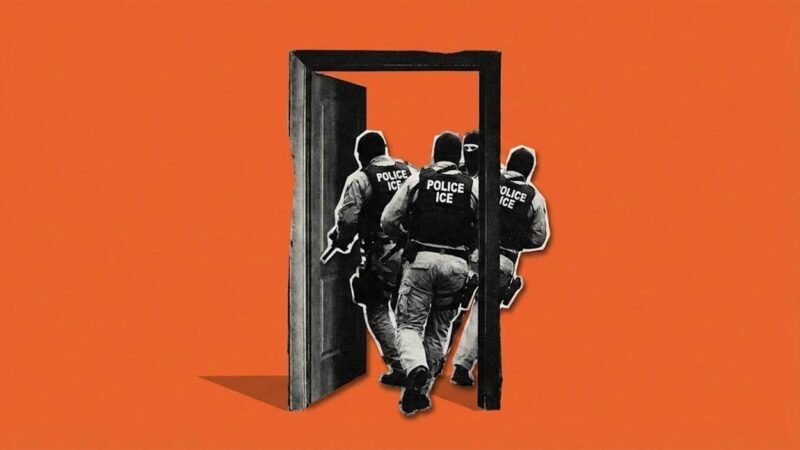
The right to be free from unreasonable search and seizure had an up-and-down sort of year at the U.S. Supreme Court. Back in May, the Court delivered a 9–0 decision that left civil libertarians cheering for its expansion of constitutional safeguards. But in September, a 6–3 Court left civil libertarians seething over the constitutional wrongs the majority was willing to countenance. Let's review what turned out to be an erratic year in Fourth Amendment law.
First, the good news. In May's Barnes v. Felix, the Supreme Court unanimously rejected a legal standard governing the use of force by law enforcement that, as Justice Elena Kagan's majority opinion put it, told courts to look "only to the circumstances existing at the precise time an officer perceived the threat inducing him to shoot."
That approach "improperly narrow[ed] the requisite Fourth Amendment analysis," Kagan held. "To assess whether an officer acted reasonably in using force, a court must consider all the relevant circumstances, including facts and events leading up to the climactic moment."
The facts and events leading up to an officer's split-second decision to use force may include many pieces of relevant information, including whether the officer's own poor judgment or improper tactics helped to foster (or to create) the deadly situation. Yet the "moment of threat" rule told the courts to pay no heed to such important info. By rejecting this rule, the Supreme Court ensured that law enforcement would be governed by a more robust Fourth Amendment standard. It was a good day for civil liberties.
Now for the bad news. In September's Noem v. Perdomo, the Supreme Court lifted a lower court order that had blocked the Trump administration from employing "likely" unconstitutional tactics as part of its roving immigration crackdowns.
According to the U.S. Court of Appeals for the Ninth Circuit, federal immigration officials likely violated the Fourth Amendment rights of multiple U.S. citizens in the greater Los Angeles area by seizing them based solely on such illegal factors as their "apparent race or ethnicity," or the fact that they were "speaking Spanish or speaking English with an accent."
But the Supreme Court, in an unsigned emergency order that offered no legal rationale, lifted the block and allowed the Trump administration to resume such tactics. Justices Kagan, Sonia Sotomayor, and Ketanji Brown Jackson dissented from that order.
Only one of the six justices who favored the order actually explained why. Writing in concurrence, Justice Brett Kavanaugh asserted that such racial profiling by immigration agents deserved a judicial green light because it is "common sense" to seize people based on "relevant factors" such as their "apparent ethnicity" or that they "gather in certain locations to seek daily work."
To make matters worse, Kavanaugh was apparently untroubled by the obvious threat such tactics posed for those U.S. citizens who were ensnared in the dragnet based on their "apparent ethnicity." "As for stops of those individuals who are legally in the country, the questioning in those circumstances is typically brief," Kavanaugh asserted, "and those individuals may promptly go free after making clear to the immigration officers that they are U.S. citizens or otherwise legally in the United States."
The facts on the ground contradict Kavanaugh's breezy assertions. For example, as Reason's Autumn Billings has reported, a U.S. citizen and Iraq War veteran named George Retes "was detained by Immigration and Customs Enforcement (ICE) and other federal agencies for three days and nights despite telling officers he was an American citizen and his identification was in his nearby car." Similarly, as Reason's C.J. Ciaramella has detailed, the Alabama construction worker Leo Garcia "is challenging the Trump administration's warrantless construction site raids after he says he was arrested and detained by federal immigration agents—twice—despite being a U.S. citizen with a valid ID in his pocket."
So much for harmless "brief" encounters from which citizens "may promptly go free." These "Kavanaugh stops," as some critics have taken to calling them, illustrate the utter disregard that Kavanaugh and some of his colleagues have shown for the right to be free from unreasonable search and seizure regardless of skin color.
Let's hope the new year brings gladder tidings for the Fourth Amendment.




