

Refusing To Let Trump Deploy the National Guard in Chicago, SCOTUS Adds a New Wrinkle To the Debate
The justices suggested the president is misinterpreting "the regular forces," a key phrase in the statute on which he is relying.
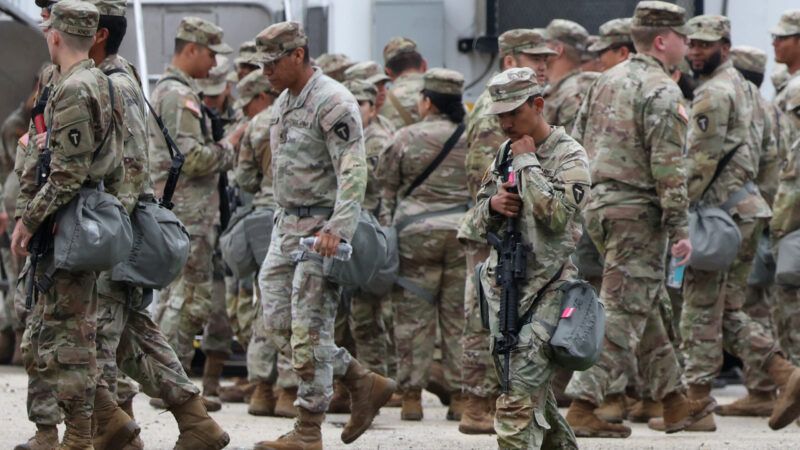
The Supreme Court yesterday declined to let President Donald Trump deploy federalized National Guard members in the Chicago area to protect immigration agents and facilities from protests that have sometimes turned violent. Although the decision is preliminary, it casts serious doubt on the broad authority that Trump has claimed under 10 USC 12406, which allows him to "call into Federal service members and units of the National Guard of any State" in specified circumstances.
As relevant here, the third subsection of that law permits federalization when the president is "unable with the regular forces to execute the laws of the United States." Trump has invoked that provision to justify National Guard deployments in California, Oregon, and Tennessee as well as Illinois. While litigation over those deployments has mainly involved the question of what it means to say the president is "unable" to enforce federal law, the Supreme Court's ruling in Trump v. Illinois focuses on a different issue: What are "the regular forces"?
U.S. District Judge April Perry addressed that question after Illinois challenged Trump's use of National Guard personnel from Illinois and Texas to assist his immigration crackdown in Chicago. When Perry issued a temporary restraining order (TRO) against that deployment on October 10, she cited "several historical sources" indicating that "the phrase 'regular forces' was understood at the time of enactment to mean the soldiers and officers regularly enlisted with the Army and Navy, as opposed to militiamen who did not make it their livelihoods to serve their country but instead took up arms only when called forth in times of national emergency."
Trump "made no attempt to rely on the regular forces before resorting to federalization of the National Guard," Perry noted. "Nor do Defendants argue (nor is there any evidence to suggest) that the President is incapable with the regular forces of executing the laws. Therefore, the statutory predicate contained within Section 12406(3) has not been met on that basis alone."
The Trump administration asked the U.S. Court of Appeals for the 7th Circuit to block Perry's TRO while the case was pending, and it declined to do so on October 16. Although the 7th Circuit's decision did not discuss the meaning of "the regular forces," the Supreme Court expressed interest in that issue after the Trump administration asked the justices for a stay. In supplemental briefs, U.S. Solicitor General D. John Sauer argued that "the regular forces" refers to civilian law enforcement officers, while Illinois Solicitor General Jane Notz urged the Court to accept Perry's reading.
Six justices thought Illinois had the better of that argument. "We conclude that the term 'regular forces' in §12406(3) likely refers to the regular forces of the United States military," five of them say in an unsigned ruling. "This interpretation means that to call the Guard into active federal service under §12406(3), the President must be 'unable' with the regular military 'to execute the laws of the United States.' Because the statute requires an assessment of the military's ability to execute the laws, it likely applies only where the military could legally execute the laws."
Such circumstances "are exceptional," the majority notes. The Posse Comitatus Act prohibits the use of the regular armed forces "to execute the laws" except in situations where it is "expressly authorized" by the Constitution or an act of Congress. The implication, the Court says, is that "before the President can federalize the Guard under §12406(3), he likely must have statutory or constitutional authority to execute the laws with the regular military and must be 'unable' with those forces to perform that function."
At this stage of the case, the government "has failed to identify a source of authority that would allow the military to execute the laws in Illinois," the majority says. "The President has not invoked a statute that provides an exception to the Posse Comitatus Act. Instead, he relies on inherent constitutional authority that, according to the Government, allows him to use the military to protect federal personnel and property. But the Government also claims—consistent with the longstanding view of the Executive Branch—that performing such protective functions does not constitute 'execut[ing] the laws' within the meaning of the Posse Comitatus Act. If that is correct, it is hard to see how performing those functions could constitute 'execut[ing] the laws' under §12406(3)."
Justice Brett Kavanaugh agreed with the majority that "the statutory term 'regular forces' likely refers to the U.S. military, not to federal civilian law enforcement officers." And since Trump has not "made the statutorily required determination" that he is "unable" to "ensure the execution of federal law in Illinois" with "the U. S. military," Kavanaugh says in an opinion concurring in the judgment, the majority was right to deny the application for a stay. But he adds that the Court did not need to go further than that by implying that such a determination might not be sufficient in light of the limits imposed by the Posse Comitatus Act.
Justice Samuel Alito, joined by Justice Clarence Thomas, faults the majority for considering an issue—the meaning of "the regular forces"—that was not initially raised by either party. Alito also questions the majority's "tentative view" that the phrase "execute the laws of the United States" in Section 12406 does not encompass "protective functions" such as "preventing potentially lethal attacks on civilian federal law enforcement officers or the takeover or destruction of Government facilities." And he suggests that the president's "inherent constitutional authority to protect federal officers and property" should be "sufficient to justify the use of National Guard members in the relevant area for precisely that purpose."
In a separate dissent, Justice Neil Gorsuch notes that "in their initial briefing before this Court," both sides "proceeded on the premise that §12406(3) statutorily permits the President to call up and deploy the National Guard when he is unable to execute
federal law with civilian federal law enforcement officials." Based on that premise, he says, statements from federal officials about the impact of protests on immigration law enforcement should be enough to grant a stay.
Perry found those declarations unpersuasive. "There is evidence of protests, some of which have included acts of violence," she wrote. "There is also evidence of property destruction, and discrete groups who have attempted to impede DHS [Department of Homeland Security] agents. At the same time, there is significant evidence that DHS has not been unable to carry out its mission. All federal facilities have remained open. To the extent there have been disruptions, they have been of limited duration and swiftly controlled by authorities." She added that "federal immigration officials have seen huge increases in arrests and deportations," which she thought also undermined the claim that they were "unable" to enforce U.S. law.
The Supreme Court's ruling adds a new wrinkle to this familiar debate about how much disruption is necessary to invoke Section 12406. If "the regular forces" refers to the military, as Perry and six justices thought likely, the requirements for federalizing the National Guard under that law may be considerably stricter than the Trump administration argues.
In any case, the Supreme Court clearly does not accept Trump's claim that there is no role for judicial review in determining when he can deploy the National Guard. "The President's decision whether to federalize the Guard is not subject to second-guessing by the State of Illinois or a federal district court," Sauer argued in his application for a stay. "Such decisions are committed to the discretion of the President and are unreviewable."
If that were true, we would not be having this conversation about the meaning of Section 12406. That debate assumes the courts have a duty to interpret the law and determine whether the president is complying with the constraints imposed by Congress.




