
Tariffs Are Leaving Fewer Footballs, Golf Clubs, and Toys Under the Christmas Tree
Plus: College Football Playoff complaints and an awful NFL officiating blunder.
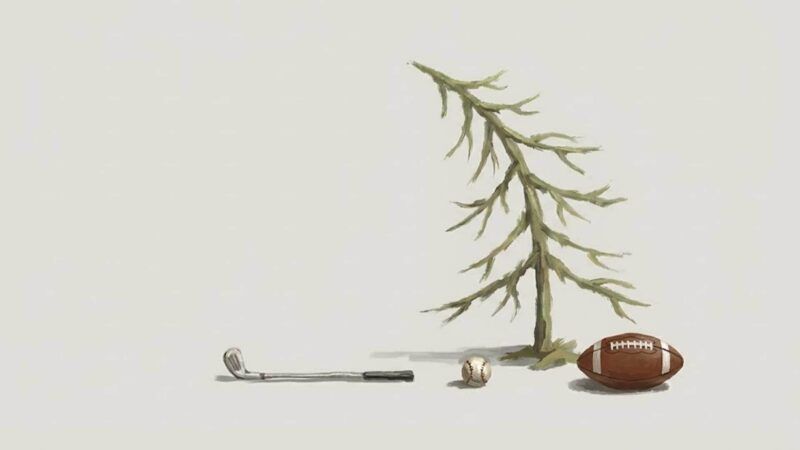
Hello and welcome to another edition of Free Agent! It's still not too late to break out your ugly Christmas sweaters and coordinate with your friends.
Is Christmas ruined because of tariffs? Probably not, because the true meaning of Christmas isn't what's under the tree, it's what's in your heart (cue awful movie soundtrack). We'll talk about tariffs and prices on sporting goods anyway, then close with quick hits on the College Football Playoff and NFL officiating.
Don't miss sports coverage from Jason Russell and Reason.
Locker Room Links
- The Kansas City Chiefs are moving to Kansas. Lamar Hunt is either rolling over in his grave or proud of his son for bilking taxpayers like he did 50-plus years ago when Lamar moved the team to Missouri from Dallas. Don't worry, it won't cost taxpayers anything. (Why is it only stadium funding projects that get this ridiculous claim?)
- Meanwhile, the Bears are threatening to move to northwest Indiana if they don't get enough government help to stay in Chicago or the suburbs. (Every other Chicago team, except the White Sox, isn't asking for government help.)
- Tiger Woods makes more money as a player-director for the PGA Tour than its commissioner makes from the tour.
- Why don't NFL coaches guard their call sheets more closely from TV cameras? J.J. Watt has the answer.
- The Caribbean Series for baseball moved to Mexico from Venezuela because of "geopolitical tensions."
- "How 2025 Became the Year of the College Sports FOIA Request"
- Elsewhere in Reason, a new documentary: Deplatforming Backfired
- Merry Christmas!
Whoever decided to play Feliz Navidad during this scrum deserves a raise. Incredible video with that music pumping in the background pic.twitter.com/OnDwY9UHt5
— Ryan Whitney (@ryanwhitney6) December 17, 2025
Christmas Clubs
I've been dipping my toes into Full Swing, Netflix's docuseries on professional golfers. Apparently every golfer worth featuring these days has a cute home video of them unwrapping a set of toy golf clubs when they were a toddler (important to keep this in mind if you have PGA Tour aspirations for your child—don't forget to save the video for Netflix in 25 years).
But there might be fewer sets of toy golf clubs underneath the Christmas tree this year than last year—and real golf clubs, for that matter. If you look at graphs of prices for toys, sporting goods, and similar categories, there's a clear trend: prices falling throughout 2024 and at the start of 2025—until tariff chaos came into play in April, causing prices to spike. Unlike the rest of the economy, at least prices in these areas have started to drop again, though they're still well above their March 2025 levels.
From March 2024 to March 2025, the prices of sporting goods fell 5 percent, according to the Bureau of Labor Statistics (BLS). But since March 2025, they're up 2.9 percent. The difference is even more stark for "sports vehicles including bicycles," as the BLS defines it: Prices dropped 7 percent from March 2024 to March 2025, then spiked 5.7 percent since then. Tariffs are hitting sports especially hard—those price increases since March 2025 are well above the 1.7 percent inflation seen in the rest of the economy.
As I wrote on April 8 just after President Donald Trump's shocking "Liberation Day" tariff announcement: "The clearest victim in the sports world are sporting goods companies: Nike, Adidas, and Puma stocks are all down 10-plus percent in the last five days of stock market trading, as of Monday's close. The same is true of Amer Sports—headquartered in Finland but owned by a Chinese conglomerate, they own some well-known brands like Wilson, Louisville Slugger, and Arc'teryx. Golf brands have been hit too, with similar losses for Acushnet Company (Titleist, FootJoy) and Topgolf Callaway Brands. Those are all worse than the 9.4 percent drop in the Dow Jones over the last five days."
The record on those stocks since then is mixed (hope you don't have a bunch of Nike or Adidas stock!), but the amount of time passed since April makes it hard to clarify what's caused by tariffs and what's caused by overall company strategy.
Christmas morning still might have fewer presents under the tree, though. After dropping 1.5 percent from March 2024 to March 2025, toy prices have risen at the same rate (1.7 percent) as overall prices since then. But at least Amazon has a $28 set of toddler golf clubs for your future Scottie Scheffler, and they still might arrive on time if you order now.
Let Them In
Anyone who thought college football moving to a 12-team playoff would mean the end of bellyaching over the championship format was the wrongest wrong person who ever wronged in Wrongville (that's the state capital of Wrongtucky).
The whining continued after Tulane and James Madison University (JMU) made it into the College Football Playoff, thanks to being conference champions ranked over ACC champion Duke (the five best conference champions get a spot, but are no longer guaranteed a bye after last season). Tulane and JMU were promptly knocked out by Ole Miss and Oregon, respectively, in games that weren't particularly close.
Let's not pretend this year's playoff games were foregone conclusions, though. Tulane and JMU stood on the shoulders of midmajor giants like 2006 Boise State, 2008 Utah (then in the Mountain West conference), 2017 UCF, and even 2022 Tulane, which upset USC in that season's Cotton Bowl. JMU outscored Oregon 28–17 in the second half—Oregon acted like they'd lost.
If you're not a fan of a midmajor team, you might not realize that taking away a slot for just one in the playoff basically gives midmajor football teams nothing to play for. They play under the old ways, where every game feels like the playoffs, one loss might doom your season, and a second loss dooms you to playing Kennesaw State in the Myrtle Beach Bowl, even if you win your conference.
Is there a strong case to be made that the format should just be the 12 best teams ranked by the committee, regardless of conference championships or anything else? Absolutely. But again, the teams that were left out don't have the resume to claim they had the best regular season. The teams left out of Bowl Championship Series title games and four-team playoffs sometimes did.
So the best midmajor team deserves a shot at the big boys, and maybe the best-ranked big boy who's not getting a bye deserves a supposedly easier matchup, too.
Complaining about how the sport's national titles are decided is just an annoying part of college football's DNA. It's been part of the sport for as long as I've known it, and probably will be until the sport settles on a format that it can keep around for a couple of decades or more.
Ejected? Nope
My Lions aren't blaming the officials for their season-dooming loss to the Steelers on Sunday, and I'm not either (the defense and offensive line are another matter). But two incidents in the game show the need for more refereeing intervention from a "sky judge" who can help the busy officials on the ground, especially when they constantly have players, coaches, and fans chirping in their ears.
First of all, D.K. Metcalf hit a fan and got to stay in the game because the refs didn't see it. (His two-game suspension does the Lions no good.)
Statement from the NFL on the situation involving Steelers WR D.K. Metcalf, who threw a close-fisted punch at a fan sitting near the front row.
"There was no flag on the field, so New York cannot weigh in with regard to a potential disqualification."
— Nolan Bianchi (@nolanbianchi) December 21, 2025
That's ridiculous. It went viral in the middle of the game, and there was Metcalf, still making big plays in the fourth quarter. Does the NFL really want players to think, "It's OK if I hit a trash-talking fan in a big game as long as the referees don't see it"? How are outside officials not empowered to buzz down and say, "Hey, No. 4 on Pittsburgh is super ejected for hitting a fan"? It shouldn't matter if the next play has already happened, because an ejection-worthy offense is bad enough that it should be penalized whenever the refs are able to dish it out. Outside help for ejecting players is a no-brainer, especially when there are brawls on the field. Usually in a soccer league with a video assistant referee (VAR), for example, the VAR can intervene on any possible red-card offense.
The final play of the game was insane. Down five points, a Lions touchdown would have taken the lead—and they briefly seemed to have it after Amon-Ra St. Brown came up just short but then lateraled it to Jared Goff, who darted into the end zone as time expired. In the end, it was for naught since St. Brown got flagged for offensive pass interference.
Chaos in the final seconds in Detroit ???? pic.twitter.com/Q6BriP9Qv4
— NFL (@NFL) December 22, 2025
What ensued was a two-minute discussion by the officials (who, at least on the TV cameras, had thrown flags but never signaled for the touchdown). I spent those two minutes thinking how it would be very reassuring for fans and referees alike to have had some input from someone who was watching replays of the play, telling the officials on the field what had happened.
Of course, had there been no flag and had it been ruled a touchdown, everything except the lack of flags would have been reviewable. But maybe a sky judge could have helped the refs to start with.
The NFL needs this "to help save referees from themselves," as I wrote last month.
Replay of the Week
The two-point conversion that nobody, except the refs, initially thought was successful.
The luckiest 2-point conversion ever. This is called a backward pass and recovered in the endzone for a successful two-point try. Game is now tied.
What the heck. CRAZY. pic.twitter.com/rQo2wWbErp https://t.co/0nkKykHfmY
— Ari Meirov (@MySportsUpdate) December 19, 2025
That's all for this week. Enjoy watching the real game of the week, the Hawai'i Bowl on Christmas Eve (go 'Bows!).
