

More Republican Socialism
The Trump administration has not made a convincing case for why it is buying stakes in these companies—and why these companies in particular, rather than others.
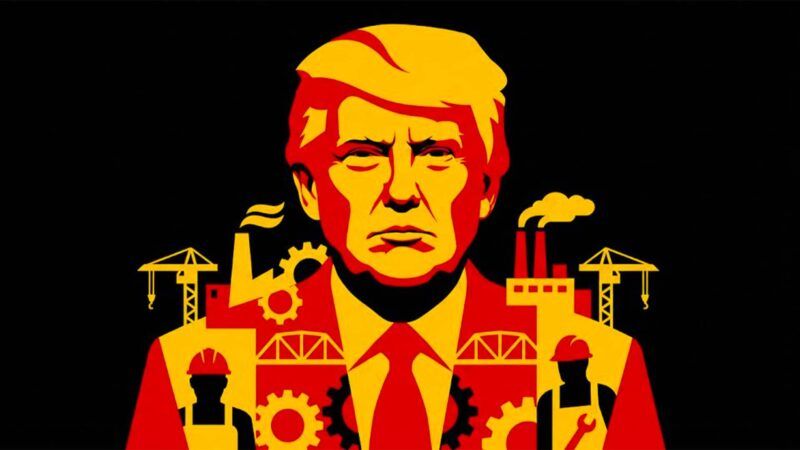
Like a kid in a toy store with a nearly unlimited supply of someone else's money, President Donald Trump is on a shopping spree the likes of which America has never seen.
With the announcements earlier this month that the federal government will take equity stakes in a company that makes advanced lasers and another that mines critical minerals, the Trump administration has now bought pieces of more than a dozen private companies. What began as an apparent effort to prop up stumbling giants like U.S. Steel and Intel has quickly morphed into a recurring, even routine, behavior. And it is all happening without even an attempt at getting congressional authorization.
As I detailed in a recent cover story for Reason, this pivot towards a more aggressive form of state capitalism is a risky experiment that involves more central planning, invites more corruption, and risks both taxpayer dollars and vital sectors of the economy. Even amid the Trump administration's many other intrusions into the private economic sphere—tariffs, attacks on independent media outlets, and so on—the rapid acquisition of shares in so many private companies has been astonishing.
Since that article was published a few weeks ago, there has been a whirlwind of additional acquisitions. In November, the White House announced a $750 million investment (with funds coming from the Pentagon and the Commerce Department) in Vulcan Elements, a North Carolina-based company that makes advanced magnets. In return, the government is taking a $50 million equity stake in the company and an unspecified "warrant" that allows the government to buy stock in the company. An $80 million deal with ReElement Technologies, which is also involved in the supply chain for rare earth minerals, was announced at the same time.
This month, the White House announced that it was taking a 10 percent stake in Korea Zinc, which is building a new plant in Tennessee. The Trump administration is also taking an undisclosed equity stake in xLight, a Silicon Valley startup that will receive $150 million from taxpayers via the CHIPs and Science Act. The company is attempting to compete with the Dutch firm ASML, which is currently the only manufacturer in the world producing the ultra-violet lithography machines capable of making high-end semiconductor chips.
Meanwhile, the Trump administration also granted permission to Nvidia to sell its most advanced chips to buyers in China—but only after the company agreed to pay 25 percent of the profits from those sales to the federal government. That ought to raise some questions. Do the Trump administration's worries about the national security value of rare earth minerals and high-end technology simply vanish if a private company is willing to pay a big enough bribe?
There's no doubt that many of these companies do important work in critical parts of the economy, and that producing more rare earth minerals and semiconductors will strengthen America's economy and national security. And there is certainly a long history of the federal government propping up, subsidizing, and protecting businesses for political reasons.
What's happening now is fundamentally different. As Scott Lincicome writes in The Dispatch, previous subsidies and other forms of protectionism were "offered broadly, provided at arm's length, and authorized by law. They're also relatively insulated from ongoing government involvement and oversight: Washington doesn't interest itself in a firm's public share price or day-to-day business—sales, purchases, factory locations, etc.—beyond (perhaps) ensuring that the company complies with terms of a government contract or subsidy agreement. Trump's state corporatism fundamentally differs from these policies in that it empowers (if not requires) the government to be involved in a specific company's routine operations and to care deeply about the firm's ultimate success or failure."
Indeed, the Trump administration has not made a convincing case for why it is buying stakes in these companies—and why these companies in particular, rather than others. At a minimum, it should make that case to Congress and get congressional authorization for these purchases. If American taxpayers are going to be equity stakeholders in more than a dozen private companies, their elected representatives ought to approve that.
Unless Congress demands such a thing, there's unlikely to be much resistance to Trump's new state capitalism. That's because the companies involved in these deals seem eager to go along.
"State capitalism is a two-way street. Many businesses, by aligning themselves with Trump's agenda, elicit better treatment—in their ability to sell to China, the tariffs they pay, how they are regulated, and what mergers are allowed," wrote Greg Ip, The Wall Street Journal's chief economics commentator, in a recent piece about how CEOs are navigating Trump's state capitalism. "In other words, state capitalism doesn't just serve the interests of the state, but of favored capitalists."
And the Trump administration does not seem likely to place its own limits on this behavior. Asked recently about the logic behind these acquisitions, Trump said, "We should take stakes in companies when people need something." That's an answer that lacks any limiting principle.
A powerful executive branch unrestrained by Congress, precedent, or principle will only keep growing. The past few months have shown that even vague claims of "national security" are enough to establish a new and dangerous norm that allows presidents to insert themselves in the management of private companies. It would be surprising if this trend does not continue.

Editor's Note: As of February 29, 2024, commenting privileges on reason.com posts are limited to Reason Plus subscribers. Past commenters are grandfathered in for a temporary period. Subscribe here to preserve your ability to comment. Your Reason Plus subscription also gives you an ad-free version of reason.com, along with full access to the digital edition and archives of Reason magazine. We request that comments be civil and on-topic. We do not moderate or assume any responsibility for comments, which are owned by the readers who post them. Comments do not represent the views of reason.com or Reason Foundation. We reserve the right to delete any comment and ban commenters for any reason at any time. Comments may only be edited within 5 minutes of posting. Report abuses.
Please to post comments
Where is Trump getting money to do this? I thought Congress controlled the purse?
Trump's billionaire backers control the purse strings. They also control Congress - and the various poodles that make this all happen.
The real question is - how is Trump going to personally profit from this? He certainly is - and the media is certainly nowhere to be seen on any of this.
It is being done illegally.
Boom!
https://legalinsurrection.com/2025/12/judge-hannah-dugan-found-guilty-of-obstructing-immigration-agents-faces-prison-time/
fTA:
found guilty of a felony count of obstructing federal agents seeking to make an immigration arrest outside her courtroom, a precedent-setting case that has been closely watched nationally and drawn passionate protests.
A jury of seven men and five women deliberated more than six hours before delivering a split verdict. They found the judge not guilty on a lesser misdemeanor charge of concealing a wanted person.
I don't really care about this particular judge but I really hope she does some time in a federal penitentiary. Judges are by far the most arrogant actors in the Republic and I'd like to see a lot of them in jail.
Things were so much better when Congress just dumped trillions into Green startups that filed chapter 11 nine months later.
Has Eric ever read a history book or have a dictionary? My guess is no as he doesnt understand what socialism actually means.
I will once again state that the regulations reason largely ignore have far more control than an equity exchange for money. Giving away hundreds of billions while congress, see Pelosi, gives money away is worse. Funding supply chain risk is literally the least of my concerns.
But dependency on china seems to be Eric's primsry concern.
If Biden had done this, you'd be yelling SOCIALISM from the rooftops.
Hypocrite of the first water, you are. Like the idiots that claim Nazis weren't socialists because they only controlled companies, they didn't own them. No doubt you claim this isn't socialism because the government doesn't own a controlling interest.
Hypocrites, the lot.
This is outrage Fascism, as Mussolini defined Fascism. And Fascism is indeed a form of Socialism. State control of the means of production.
That it is not a "controlling" share is irrelevant. A 10% share in in an entity means they have the effective leverage to direct the firm to the State's ends.
Again, if Biden did this the conservatives would be screaming "Socialism!"
Fascism is only a form of socialism if socialism is defined as everything outside the Venn diagram of ancap. In this particular issue - fascism and what is happening now re Trump/US is corporatism - government of by and for the corporate owners of property. The people - the collective - the 'social' - - even the bureaucrats - has fucking NOTHING to do with any of this. This is more like pure plutocracy with a veneer of whitewash to bafflegab everyone who might ask questions or think that govt is of/by/for people/social/bureaucrats/collective/whatever.
Socialism is where the government owns the means of production. This is most defiantly socialist.
Trump pretends to be a conservative but proves otherwise.
He also pretends to oppose censorship, unless of course it comes from his administration.
A little ideological consistency would be nice..
In December 2008, President George W. Bush approved an emergency $17.4 billion loan package to rescue the struggling U.S. auto industry,
Reagan generally opposed industrial policy, his administration did support certain programs that indirectly funded industry, particularly through research and development.
Afraid to use the S-word?
Forgotten Reagan's "deal" with the Japanese auto industry?
Hypocrite.
maybe you can hand wave away this stupid shit now cuz trump believes ostensibly in making money and meritocracy ... but the next time the democrats are in charge they will try to take a government stake in every hospital and urgent care center in order to ration healthcare by an intersectionality score
You mean like ACA subsidizing insurers directly?
Try answering the question, hypocrite.
Should we add Obama and Biden's Green energy give aways or the multi-billion dollar gift Obama gave to GM? A NON-VITING stake in GM may not be worth the full investment amount but it would have been a sight more than the $0.00 Obama traded billions in taxpayer money for.
Can we add the directed verdicts both Obama and Biden funnelled into leftist organizations instead of to the treasury or injured parties...what is this worrying about next time when they're already so far past that.
Yes, all socialists. Go back to Woodrow Wilson. Go back earlier.
Non-voting means non-controlling you imbecile. How does non-controlling jive with socialism where the entire point is control?
They control the laws that govern the company. Do you trust the state to not give advantages/contracts to themselves rather than competitors? Selling critical chips to China is illegal...with one exception...
Man do I miss the days of the Tea Party, which formed when George Bush was saying, "I had to abandon free market principles in order to save the free market system."
Now instead Republicans defend this shit.
Trump stealing partial ownership of companies is something that should scare anyone.
If these companies fail economically, will the Trump regime allow them to go bankrupt so that their assets will be redeployed by people who by having the money to buy the bankrupt companies indicate that they probably are better than the previous owners at managing assets productively? Or will the Trump regime use subsidies and regulatory favoritism to avoid admitting failure?
If the Trump regime does not allow the bankruptcy of its favored companies, the Trump regime will thwart one of the major causes of the greater growth and productive efficiency of free market systems versus other economic systems. Reducing productivity directly hurts military potential, among other things. This is not putting America first.


