

Americans Need More and Better 'Third Places.' User Fees Can Help.
As traditional gathering places disappear, market-based funding could expand parks, courts, and other spaces that help people reconnect without raising taxes.
America is lonelier than ever. Recent surveys find that nearly half of Americans report feeling lonely, and 21 percent express experiencing "serious loneliness." Close friendships are also in free fall across the country. In 2021, the American Enterprise Institute's Survey Center on American Life found that close friendships have "declined considerably over the past several decades," with 12 percent of Americans reporting "they did not have any close friends."
Documented causes of this loneliness epidemic include social media and the rise in remote work, mental health challenges, and the decline of what sociologist Ray Oldenburg famously called "third places"—the spaces beyond home and work where people meet and connect.
Historically, churches, fraternal organizations, and even bowling leagues functioned as third places where people found connection. Such institutions are now in steady decline, but the demand for connection is not. Now, Americans are turning to recreational amenities such as pickleball courts and dog parks to fill the void that traditional institutions once met.
But the supply of these new third places has failed to keep pace. As our lonely society searches for connection, America desperately needs more of these spaces, and at sufficient quality to attract and sustain demand. One tool long championed by libertarians could help close this gap: user fees.
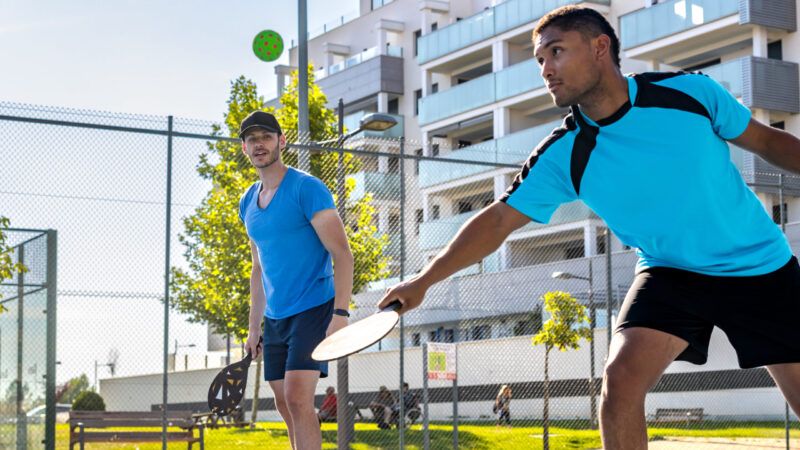
Consider pickleball, which has been America's fastest-growing sport for four consecutive years. Nearly 20 million Americans played the paddle sport in 2024, a 311 percent increase since 2021. Its distinctive "open play" format brings strangers together on public courts, fostering the kind of social interaction needed to combat loneliness. As writer and pickleball player Mitch Dunn says, the pickleball court is "a Third Place where we meet new people, collaborate with them, and leave wanting to do it all over again as soon as possible."
But even pickleball courts are in short supply. Despite adding 18,000 new courts in 2024, major metropolitan areas remain underserved. New York, Los Angeles, and Chicago all sit roughly 90 percent below national averages for dedicated court density, according to data from the Sports and Fitness Industry Association. The result is overcrowded facilities and frustrated players—hardly a recipe for fostering the relaxed social atmosphere that makes third places work.
User fees offer municipalities a way to expand these amenities without further straining the public fisc. Earlier this year, Burlington, North Carolina, opened a pickleball complex featuring 17 courts. The complex is operated by the city using a blended funding system of member and non-member user fees. For a $20 monthly fee, members get advanced court reservations and free use of the ball machine, while non-members can access the courts for a $3 entry fee. Other cities are implementing similar systems.
The possibilities extend far beyond pickleball. Dog parks have come to play a similar community-building role. In an analysis of Dallas-area parks, researcher Lori Lee concluded that dog parks qualify as third places that "encourage people to discard passive imitations of life to take part actively." Whereas alcohol historically acted as a social lubricant in many third places, such as the local tavern, Lee argues that dogs increasingly act as a new type of social stimulant by encouraging humans to talk to each other and swap pet stories. Unfortunately, dog parks face their own funding shortfalls across the country.
Public swimming pools offer another example, but more and more are closing as local governments face chronically underfunded parks and recreation budgets. The same is true for trails and other outdoor amenities, which are increasingly operating as third places.
The economic logic of user fees is straightforward: Fees are incurred by those who directly benefit from the service, rather than taxing the general population. And when revenues are retained and reinvested in those services, it creates a virtuous cycle—more users means more funding for improvements, which attracts still more users. Reason Foundation and other free market organizations, such as the Property and Environment Research Center, have long championed such user-pays-user-benefits models. This concept could easily extend to municipal park systems to fund the amenities most desired by the local community.
Of course, markets are already responding to America's demand for social recreational spaces. Private pickleball clubs are proliferating, as are mountain biking trails and hiking destinations on privately owned lands. But voters still expect many recreational opportunities to be provided publicly. Even within this constraint, user fees offer a productive path forward.
The approach addresses multiple policy goals simultaneously. User-fee models could help reduce property taxes by shifting recreational costs from general revenues to direct beneficiaries. They also create sustainable funding streams that are less susceptible to politically motivated appropriations. They generate resources not only to build more parks, trails, and recreation facilities, but also to improve their quality so they attract more Americans seeking to escape their screens and rediscover community.
Embracing user fees could increase the supply of third places without tax hikes or unnecessary growth in government coffers. In turn, Americans could gain access to forums in which they can get off their smartphones, connect with other human beings, and maybe even make a friend or two along the way.




