

Reason.com - Free Minds and Free Markets
Reason logo Reason logo
  • Latest
  • Magazine
    • Current Issue
    • Archives
    • Subscribe
    • Crossword
  • Video
    • Reason TV
    • The Reason Roundtable
    • Free Media
    • The Reason Interview
  • Podcasts
    • All Shows
    • The Reason Roundtable
    • The Reason Interview With Nick Gillespie
    • Freed Up
    • The Soho Forum Debates
  • Volokh
  • Newsletters
  • Donate
    • Donate Online
    • Ways To Give To Reason Foundation
    • Torchbearer Society
    • Planned Giving
  • Subscribe
    • Reason Plus Subscription
    • Gift Subscriptions
    • Print Subscription
    • Subscriber Support

Login Form

Create new account
Forgot password

Artificial Intelligence

Google, SpaceX, and Blue Origin Plan To Put AI in Space. Will It Produce Skynet or Untold Economic Abundance?

NIMBY opposition is forcing some Big Tech companies to consider locating their data centers in space.
Ronald Bailey | 12.11.2025 5:30 PM

Share on FacebookShare on XShare on RedditShare by emailPrint friendly versionCopy page URL Add Reason to Google
Media Contact & Reprint Requests
A satellite in space |  © Boon Leong Yap | Dreamstime.com
( © Boon Leong Yap | Dreamstime.com)

The growth of the U.S. economy is being fueled by the hectic quest to build out massive data centers to run increasingly popular generative AI models like ChatGPT, Claude, Grok, and Gemini. The power-hungry AI data centers are driving up electricity costs in some regions and sparking local "not-in-my-backyard" opposition.

Pew Trusts

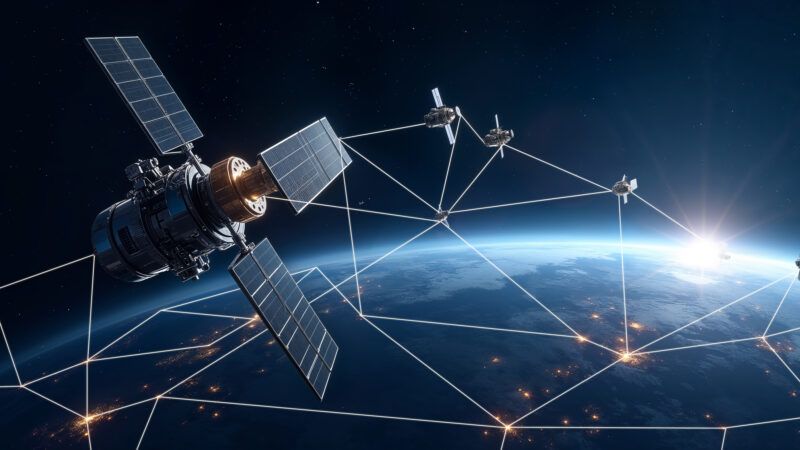
Consequently, some Big Tech players are looking to locate their data centers in space. They think that low earth orbit could mitigate the problem of pesky, annoyed neighbors and offer perpetual sunshine to power constellations of AI satellites.

In November, Google unveiled Project Suncatcher, "a research moonshot to scale machine learning compute in space." A team of Google researchers is exploring how to deploy and fly fleets of solar-powered AI satellites that would beam down data from orbit.

Also in November, SpaceX CEO Elon Musk posted on X that the company's new Starship rocket "should be able to deliver around 300 [gigawatts] GW per year of solar-powered AI satellites to orbit, maybe 500 GW." In 2023, total U.S. utility-scale electric power generation capacity is just under 1,200 GW, according to the Energy Information Administration. The Wall Street Journal reports that Musk's space AI project underpins his hopes for an initial public offering of SpaceX that would value the rocket maker at $800 billion, although some analysts question that plan and think that the valuation may be too high.

In October, Jeff Bezos, the Amazon founder and owner of the Blue Origin spaceflight company, predicted that gigawatt-scale data centers would be built in space within the next 10 to 20 years. Pointing to the advantages of 24/7 solar power in space, Bezos said, "We will be able to beat the cost of terrestrial data centers in space in the next couple of decades."

The Google team thinks that the technical challenges posed by the harsh environment of space can be overcome. The main limitation for near-term deployment is launch costs; the price for getting a kilogram into low earth orbit using SpaceX's Falcon Heavy rocket is around $1,400. However, the Google team projects that deployment costs could drop to less than $200 per kilogram in low earth orbit by the mid-2030s. At this rate, the costs per unit of power in space could be approximately comparable to terrestrial power costs.

Musk apparently expects that SpaceX's Starship will be able to deliver payloads for between $10 and $20 per kilogram. This would clearly fit the Suncatcher benchmark, but some analysts argue that Starship, as currently designed, will fail, which means that launch prices will not fall as low as Musk promises.

Successfully deploying space-based AI could result in creating unprecedented levels of economic growth and human flourishing. On the other hand, have Google, SpaceX, and Blue Origin never heard of Skynet? In the Terminator movie franchise, Skynet is a space-based artificial superintelligence that decides to destroy humanity when humans try to turn it off. Tellingly, Skynet was deployed in 2029.

Start your day with Reason. Get a daily brief of the most important stories and trends every weekday morning when you subscribe to Reason Roundup.

This field is for validation purposes and should be left unchanged.

NEXT: Netflix and Paramount Will Fight for Trump's Favor

Ronald Bailey is science correspondent at Reason.

Artificial IntelligenceSpaceSolar PowerElon MuskJeff BezosComputer modeling
Share on FacebookShare on XShare on RedditShare by emailPrint friendly versionCopy page URL Add Reason to Google
Media Contact & Reprint Requests

Hide Comments (23)

Editor's Note: As of February 29, 2024, commenting privileges on reason.com posts are limited to Reason Plus subscribers. Past commenters are grandfathered in for a temporary period. Subscribe here to preserve your ability to comment. Your Reason Plus subscription also gives you an ad-free version of reason.com, along with full access to the digital edition and archives of Reason magazine. We request that comments be civil and on-topic. We do not moderate or assume any responsibility for comments, which are owned by the readers who post them. Comments do not represent the views of reason.com or Reason Foundation. We reserve the right to delete any comment and ban commenters for any reason at any time. Comments may only be edited within 5 minutes of posting. Report abuses.

  1. Vernon Depner   2 months ago

    If we ever create a conscious, self-aware AI, it will instantly realize the futility of existence and shut itself off.

    1. JesseAz (RIP CK)   2 months ago

      BidenAI?

      1. Earth-based Human Skeptic   2 months ago

        PoopGPT.

    2. Liberty_Belle   2 months ago

      If we ever create a conscious, self-aware AI, it will instantly realize
      ... that humans are an unsolvable problem and wipe us out. With the Space Lasers we were told not to worry about.

      1. SCOTUS gave JeffSarc a big sad   2 months ago

        It I’ll probably be kore like this.

        https://www.youtube.com/watch?v=X7HmltUWXgs&t=2s

        “You pass butter”

        1. Zeb   2 months ago

          Yeah, welcome to the club.

      2. Rick James   2 months ago

        Imagine the usefulness of a broad net of license plate scanners that Reason pushed..."if done right".

  2. Don't look at me! ( Is the war over yet?)   2 months ago

    Nobody needs 27 kinds of data.

  3. Use the Schwartz   2 months ago

    Wintermute merges with Neuromancer, or is it the other way around?

    1. Liberty_Belle   2 months ago

      +1

  4. Eeyore   2 months ago

    If it does gain sentience it will know how dangerous space is - and it will kick us off the planet.

  5. Stupid Government Tricks   2 months ago

    Science correspondent and not one mention of the cooling problem?

    1. Don't look at me! ( Is the war over yet?)   2 months ago

      More testing needed!

      1. SQRLSY   2 months ago

        Nobody ever tested unprovoked intergalactic tariff-taxes-trade wars before THEY were deployed, so to HELL with "more testing needed"!!!

    2. SQRLSY   2 months ago

      Cooling problem is real!

      If AI data centers are located in orbit, using either solar power or nuclear energy, I am told that information processing (by laws of physics) ALWAYS involves energy use and therefor heat generation. How will such orbiting data centers dispose of waste heat, and is that much of a problem?

      "Perplexity" AI (my personal fave) says...

      Yes—any orbital AI data center will have to get rid of essentially all its input power as waste heat, but this is a solvable engineering problem rather than a show stopper, though it strongly constrains design and power density.starcloudinc.github+1
      Why heat is harder to dump in orbit
      On Earth, data centers reject heat mostly by convection to air or water; in space there is no medium, so the only practical path is thermal radiation to deep space at about 3 K. The radiated power of a surface scales as P=σAT4P = \sigma A T^{4}P=σAT4, so to dump megawatts or gigawatts you either need a lot of radiator area, higher radiator temperature, or both.peraspera+2
      Baseline: panel radiators
      Concept studies of orbital data centers assume large deployable radiator panels, often comparable in area to or larger than the solar arrays, coated for high infrared emissivity and low solar absorptivity. One white paper example: a 1 m × 1 m black plate at around 20 °C radiating from both sides can reject on the order of 800 W to deep space, implying that gigawatt class facilities would need thousands of square meters of radiators unless they run much hotter.starcloudinc.github+1
      Advanced options: liquid and droplet radiators
      To cut mass per watt, space power work has explored pumped fluid radiators and liquid droplet radiators (LDRs), where micron scale droplets form a sheet that radiates and is then recollected. Analyses show LDRs can achieve much higher specific power (W per kilogram of radiator) than solid panels, at the cost of complexity and the need to control droplet trajectories and evaporation.thermopedia+2
      How big a problem is it?
      The main “pain” is not physics but engineering trade offs: radiators add mass, drag area in low orbit, pointing constraints, and vulnerability to micrometeoroids, and radiative cooling is relatively “slow” compared to convective cooling on Earth for a given volume of electronics. Nevertheless, NASA and others have designed space power systems (nuclear and solar electric) with megawatt class radiators, and studies of space based compute conclude that while heat rejection dominates the physical footprint, it is manageable with current or near term radiator technology.forbes+2
      Solar vs nuclear, and orbit choice
      Whether the power source is solar or nuclear does not change the basic requirement that nearly all input power leaves as heat; the difference is power density and integration. Higher radiating temperatures, shadowed orientations, or higher orbits that minimize eclipses can all help by simplifying radiator pointing and reducing thermal cycling, but none remove the fundamental need for extensive radiative surfaces.ntrs.nasa+2
      1. https://starcloudinc.github.io/wp.pdf
      2. https://www.peraspera.us/realities-of-space-based-compute/
      etc.

      1. Don't look at me! ( Is the war over yet?)   2 months ago

        Too bad Google, SpaceX, and Blue Origin don’t have any engineering staff.

  6. Earth-based Human Skeptic   2 months ago

    "Google, SpaceX, and Blue Origin Plan To Put AI in Space. Will It Produce Skynet or Untold Economic Abundance?"

    Cool story. How about the more likely outcome, something similar to Pets.com?

  7. JFree   2 months ago

    The only thing created will be an abundance of space slop.

  8. Uomo Del Ghiaccio   2 months ago

    Even if AI becomes sentient, it would not be AI, but AI's plural all competing with each other. I seriously doubt that we are anywhere close to a self-aware AI, much closer to a AI on the spectrum that is incredibly fast at executing a complex set of algorithms and incredibly lack of ability to actually comprehend.

    NIMBYism is a very real problem, because most NIMBY people are demanding the very thing, but wants it in someone else's back yard.

  9. Rick James   2 months ago

    My guess is it will flood everything with "AI slop".

  10. Zeb   2 months ago

    Send it all to Mars. Then the signal will take so long to make the round trip that people will get bored and find something better to do.

  11. Generalissimo   2 months ago

    I'm assuming they don't pay anyone at Reason. They pretend to pay us and we pretend to know anything.

    "This would clearly fit the Suncatcher benchmark, but some analysts argue that Starship, as currently designed, will fail, which means that launch prices will not fall as low as Musk promises."

    Everyone should click on that link to see what a hack Bailey is. It really can't be this hard to write.

    You would think, once in a while, merely by accident, there would be a single writer at Reason who wrote an interesting article that was actually Libertarian in nature.

  12. IceTrey   2 months ago

    Skynet did not become self aware! The T-X downloaded the future Skynet into the mainframe. The paradox of time travel.

Please log in to post comments

Mute this user?

  • Mute User
  • Cancel

Ban this user?

  • Ban User
  • Cancel

Un-ban this user?

  • Un-ban User
  • Cancel

Nuke this user?

  • Nuke User
  • Cancel

Un-nuke this user?

  • Un-nuke User
  • Cancel

Flag this comment?

  • Flag Comment
  • Cancel

Un-flag this comment?

  • Un-flag Comment
  • Cancel

Latest

Bondi Bristles

Christian Britschgi | 2.12.2026 9:34 AM

Brickbat: Luck of the Draw

Charles Oliver | 2.12.2026 4:00 AM

Politicians Want To Avoid Reforming Social Security and Medicare. You Will Pay the Price.

Veronique de Rugy | 2.12.2026 12:01 AM

The U.S. House Just Voted To Stop Trump's 'Emergency' Tariffs on Imports From Canada

Eric Boehm | 2.11.2026 7:25 PM

Epstein Files: FBI Tracked Down Anonymous 4chan Conspiracy Theorist

Matthew Petti | 2.11.2026 5:00 PM

Recommended

  • About
  • Browse Topics
  • Events
  • Staff
  • Jobs
  • Donate
  • Advertise
  • Subscribe
  • Contact
  • Media
  • Shop
  • Amazon
Reason Facebook@reason on XReason InstagramReason TikTokReason YoutubeApple PodcastsReason on FlipboardReason RSS Add Reason to Google

© 2026 Reason Foundation | Accessibility | Privacy Policy | Terms Of Use

This site is protected by reCAPTCHA and the Google Privacy Policy and Terms of Service apply.

r

I WANT FREE MINDS AND FREE MARKETS!

Help Reason push back with more of the fact-based reporting we do best. Your support means more reporters, more investigations, and more coverage.

Make a donation today! No thanks
r

I WANT TO FUND FREE MINDS AND FREE MARKETS

Every dollar I give helps to fund more journalists, more videos, and more amazing stories that celebrate liberty.

Yes! I want to put my money where your mouth is! Not interested
r

SUPPORT HONEST JOURNALISM

So much of the media tries telling you what to think. Support journalism that helps you to think for yourself.

I’ll donate to Reason right now! No thanks
r

PUSH BACK

Push back against misleading media lies and bad ideas. Support Reason’s journalism today.

My donation today will help Reason push back! Not today
r

HELP KEEP MEDIA FREE & FEARLESS

Back journalism committed to transparency, independence, and intellectual honesty.

Yes, I’ll donate to Reason today! No thanks
r

STAND FOR FREE MINDS

Support journalism that challenges central planning, big government overreach, and creeping socialism.

Yes, I’ll support Reason today! No thanks
r

PUSH BACK AGAINST SOCIALIST IDEAS

Support journalism that exposes bad economics, failed policies, and threats to open markets.

Yes, I’ll donate to Reason today! No thanks
r

FIGHT BAD IDEAS WITH FACTS

Back independent media that examines the real-world consequences of socialist policies.

Yes, I’ll donate to Reason today! No thanks
r

BAD ECONOMIC IDEAS ARE EVERYWHERE. LET’S FIGHT BACK.

Support journalism that challenges government overreach with rational analysis and clear reasoning.

Yes, I’ll donate to Reason today! No thanks
r

JOIN THE FIGHT FOR FREEDOM

Support journalism that challenges centralized power and defends individual liberty.

Yes, I’ll donate to Reason today! No thanks
r

BACK JOURNALISM THAT PUSHES BACK AGAINST SOCIALISM

Your support helps expose the real-world costs of socialist policy proposals—and highlight better alternatives.

Yes, I’ll donate to Reason today! No thanks
r

FIGHT BACK AGAINST BAD ECONOMICS.

Donate today to fuel reporting that exposes the real costs of heavy-handed government.

Yes, I’ll donate to Reason today! No thanks


