

CBP Agents Held This U.S. Citizen for Hours Until He Agreed To Let Them Search His Electronic Devices
A federal lawsuit argues that the agency's policy of perusing travelers' personal data without a warrant or probable cause violates the Fourth Amendment.
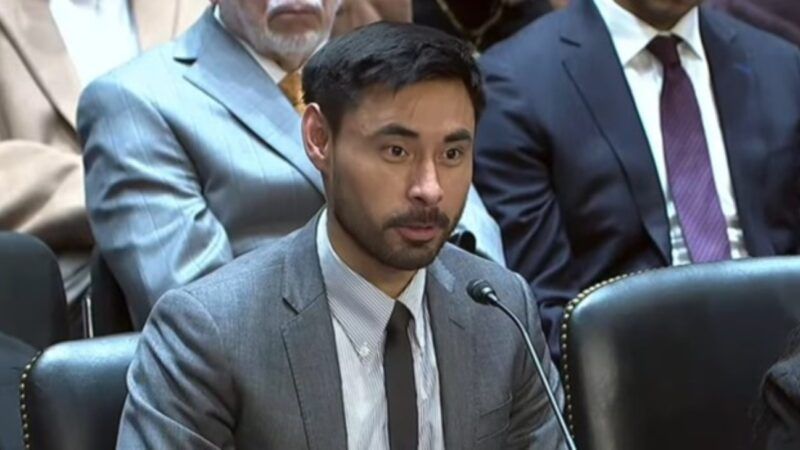
Last July, Wilmer Chavarria, a naturalized U.S. citizen who lives in Vermont, was returning from Nicaragua, where he had visited his mother and other relatives, when he was detained by Customs and Border Protection (CBP) agents at the George Bush Intercontinental Airport in Houston for no apparent reason. Chavarria was held for more than four hours and released only after he finally agreed to let the agents search his smartphone, tablet, and laptop computer. The agents, who persistently pressured Chavarria to surrender his devices and the passwords for them, informed him that he had no Fourth Amendment right to resist.
They were wrong about that, the Pacific Legal Foundation (PLF) says in a lawsuit it filed in the U.S. District Court for the District of Columbia on Wednesday against the Department of Homeland Security (DHS), which includes CBP. "Americans don't surrender their constitutional rights as the price of international travel," the PLF says. "CBP policies that claim to give its employees the power to search and seize electronic devices without a warrant violate the Fourth Amendment and therefore should be set aside."
The Fourth Amendment guarantees "the right of the people to be secure in their persons, houses, papers, and effects" against "unreasonable searches and seizures." It also specifies that judicial warrants, which are ordinarily required for searches, must be based on "probable cause" supported by "oath or affirmation" and must "particularly" describe the target of the search and "the persons or things to be seized."
The contents of electronic devices qualify as "papers" and "effects," PLF lawyers Amy Peikoff and Molly Nixon argue. And although the Supreme Court has recognized a "border exception" to the Fourth Amendment, they say, it cannot reasonably be understood to encompass the potentially vast amount of sensitive information that Americans routinely carry with them when they travel.
Under the CBP's broad interpretation of the border exception, the PLF notes, federal agents are free to examine the contents of electronic devices anywhere within 100 miles of a U.S. border—a zone that includes about two-thirds of the U.S. population. They can do so at will without any articulable reason, let alone probable cause or a warrant. And under CBP policy, they can copy and retain that information based on "a national security concern" or "reasonable suspicion of activity in violation of the laws enforced or administered by CBP," provided they obtain "supervisory approval."
Chavarria, who is superintendent of Vermont's Winooski School District, was understandably dismayed by the CBP's assertion of that authority. "When he objected, he was told he had no Fourth Amendment rights at the border," the complaint says. "Moreover, he was told he was behaving suspiciously simply by asserting those rights and refusing to consent to the device searches. His requests to contact his family and lawyer were denied during the detention."
Chavarria was especially concerned because the laptop he was carrying, which was the school district's property, contained student records. But "after enduring hours of isolation, physical discomfort, threats, and badgering," the complaint says, Chavarria "finally succumb[ed] to the pressure and hand[ed] over his devices and passwords" based on the agents' "assurances that they would not access the student data on his laptop."
Because "the searches were conducted outside his presence," according to the lawsuit, Chavarria had no way of verifying that the agents kept their promise of self-restraint. "Adding insult to injury, one of the plainclothes officers stopped Mr. Chavarria as he was being released to shake his hand and praise him for his resilience during the detention," the PLF says. "Because of his unflinching commitment to his students' rights, the agent said he would be proud for his children to attend a school with a superintendent like Mr. Chavarria."
The border exception, which is meant to facilitate detection of contraband, weapons, customs violations, and illegal immigration, has traditionally applied to "searches of persons entering the United States and their physical property," Peikoff and Nixon note. "And while digital contraband does exist, such contraband can also be emailed or stored in the cloud for remote access from anywhere in the world, making searches for such contraband a general criminal law interest, not a border concern. Accordingly, the normal Fourth Amendment rules and warrant requirement apply."
Given the ubiquity of electronic devices and their storage capacity, extending the border exception to include the data they contain has profound privacy implications. Laptops can store up to four terabytes of data, while some smartphone models can store as much as two terabytes.
The upshot is that Americans commonly carry enormous amounts of data in their pockets and computer bags, potentially including years of personal information about their habits, opinions, work, family life, relationships, and medical histories. But according to the CBP, its agents have plenary authority to peruse that information whenever they want "with or without suspicion." And if they have a "reasonable suspicion" of illegal activity, which is supposed to be based on "specific, articulable facts" but in practice may amount to little more than a hunch, they also can copy information.
In a 2022 letter to Chris Magnus, then the CBP commissioner, Sen. Ron Wyden (D–Ore.) noted a briefing that year in which an agency official reported that CBP copies data from "less than 10,000" phones each year. That information, Wyden noted, "typically includes text messages, call logs, [and] contact lists" but may also include "photos and other sensitive data." According to the senator, the agency "confirmed during this briefing that it stores this deeply personal data," obtained "without a warrant signed by a judge," for "15 years" and "allows approximately 2,700 DHS personnel" to search it "at any time, for any reason."
Between 2015 and 2024, the PLF notes, the annual number of warrantless electronic-device searches by CBP more than quintupled, from about 8,500 to more than 46,000. "That trend continues apace in 2025," the PLF reports, "with the third fiscal quarter showing CBP having searched 14,899 people—the highest number on record and 16.7 percent higher than the next-highest quarterly figure of 12,766 set in the second fiscal quarter of 2022." Most of these searches are "basic," meaning they involve reviewing and analyzing information "encountered" during examination of a device. But about 10 percent are "advanced," meaning they entail using external equipment to "review, copy, and retain device contents for later analysis."
The threat of such invasions, Peikoff and Nixon note, means that travelers "must decide between leaving their electronic devices at home or risking being detained and having their device contents perused, uploaded into a government database, or maybe even shared with multiple government agencies—all without a warrant or probable cause." In light of that risk, they add, some travelers "take precautions such as deleting their social media accounts from their devices or encrypting their hard drives in advance of travel."
In light of his brush with CBP, Chavarria left his laptop at home during a visit to Nicaragua in October, meaning he was "unable to work remotely while visiting his family," the complaint says. "This is a choice no American should have to make."
Chavarria reflected on his experience in a recent interview with WPTZ, the NBC affiliate in Burlington, Vermont. "You feel like you've been abducted by a gang of aggressive, violent people who are trying to manipulate you and who are lying to you," he said. "And while you are being abducted, you know that these people are capable of doing anything to you because they don't care."
At a Washington, D.C., forum convened on Tuesday by Democratic lawmakers, Chavarria was one of five U.S. citizens who described jarring and allegedly illegal encounters with DHS employees. "I do not feel like I am free to visit my mother without being afraid that I will be detained or disappeared at any time for any reason," he said. "I don't think any American should be deprived [of] the right to visit their mother."




