
Trump Is Still Claiming He Saves '25,000 American Lives' When He Blows Up a Suspected Drug Boat
So far, by the president's reckoning, he has prevented 650,000 U.S. drug deaths—eight times the number recorded last year.
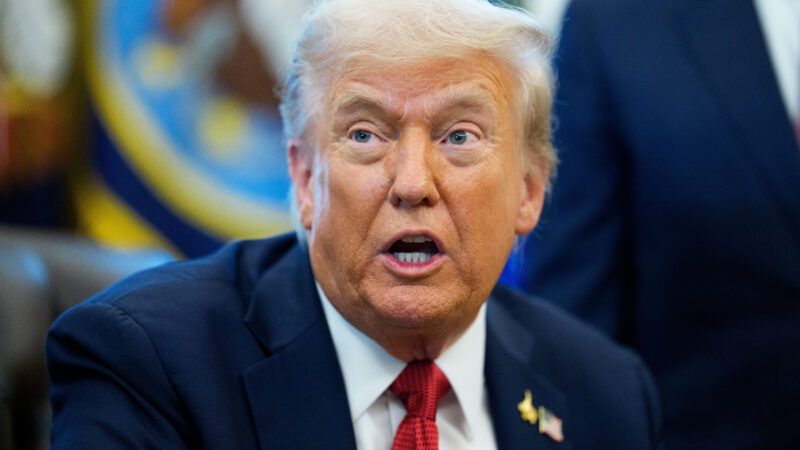
President Donald Trump was widely mocked for claiming "we save 25,000 American lives" every time the U.S. military blows up a suspected drug boat in the Caribbean or the eastern Pacific. Undeterred by the well-deserved ridicule, the president is still pushing that preposterous premise, which implies that he has prevented 650,000 drug-related deaths by ordering attacks that so far have destroyed 26 vessels in 22 operations.
"Every boat that you see get blown up, we save 25,000, on average, lives, 25,000 lives," Trump averred during a Cabinet meeting last week. On Monday, he reiterated that "every single boat we shoot out, on average, we save 25,000 American lives."
The BBC dryly notes that "the White House has not explained how it arrived at this figure." But it seems to be the product of several empirical and logical fallacies.
First, Trump erroneously thinks the targeted boats, which would have been transporting cocaine produced mainly in Colombia, were carrying fentanyl, which generally enters the United States in small packages carried over land across the border with Mexico. "The boats get hit, and you see that fentanyl all over the ocean," he claimed at a press conference in October. Trump's confusion is relevant because fentanyl accounts for most drug-related deaths in the United States. Last year, according to estimates from the Centers for Disease Control and Prevention (CDC), fentanyl was implicated in more than 49,000 drug deaths, 60 percent of the total, while cocaine was detected in about 22,500 cases, around 28 percent of the time.
Second, Trump imagines, contrary to more than a century of experience with drug interdiction, that traffickers do not compensate for intercepted shipments by sending more. When drugs are seized or destroyed, he seems to think, the total supply available to Americans is reduced by that amount. If that were true, it would be hard to understand why Trump says drug interdiction is "totally ineffective."
Third, Trump assumes that any given amount of drugs would be evenly divided into lethal doses, each of which would be consumed in one sitting by a different person. Attorney General Pam Bondi relied on the same plainly unrealistic assumption when she absurdly claimed that the Trump administration had "saved…258 million lives" during its first 100 days by intercepting fentanyl shipments.
Bondi's claim epitomized the illogic of the war on drugs, and Trump implicitly contradicted it when he described drug interdiction as "totally ineffective"—his rationale for resorting to summary execution of suspected smugglers. If the traditional approach of seizing drugs and arresting smugglers was "totally ineffective," it did not save any lives, let alone prevent three-quarters of the U.S. population from succumbing to fentanyl overdoses, which is what Bondi suggested would have happened but for the Trump administration's heroic interdiction efforts during its first few months.
Trump's claim about the lives saved by blowing up drug boats is modest compared to Bondi's jaw-dropping assertion. But given the powerful financial incentive for delivering drugs to American consumers and the many ways of doing that, there is no reason to think his lethal version of drug interdiction will be any more effective than the less violent strategy that prevailed prior to September 2. And although Bondi's hyperbole would be hard to match, Trump is still claiming, with a straight face, that he has already prevented eight times the number of U.S. drug deaths recorded in 2024 (about 82,000, per the CDC). "I don't see a universe in which [Trump's claim] could possibly be true," UCLA epidemiologist Chelsea Shover told the BBC.
These bogus numbers would be merely amusing if Trump were not deploying them to justify a policy of killing suspected cocaine couriers, at a distance and in cold blood, without legal authorization or any semblance of due process. Trump conflates drug smuggling with violent aggression, saying it amounts to "an armed attack against the United States" that requires a lethal military response. His meretritious math aims to bolster that reality-defying description. He hopes his extravagant claims about hypothetical deaths prevented by his bloodthirsty anti-drug strategy will distract the public from the actual deaths he is ordering.
