
The 'Threat' That Supposedly Justified Killing 2 Boat Attack Survivors Was Entirely Speculative
The commander who ordered a second missile strike worried that the helpless men he killed might be able to salvage cocaine from the smoldering wreck.
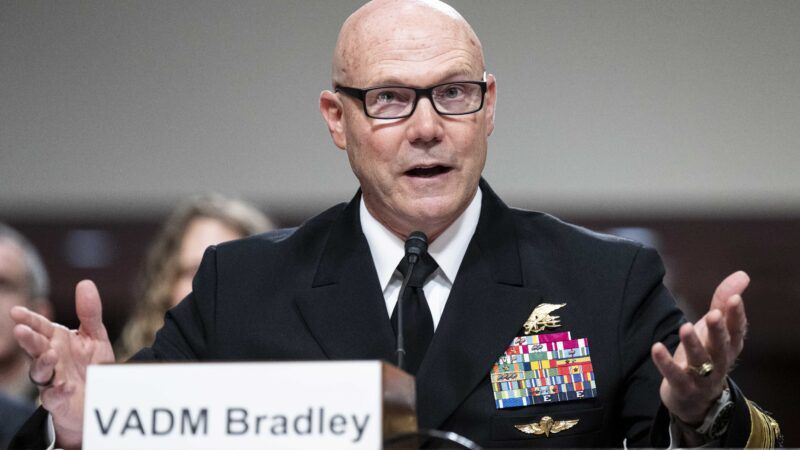
On Thursday, Adm. Frank M. Bradley, commander of the newly controversial September 2 operation that inaugurated President Donald Trump's deadly military campaign against suspected drug boats in the Caribbean and the eastern Pacific, briefed members of Congress about his justification for ordering a second missile strike that killed two men who survived the initial attack. Hours later, the U.S. Southern Command announced yet another boat attack, raising the total to 22 and the death toll to 87.
The confluence of those two developments highlights the risk that the debate about Bradley's second strike will obscure the broader issue of whether Trump's reality-defying assertion of an "armed conflict" with drug smugglers, which supposedly turns criminal suspects into "combatants," is enough to transform murder into self-defense. While the renewed congressional interest in the legal and moral justification for Trump's bloodthirsty anti-drug strategy is welcome, that inquiry should not be limited to the question of whether one particular attack violated the law of war.
The details of Bradley's defense nevertheless illustrate the outrageous implications of conflating drug smuggling with violent aggression. He argues that the seemingly helpless men in the water, who were blown apart by a second missile while clinging to the boat's smoldering wreckage, still posed a threat because they could have recovered and delivered whatever cocaine might have remained after the first strike.
Prior to Thursday's closed-door briefings, The New York Times reported that Bradley was expected to support that argument by citing radio communications between the survivors and other members of their organization. In deciding to order the second strike, The Wall Street Journal said, Bradley "considered that other 'enemy' vessels were nearby and that the survivors were believed to be communicating via radio with others in the drug-smuggling network." He "concluded the two survivors were attempting to continue their drug run, making them and the already-damaged vessel legitimate targets for another attack."
That concern, it turns out, was entirely speculative. During the briefings, lawmakers watched a video that, unlike the snippet that the Defense Department had released to the public, showed both the first and second missile strikes. Judging from the accounts of people who watched that video, it does not support the improbable claim that "the two survivors were attempting to continue their drug run."
The first strike "destroyed most of the boat," The New York Times reports. "When the smoke finally cleared about 30 minutes later, the front portion of the boat was overturned but still afloat, according to lawmakers and congressional staff who viewed the video or were briefed on it. Two survivors, shirtless, clung to the hull, tried unsuccessfully to flip it back over, then climbed on it and slipped off into the water, over and over."
During the briefings, "military officials" reportedly "told lawmakers they assumed the hull might be afloat because it still contained packs of cocaine," the Times says. "They thought that the survivors might eventually have managed to float back to Venezuela, allowing them to try again to deliver that cocaine, or that another boat could come retrieve it. They assumed the survivors could be communicating." But "the video did not show any radios or satellite phones," and "a surveillance plane apparently did not spot any nearby boat."
Bradley, in short, did a lot of assuming and supposing, then decided the hypothetical risk that possibly remaining cocaine might eventually make its way to American noses was enough to justify the cold-blooded murder of two defenseless men who were desperately trying not to drown. That explanation was good enough for Sen. Tom Cotton (R–Ark.), who pronounced the attack "righteous" and "highly lawful." As Cotton saw it, the men whose deaths Bradley ordered were not struggling for their lives; they were "trying to flip a boat loaded with drugs bound for [the] United States back over so they could stay in the fight."
In reality, there was no "fight" to stay in. The violence exemplified by this attack is so one-sided that the government's lawyers claim blowing up drug boats does not constitute "hostilities" under the War Powers Resolution because U.S. personnel face no plausible risk of casualties. So we are talking about an "armed conflict" that does not involve "hostilities" yet somehow does involve enemy "combatants"—who, contrary to that label, are not actually engaged in combat.
Cotton's counterintuitive characterization aims to support Bradley's argument that the men he obliterated were not truly "shipwrecked," which would mean he and his underlings committed a war crime by killing them. According to the Defense Department's Law of War Manual, "orders to fire upon the shipwrecked would be clearly illegal." The manual says individuals are deemed "shipwrecked" when they are "in distress at sea," "helpless," and "in need of care and assistance," provided they "refrain from any hostile act."
Bradley seems to have determined that the flailing men were engaged in a "hostile act" simply by existing near a boat remnant that might have contained salvageable cocaine. As ridiculous as that position is, it is only a bit more risible than Trump's assertion that supplying cocaine to Americans amounts to "an armed attack against the United States" that justifies a lethal military response.
Since Bradley's reasoning is consistent with that preposterous premise, it is not surprising that Trump, who initially said he "wouldn't have wanted" a "second strike," now agrees it was just as "fine" as the first one. Nor is it surprising that Defense Secretary Pete Hegseth, who like the president revels in dealing death to suspected cocaine smugglers without legal authorization or any semblance of due process, thinks Bradley "made the correct decision to ultimately sink the boat and eliminate the threat."
The congressional investigation was prompted by The Washington Post's recent report that Bradley ordered the second strike based on his understanding that Hegseth wanted him to "kill everybody" on the boat. Hegseth denied giving any such instruction, and Bradley reportedly confirmed to lawmakers that Hegseth had not said anything to that effect.
That point is legally relevant because such an order arguably would have violated the law-of-war rule against "declar[ing] that no quarter will be given" or "conduct[ing] hostilities on the basis that there shall be no survivors." But the logic of Trump's policy and Hegseth's implementation of it, which portrays suspected drug smugglers as "combatants" who can be killed at will and their vessels as threats than can be eliminated only by complete destruction, effectively blesses what the law of war theoretically forbids, as this attack vividly shows.
"There is a risk that the focus on the second strike and specifically the talk of 'war crimes' feeds into the administration's false wartime framing and veils the fact that the entire boat-strikes campaign is murder, full stop," Cardozo School of Law professor Rebecca Ingber, an expert on the law of war, told The New York Times. "The administration's evolving justification for the second strike only lays bare the absurdity of their legal claims for the campaign as a whole—that transporting drugs is somehow the equivalent of wartime hostilities."
