
Hegseth's 'Fog of War' Is No Excuse for Summarily Executing Suspected Drug Smugglers
Regardless of what the defense secretary knew or said about the September 2 boat attack, the forces he commands are routinely committing murder in the guise of self-defense.
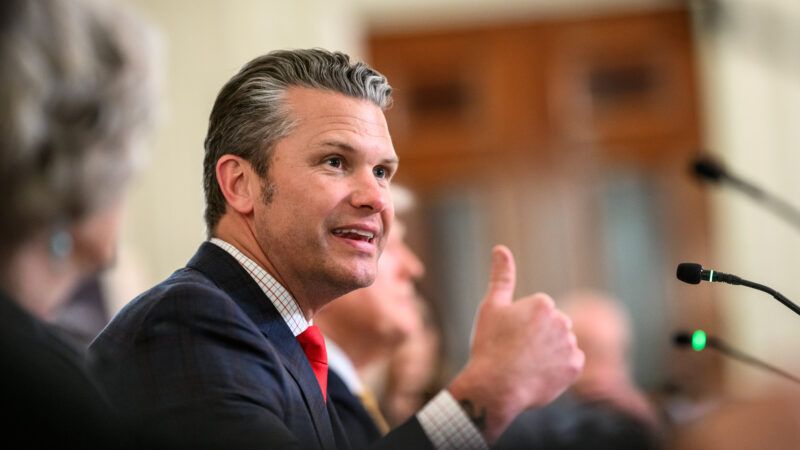
"I did not personally see survivors," Defense Secretary Pete Hegseth said at a Cabinet meeting on Tuesday. "The thing was on fire. It exploded, there's fire, there's smoke….This is called the fog of war."
Hegseth, who was referring to the newly controversial September 2 boat attack that inaugurated President Donald Trump's deadly campaign against suspected drug smugglers in the Caribbean and the eastern Pacific, may have been blowing some smoke of his own. It is hard to tell, given the dueling accounts of the circumstances in which two survivors of the initial attack were killed by a second missile. This is called the fog of politics, and it should not obscure the fundamental immorality and lawlessness of the anti-drug strategy that Trump and Hegseth are proudly pursuing.
Let's start with the facts on which everyone seems to agree. As The Intercept reported eight days after the attack, the first strike did not kill everyone on the boat, which was carrying 11 men whom Trump described as "narcoterrorists" affiliated with the Venezuelan gang Tren de Aragua. But the survivors were "killed shortly after in a follow-up attack." Last Friday, a Washington Post story added new details: After the first strike, two men "clinging to the smoldering wreck" were "blown apart in the water" by a second missile.
The dispute about the follow-up strike centers on two issues. If Adm. Frank M. Bradley, who was in charge of the SEAL Team 6 operation, knowingly and deliberately killed the survivors, both his order and the execution of it could qualify as war crimes. According to the Defense Department's law-of-war manual, "orders to fire upon the shipwrecked would be clearly illegal." And if, as the Post reported, Bradley acted in response to Hegseth's oral instruction to "kill everybody" on the boat, the operation arguably violated the rule against "declar[ing] that no quarter will be given" or "conduct[ing] hostilities on the basis that there shall be no survivors."
According to the Post, "commanders watched the boat burning on a live drone feed" and saw that "two survivors were clinging to the smoldering wreck." On the afternoon of September 2, Hegseth posted an edited 29-second clip of that footage on X, showing the initial missile strike. "I watched it live," he said during a Fox News interview the next day. "We knew exactly who was in that boat. We knew exactly what they were doing, and we knew exactly who they represented."
During Tuesday's Cabinet meeting, however, Hegseth said he saw only part of that live feed. "I didn't stick around for the hour and two hours, whatever, where all the sensitive site exploitation digitally occurs," he said. "I moved on to my next meeting. A couple of hours later, I learned that the commander [Bradley] had made the [second strike], which he had the complete authority to do."
Bradley "made the correct decision to ultimately sink the boat and eliminate the threat," Hegseth added. "It was the right call. We have his back."
That last statement is open to question. "I wouldn't have wanted that," Trump told reporters on Sunday. "Not a second strike." But Hegseth "said he did not order the death of those two men," Trump said, and "I believe him, 100 percent." According to the president, in other words, he would not have approved the second strike, and Hegseth had not done so either.
On Monday, White House press secretary Karoline Leavitt reiterated that Hegseth issued no such order, then read a written statement that added: "President Trump and Secretary Hegseth have made it clear that presidentially designated narcoterrorist groups are subject to lethal targeting in accordance with the laws of war. With respect to the strikes in question on September 2, Secretary Hegseth authorized Admiral Bradley to conduct these kinetic strikes. Admiral Bradley worked well within his authority and the law, directing the engagement to ensure the boat was destroyed and the threat to the United States of America was eliminated."
That framing, the Post reported, left Pentagon officials "concerned that the Trump administration intends to scapegoat" Bradley. "This is 'protect Pete' bullshit," one unnamed "military official" told the Post. Other Pentagon sources complained that Leavitt's statement left the responsibility for the second strike "up to interpretation" and worried that the administration was "throwing us, the service members, under the bus."
Not so, Pentagon spokeswoman Kingsley Wilson implied during a press briefing on Tuesday. "The secretary has been very clear in every statement that we've released about these strikes, that they are presidentially directed," she said. "The chain of command functions as it should. And we make sure that [the opinions of] commanders on the ground…are taken into account, and they are able to tell us and make decisions if they…see things that need to be flagged. But at the end of the day, the secretary and the president are the ones directing these strikes. And any follow-on strikes, like those which were directed by Admiral Bradley, the secretary 100 percent agrees with."
Wilson described the Post's reporting as "totally fabricated" and "insanely false," complaining that the newspaper used "anonymous sources" who "probably have no idea what's going on" to "falsely attribute a quote" to Hegseth that "he never said." She added that "The New York Times stepped in and corrected the record," making it clear that the Post's article was "absolutely fake news."
In the story to which Wilson referred, which was published on Monday, the Times cited five unnamed "U.S. officials" who said Hegseth "ordered a strike that would kill the people on the boat and destroy the vessel and its purported cargo of drugs" but "did not specifically address what should happen if a first missile turned out not to fully accomplish all of those things." Those sources also said Hegseth's order "was not a response to surveillance footage showing that at least two people on the boat survived the first blast."
Contrary to Wilson's spin, that report does not show the Post's article was "absolutely fake news." The Post's sources, which it described as "two people with direct knowledge of the operation," did not say Hegseth explicitly ordered the second strike or even claim he was aware that the first strike had left two survivors. They said he had told Bradley that no one should be left alive, which they said Bradley understood to require the second strike.
That account does not let Bradley (or his underlings) off the hook. "Members of the armed forces must refuse to comply with clearly illegal orders to commit law of war violations," the Defense Department's manual notes, specifically citing "orders to fire upon the shipwrecked" as one example. But if Hegseth did in fact indicate that Bradley should "kill everybody" (which, contrary to Wilson's gloss, the Post presented as a paraphrase rather than a direct quote), he also bears responsibility for the consequences.
The House and Senate armed services committees, which launched investigations in response to the Post's report, presumably will delve into these issues. According to the Post, Trump administration officials previously told members of Congress that "the 'double-tap,' or follow-on strike, was intended to sink the boat and remove a navigation hazard to other vessels—not to kill survivors." Legislators may be newly skeptical of that explanation, especially given the justification that administration officials have offered more recently.
Although Trump initially said he "wouldn't have wanted" the second strike, the White House and the Pentagon are now saying there was nothing unlawful about it. According to Leavitt, the second strike aimed to "ensure the boat was destroyed and the threat to the United States of America was eliminated." Wilson likewise said "the decision to restrike the narcoterrorist vessel was made by Admiral Bradley, operating under clear and longstanding authorities to ensure the boat was destroyed and the threat to the United States was eliminated."
Leavitt and Wilson were not talking about "a navigation hazard to other vessels." They were talking about "the threat to the United States" posed by the transportation of illegal drugs. That threat, they maintain, requires firing on any given boat believed to be carrying drugs until it is completely destroyed and sunk—a practice that is pretty hard to distinguish from "conduct[ing] hostilities on the basis that there shall be no survivors."
That result is not merely incidental to the goal of interdicting drugs. Trump conflates drug smuggling with violent aggression, saying it amounts to "an armed attack against the United States" that justifies a lethal military response. He and Hegseth have repeatedly bragged about summarily executing suspected drug smugglers instead of intercepting and arresting them.
So far, that policy has killed 83 people in 21 attacks on vessels that posed no military threat. Contrary to Trump's assertion of an "armed conflict" with "narcoterrorists," this violence is notably one-sided, and it raises concerns that go far beyond the question of whether a particular attack went too far. The entire campaign goes too far because it trashes due process and obliterates the distinction between civilians and combatants. The question of exactly what Hegseth knew or said in this one case seems beside the point when the forces he commands are routinely committing murder in the guise of self-defense.
