

Thankfully, We Don't Have To Spend As Much of Our Incomes on Food As Our Ancestors Did
The portion that Americans spend on food has fallen steeply over the last century.
Let's set aside the controversy over what Walmart's shrinkflation of its annual Thanksgiving feast bundle might suggest for the recent trajectory of grocery prices. The good news for which we can be thankful is that the share of their incomes that average Americans devote to paying for food has fallen steeply over the last 100 years.

This happy development stems from two long-term trends: rising incomes and falling food prices.
In 1929, Americans spent 23.4 percent of their after tax-personal disposable income buying food, reported the U.S. Department of Agriculture in 2006. In 1929, food eaten at home accounted for 17 percent of expenditures.*
At the aggregate level, a crude calculation finds that in 1960, 11.4 percent of total GDP was spent on purchasing food for personal consumption. In 2025 that has fallen to 5.1 percent of GDP. Basically, as their incomes rise, Americans spend more money on food but it represents a smaller share of their income, and the proportion spent on nonfood items increases. Real U.S. disposal income per capita has increased from $13,500 in 1960 to nearly $53,000 today. After tax, personal disposable income hovers just above 70 percent of total GDP.
The U.S. Department of Agriculture confirms these declining trends using different calculations.
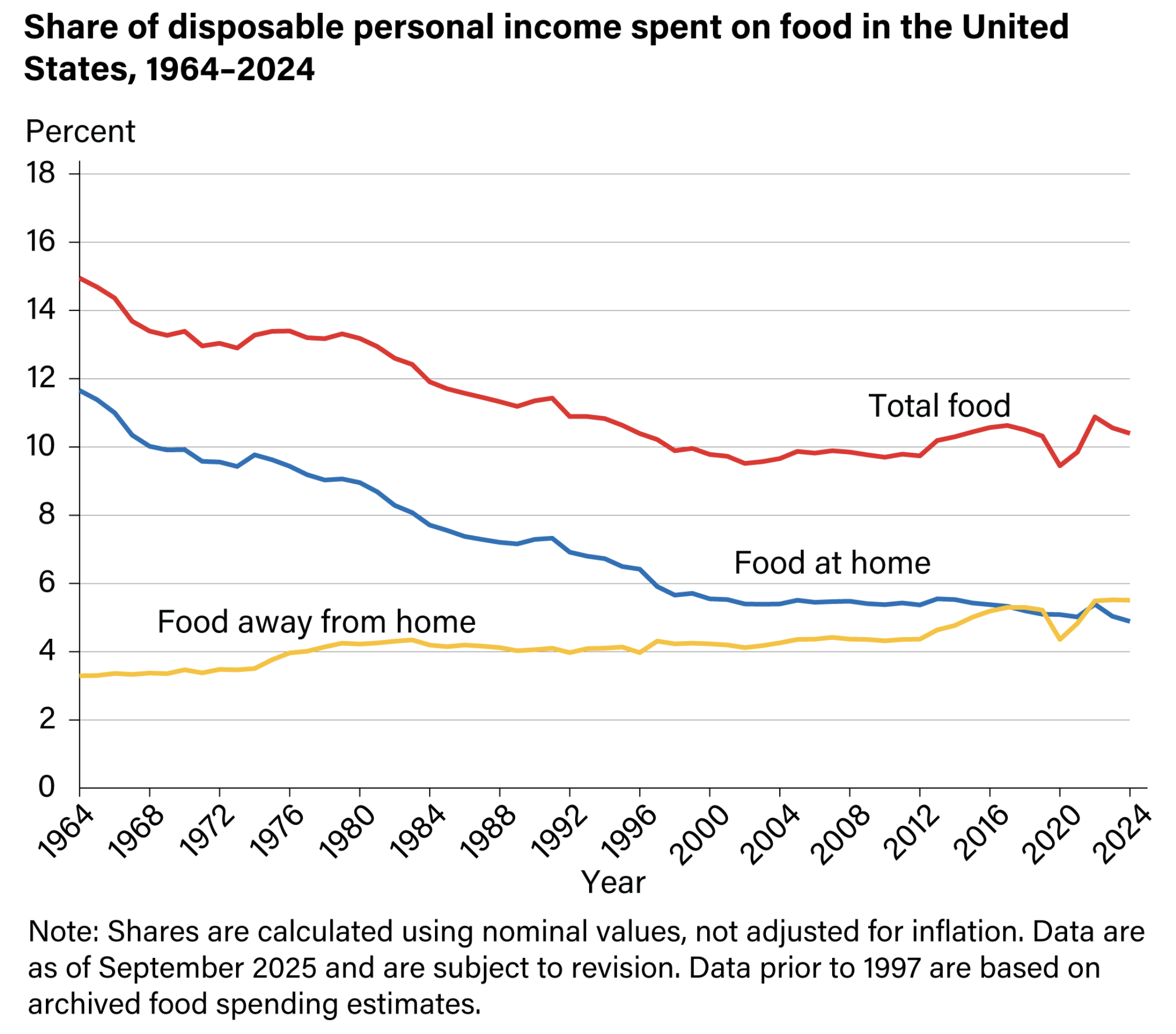
The agency reports, "In 2024, U.S. consumers spent an average of 10.4 percent of their disposable personal incomes on food, a decrease from 10.6 percent in 2023." Americans spend 4.9 percent of their incomes on food at home and 5.5 percent on food away from home, such as dining out at restaurants.
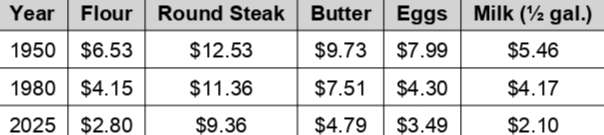
What about the price of foods? As Americans all too well know, the USDA reports that food prices rose by 23.6 percent between 2020 and 2024. Grocery prices do bounce around, especially during periods of high inflation like what we have recently been enduring. Nevertheless, the century-long trend has been falling prices for food staples, as shown by combining selected deflated Bureau of Labor Statistics and Federal Reserve Bank of St. Louis data on food prices.
While Americans on average devote just over 10 percent of their disposable incomes to food, those in the lowest income quintile spend just under 33 percent of their incomes on food.

As high as that percentage is, families in the lowest quintile were spending around 58 percent of their after-tax income on food as recently as the early 1980s.
As we gather for our holiday feasts, let us take a moment to appreciate that, over the past century, steady gains in productivity, innovation, and economic growth have allowed families to devote a smaller and smaller share of their budgets to putting food on the table. That is truly an achievement worth celebrating this Thanksgiving.
*CORRECTION: The original article misstated the percent of food expenditures.

Editor's Note: As of February 29, 2024, commenting privileges on reason.com posts are limited to Reason Plus subscribers. Past commenters are grandfathered in for a temporary period. Subscribe here to preserve your ability to comment. Your Reason Plus subscription also gives you an ad-free version of reason.com, along with full access to the digital edition and archives of Reason magazine. We request that comments be civil and on-topic. We do not moderate or assume any responsibility for comments, which are owned by the readers who post them. Comments do not represent the views of reason.com or Reason Foundation. We reserve the right to delete any comment and ban commenters for any reason at any time. Comments may only be edited within 5 minutes of posting. Report abuses.
Please to post comments
It’s all thanks to fossil fuels, the greatest eliminator of poverty in history
Well, it is also due, in part, to free markets, including international free trade. Food prices are going up! Good thing now is that Dear Orange Caligula has FINALLY partially relented, and scaled back on tariff-taxes on coffee, bananas, etc. ... Ass if the USA could EVER become self-sufficient in these kinds of things anyway!
On Thanksgiving, I am glad (give thanks) that a TINY-TINY bit of sanity has crept into Dear Orange Caligula's decrepit old so-called "brain"!!!
Thanks to rising temperatures, it costs less to cook.
https://reason.com/2008/07/23/carbon-based-prohibition/
From the link:
"If some environmentalists have their way, simple math suggests life as we know it will end"
Take your fake web site with you, and please fuck off and die, watermelon.
^+1.
The American farmer is the unrecognized hero.
Right-wing non-persons will hide behind "how bad our ancestors had it" when more recent developments would reflect very very poorly on them.
Carry on. Farmers are aware.
All it takes is for another round of bird flu or some other deadly disease they cooked up in some lab in Ukraine and released to wipe out the remaining chickens, cattle and pigs, then you can have all the lab grown mystery meat you want, that and ze bugs.
Don't think it isn't going to happen because "they" are working on it.
It will be Soylent Green and bugs for dinner.
By the way, eggs up here in northern Michigan are at $4.50 and past $5 /dozen. Frozen turkeys selling at $1.99/lb. on sale.
For many there will be no Thanksgiving dinner.
"...For many there will be no Thanksgiving dinner."
People who choose not to make enough money at these costs to feed themselves get zero sympathy. Along with Nazi shits, Nazi shit.
*As Americans all too well know, the USDA reports that food prices rose by 23.6 percent between 2020 and 2024.*
Right. Which is the entire problem. The percentage of income Americans spend on food WAS falling steadily for 100 years. Now it has been spiking steadily for 5 years. That the public is noticing doesn't make them paranoid or uneducated. It makes them, for once, totally in tune with what's actually happening.
Not one mention on the 50-some million people getting their money for food from taxpayers? It's a recent topic of conversation and incredibly relevant when we're looking at things effecting food prices and spending. The lowest quintile he cites would likely be represented by them. Touching on agricultural subsidies also seems a necessary part of the evaluation.
Not mentioned: disposable income is now falling, and the percentage of disposal income spent on food is now rising.
I also am somewhat skeptical of data collection methods on this sort of thing. Change the way the data is collected and you change the outcomes.
Ron isn't smart enough to look into the data and methodology. He cites an authority that serves his tribal narrative then says anyone questioning it is anti-science.
I would side with those who don't have a large wing that thinks the Earth is flat and that the world was created a few thousand years ago.
Carry on. More irrelevant by the day.
Ron isn't smart enough to look into the data and methodology. He cites an authority that serves his tribal narrative then says anyone questioning it is anti-science.
He's not a Trump defender you idiot.
Also missing, welfare (of any kind) which masks the lowest incomes.
But we spend more selling real estate to each other and trading bonds.
I'll bet JFucked thought there was a coherent concept somewhere in that pile of bullshit.
During the past several weeks, it seems like every church, charity, politician, self promoter and media propagandist has sponsored (and heavily publicized) a free food/dinner giveaway to purportedly feed the hungry/starving poor.
At the same time, politicians criticized the opposing party of starving the poor (due to the federal shutdown and new work requirements for SNAP food stamp recipients).
And yet, two thirds of SNAP recipients are overweight, while half are obese, which has and will continue to sharply increase taxpayer financed Medicaid costs.
By giving away already inexpensive junk food to everyone for free and urging themselves to keep gorging, it seems like the politicians, charities, churches and media are advocating (via virtue signaling) to increase rates of heart disease, cancers, obesity, kidney disease, high blood pressure/cholesterol, falls and their corresponding healthcare costs among the poorest and least healthy Americans, to be paid for mostly by taxpayers.
" two thirds of SNAP recipients are overweight, while half are obese"
Could you express that as a fraction?
This is progress?? In 1500, Americans spent practically 0% of their income on food! And there are some folks just itching to get back to their standard of living.
Unfortunately, we are still spending 25% of our income on the federal government, when the percentage should have gone down over time, since the government's delegated tasks are supposed to be confined to a few specific areas, which should have become a smaller part of the economy as progress was made.


