

How the Punisher, a Murderous Anti-Hero, Became the Mascot for Increasingly Militarized Police Forces
“He is breaking the very laws…that cops are supposed to uphold.”
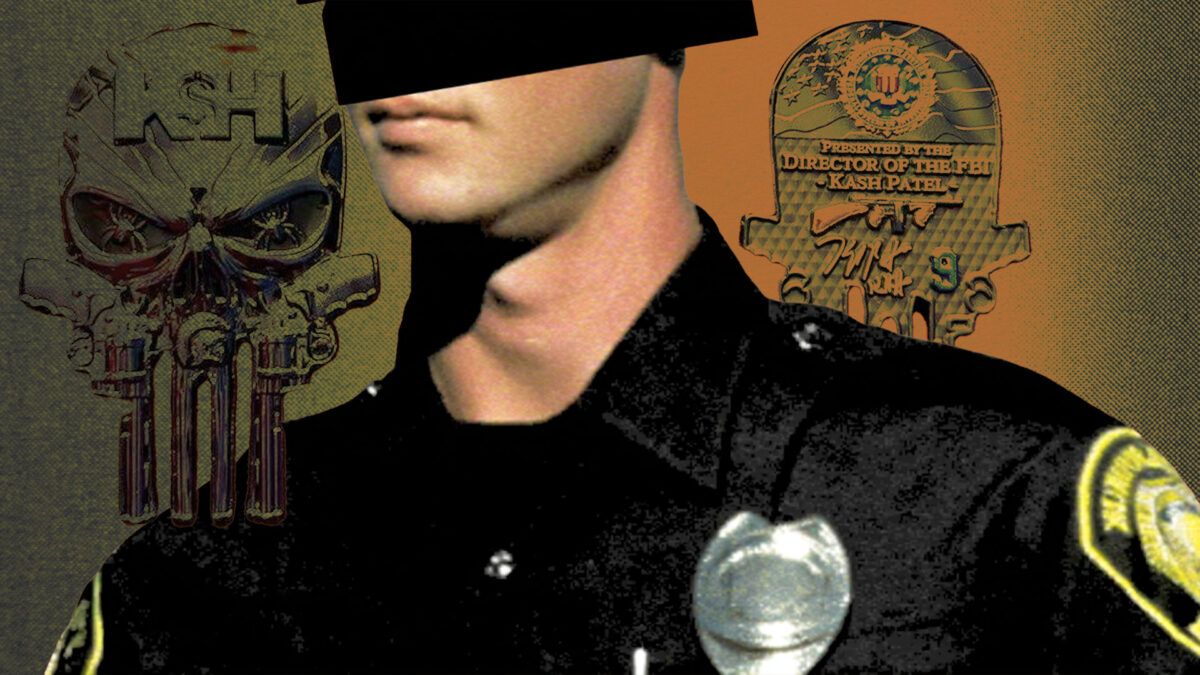
In 2015, actor Jon Bernthal appeared at New York Comic Con soon after the announcement that he would portray Marvel Comics' famous vigilante the Punisher in the Netflix series Daredevil. "I know how important he is to law enforcement, to the military," he told the crowd. "I look at this as a huge honor, a huge responsibility. And I give you my absolute word, I'm gonna give everything that I have."
Since then, Punisher iconography has only continued to proliferate among police officers. The character's skull logo has become synonymous with uncritical support for police. Even FBI Director Kash Patel is a fan. In October, MSNBC's Ken Dilanian shared a photo of a challenge coin Patel had given out featuring a skull that greatly resembled the Punisher symbol. That trend is disheartening, both for fans of the comics character, like me, and for Americans who want a sane law enforcement apparatus dedicated to serving citizens rather than unleashing violence.
Unlike most of his superhero compatriots, the Punisher is an unrepentant murderer, focused less on restorative justice than on simply massacring his enemies. He is quite possibly the worst role model comics have ever produced. While sometimes a thrilling story of a man able to right the wrongs he sees in the world, the Punisher also functions as an indictment of feckless or corrupt police and a military that sends people off to kill but does too little when they come home damaged. Some of the people who lionize the character these days miss that point—to our detriment.
As a teenager, I found the Punisher's brutally uncompromising Manichaean worldview a fascinatingly stark contrast to other, more optimistic comic book heroes. The Punisher inhabited that same world but seemed to flout all its rules and conventions: He had no superpowers other than military training, a seemingly unlimited arsenal, and tenacity. I've accrued numerous issues of Punisher comics and collectibles and multiple T-shirts bearing his signature skull logo.
But in the more than two decades since I picked up my first issue at the local grocery store, the character's cultural meaning has shifted. For years, the people most likely to wear the skull logo were comic fans like me; then, over time, it became noticeably more popular among police officers. Custom shops such as Etsy and Redbubble, and mass retailers such as Amazon, carry thousands of items printed with Punisher skulls, often combined with American flags and pro-police iconography.
"There has to be a recognition that while he's doing what they want to fantasize about doing, that he's wrong," Punisher co-creator Gerry Conway tells Reason. "He is breaking the very laws, for example, that cops are supposed to uphold. So, putting a Punisher decal on your cop car is saying you want to break the rules and you want to be outside the law."
A Unique Character in Superhero Comics
"He's this normal street-level guy in this world of gods and monsters and marvels," says David Pepose, who wrote the 2024 Punisher comic series. While benevolent heroes fly through the sky overhead, "the Punisher's the guy in the gutters. He's seeing the worst of the worst."
The character, born Frank Castle, debuted in a 1974 issue of The Amazing Spider-Man as a mercenary hell-bent on killing criminals—"a warrior fighting a lonely war," as he put it, who "kill[s] only those who deserve killing." Conway, the series' writer at the time, saysthat "he had a purpose" and a "sense of honor. There was something behind his motivation that we didn't know….Something terrible had to turn this very straight-laced, rules-bound guy into the Punisher."
Later issues filled in his backstory. Castle received numerous medals for meritorious service in Vietnam, but his final tour went badly and the experience haunts him. He survived combat and returned home to Queens, only to see his wife and children murdered in Central Park after they accidentally witnessed a Mafia hit. When corrupt cops and courts fail to bring the killers to justice, Castle declares war on all criminals—from terrorists to muggers and everyone in between. "Frank Castle died with his family," he corrects a villain while pulling the trigger. "I'm the Punisher."
Initially planned as a one-off henchman type, Conway liked the Punisher so much that he brought him back as a recurring character. Audiences also responded positively, and he soon appeared in other characters' series as well. He did not get his own solo title until 1986, a dozen years after his debut. Writer Steven Grant said he had "been trying to get a Punisher series off the ground for years and no one [at Marvel] was interested." But Grant's five-issue Punisher limited series sold well and led to an ongoing comic the following year. That series ran for eight years and launched multiple spinoffs; from 1992 through 1995, three monthly Punisher titles were running concurrently.
Comic book heroes were traditionally inherently benevolent: Though they operated outside the law and spent much of their time beating criminals into submission, they usually refused to kill. The Punisher not only had no compunction about killing, but it was his singular purpose. Other comic heroes face many of the same villains again and again over their many decades in print; by definition, the Punisher's roster of recurring foes is rather short. Marvel senior editor Stephen Wacker said in 2011 that since debuting, Castle had killed 48,502 people.
His murderousness also puts him at odds with other heroes, who can see him as little better than the crooks and killers they encounter. As a result, he has battled fellow heroes such as Daredevil, Spider-Man, and Wolverine (and also, for some reason, Archie).
Cops Heart the Punisher
In 2017, Catlettsburg, Kentucky, Police Chief Cameron Logan commissioned vinyl decals for the department's cruisers: Punisher skulls that read "Blue Lives Matter."
"I consider it to be a 'warrior logo,'" Logan told local media. "That decal represents that we will take any means necessary to keep our community safe." Logan spoke as if he were commanding troops in a war zone, but Catlettsburg employed only eight full-time officers for a town of 2,500. According to the app Nextdoor, "Catlettsburg is considered a safe place to live," with violent and property crime rates below state and national averages. After a public backlash, Logan had the decals removed.
That same year, the Solvay, New York, Police Department drew criticism for similar decals. "The Punisher symbol on the patrol vehicles…is our way of showing our citizens that we will stand between good and evil," according to a statement credited in part to Solvay's police chief. "There is clearly a war on police and the criminal element attempting to infiltrate and destroy our communities, lifestyles and quality of living requiring men and women willing to stand up to evil and protect the good of society." (Solvay, a village of about 6,500, is "known for its clean streets and welcoming community," declared Nextdoor. At the time, its police department employed only 16 people, including the chief.)
Taken at face value, these police departments see themselves as under assault from unchecked criminal forces. In that mindset, the only way to survive is to treat the community like an occupied territory, seeing civilians as potential threats and displaying a decal that signals your willingness to use unconstrained violence.
Solvay's decals, in particular, featured a thin blue line in the skull design. As noted in Errol Morris' documentary of the same name, the phrase refers to the concept of "the 'thin blue line' of police that separate[s] the public from anarchy." While now ubiquitous, the design of a thin blue line on an American flag originated in 2014, three years before it was incorporated into Punisher skulls on police cars in Solvay.
In 2019, St. Louis barred 22 city police officers from submitting cases for prosecution after they were found to have posted racist content on social media. Ed Clark, president of the city's police union, published a letter on the union's Facebook page "asking all officers and supporters to adopt the Blue Line Punisher symbol as their profile symbol in a show of solidarity."
"The Blue Line symbol and the Blue Line Punisher symbol have been widely embraced by the law enforcement community as a symbol of the war against those who hate law enforcement," Clark added. "It's how we show the world that we hold the line between good and evil."
But it's more complicated than that.
"The thin blue line narrative…highlights the assumed differences between officers and citizens and further progresses an 'us versus them' mentality among officers," criminologists Don L. Kurtz and Alayna Colburn wrote in 2019.
Kurtz and Colburn found that the thin blue line narrative "relates to the idea that death surrounds officers as they go about their daily job," though statistically that's not necessarily true. As a result, the narrative "pushes a limited subset of society into seeking the profession—people that are more likely to be conservative, justify physical violence and deadly force, are distrustful of the community, and generally suspicious of those outside of law enforcement."
Now imagine what that same symbol signifies when paired with the skull logo of an extrajudicial murderer.
Why Police Adoration of the Punisher Matters
One could argue that police adopting the cartoonish logo of a fictional character is no big deal. Nobody would bat an eye at police officers with Superman patches. But the Punisher specifically contradicts what the police should represent.
"While tamer vigilantes complicate the job of law enforcement, they accept the legitimacy of the justice system and supplement rather than deconstruct the political order," Kent Worcester, a political scientist at Marymount Manhattan College, wrote in A Cultural History of the Punisher. "Frank Castle…operates under the assumption that the law itself is a fraud and a fiction."
All too often, an embrace of the character demonstrably coincides with a proclivity to abuse one's power. "Frank Castle does to bad guys and girls what we sometimes wish we could legally do," Jesse Murrieta, a security official who had worked in federal law enforcement, told Vulture in 2020. "Castle doesn't see shades of grey, which, unfortunately, the American justice system is littered with and which tends to slow down and sometimes even hinder victims of crime from getting the justice they deserve."
In 2004, numerous off-duty Milwaukee police officers accused Frank Jude Jr. of stealing a wallet and badge at a house party. Though they searched him and didn't find either, they then assaulted Jude so badly that an emergency room physician resorted to taking photos because "there were too many [injuries] to document" in writing.
Milwaukee Police Captain James Galezewski later discovered the officers involved in the assault belonged to a "clique" within the department who called themselves "the Punishers," who "wear black caps with a skull on them" and "get carried away" while on duty. "This is a group of rogue officers within our agency who I would characterize as brutal and abusive," Galezewski noted in a 2007 report.
In 2009, Sgt. Brent Raban of Florida's Palm Beach County Sheriff's Office repeatedly bragged on Facebook about beating suspects in the course of his work. He wore a skull cap with the word "punishment" on it. Raban told investigators he was inspired by comic book characters like the Punisher. He was demoted and reassigned, and he would be fired the following year. An arbitrator later ordered the department to reinstate Raban and pay him $150,000 in back pay.
As actor Bernthal alluded, the Punisher is also popular among members of the military. This makes sense, given Castle's status as a war hero and his overtly militaristic worldview. But it also fits another troubling aspect of the police/Punisher intersection.
The Punisher as Symbol of a Militarized Police
The 9/11 attacks inspired a patriotic and nationalistic fervor and ushered in an era of unchecked police militarization. Such militarization was already on the rise over the previous few decades, but 9/11 created an atmosphere in which no method of retaliation was off limits. In 2003, as a means of fighting terrorism, the Department of Homeland Security began dispensing military weapons and equipment to police departments throughout the country.
When protests broke out after a police shooting in Ferguson, Missouri, in August 2014, officers responded wearing camouflage, brandishing military surplus shotguns and M4 rifles, and driving armored vehicles designed to withstand mines and roadside bombs. In 2020, similar scenes took place across the country: As Black Lives Matter demonstrators protested police brutality, officers outfitted in combat gear deployed brutal and violent tactics to put down demonstrations that often warranted little or no force. Some protests did turn violent, marked by rioting and looting, but reports later found that across the country, police largely responded in excess of what the situation required—ironically validating many of the protesters' concerns.
As both the 2020 protests and the police response made international news, commenters noted the presence of Punisher skulls on officers' uniforms. Sadly, neither trend was new. A 75-second video uploaded to YouTube in 2009 depicts a police training exercise in Doraville, Georgia. In the video, several heavily armed SWAT officers pile out of an M113 armored personnel carrier—designed to safely transport up to 11 soldiers at a time to the front lines of a combat zone—with "Doraville Police Department SWAT" printed on the side. The video starts and ends with flashes of the Punisher skull, set to the industrial metal song "Die Motherfucker Die." The city didn't add these flourishes, but as Radley Balko wrote in 2014 in The Washington Post, "At least as of this writing, the video was posted on the front page of the Doraville Police Department Web site."
Doraville, a suburb of Atlanta with about 10,000 residents, has crime rates higher than the state and national averages. But most of that crime is property-related, hardly the kind that would require an armored vehicle. In emails exchanged after Balko's article, city officials chose to take the video down from the police department's website, and city manager Shawn Gillen noted, "We no longer own the tank." But the emails also showed the vehicle's primary usefulness was not in stopping or solving crime: A city councilmember asked if the city should create a "presentation" to "show how the tank has helped in the past, specifically during the ice storms."
"The Department of Defense's 1033 program, which offers free surplus military equipment to police departments, has transferred at least $1.6 billion worth of equipment to departments across the country since 9/11, compared to just $27 million before the attacks," Reason's C.J. Ciaramella wrote in 2021. That was in addition to another $24.3 billion in grants that city and state governments used to purchase additional military-style equipment.
"When controlling for other variables, counties who received the highest amount of military equipment through the 1033 Program recorded twice as many police killings than counties that did not receive any equipment," according to a 2020 article in the Georgetown Security Studies Review. "A report on Georgia law enforcement agencies discovered that participating police departments and sheriff offices who took in more than $1,000 in 1033 money, on average, had four times as many fatalities as non-participating agencies."
Given what the Punisher represents, and how police departments have militarized over the last few years, it's unfortunate but perhaps unsurprising that police have adopted the character's iconography as their own. Comics writers have increasingly contended with the Punisher's popularity among police—even adapting it into the pages of the comics. In a 1993 storyline, Castle travels to Baltimore to find and kill a major drug distributor. While there, he is stopped by two local cops—but instead of arresting him, they encourage him to finish the job and marvel at his freedom to operate with "no courts, no warrants, no rules." They even threaten him with reprisal if he doesn't kill his target. Castle bristles at doing the officers' bidding, even indirectly, but he decides that unless they're "dirty," they aren't his concern.
In a storyline from the early 2000s, the New York Police Department (NYPD) names its most ineffectual detective to head the Punisher task force, because the other detectives not so secretly prefer the Punisher's method of handling criminals to their own. Over time, as life began to imitate art, writers took a different approach, openly confronting whether cops should support Frank's mission. Matthew Rosenberg tackled the issue most directly when writing the character in 2018 and 2019. In one issue, NYPD officers argue over Castle's methods—whether he "does more to clean up the streets than we'll ever be allowed to" or if he's just "a frickin' Nazi."
Later in the same series, when two officers spot Castle on the street—blood on his gloves, still fresh from a recent kill—they get excited and try to take selfies. While most of the NYPD "want[s] you in the ground," they tell him, they belong to a small but vocal contingent who "believe in what you do" and sport his skull logo as a decal on their car.
Castle peels off the decal and rips it up. "We're not the same," he admonishes them. "You took an oath to uphold the law. You help people. I gave all that up a long time ago." When the officers protest that he "started something" and "showed how it's done," Castle replies, "If I find out you are trying to do what I do, I'll come for you next."
The Punisher as a Creature of His Time
As a longtime fan of the character who is uncomfortable with the way the police and military have co-opted him, I have to ask myself: What should he represent?
The Punisher was a product of his time. He debuted in February 1974, just five months before the theatrical release of Death Wish, in which Charles Bronson wages a one-man war on crime after a gang murders his wife and brutalizes his daughter. The film had so much prerelease hype that Paramount Pictures raised ticket prices for its premiere screening. Three years earlier, Clint Eastwood starred in Dirty Harry as a San Francisco detective willing to break any rule—including limitations on the use of force—to catch a killer. Each film would spawn four sequels.
Americans were concerned about crime, and for good reason. "Between 1960 and 1980, the homicide rate doubled, and the violent crime rate, as measured by police reports, more than tripled," according to Alex Tabarrok of the Mercatus Center at George Mason University. "The violence of the 1970s was also more impersonal than previous violence. Homicide rates doubled, but homicide rates by strangers increased much faster, especially in the big cities."
The same was true when the Punisher's first solo series debuted in January 1986. The previous year, "the number of crimes reported in the United States rose 5 percent," including "increases in all major categories of crime," The New York Times reported. "The numbers showed that violent crime, including murder and rape, was up 4 percent in 1985."
Just like Death Wish, Dirty Harry, and other revenge thrillers from the era, the Punisher reflected people's concerns about crime, meeting the senseless violence they feared with a brutally effective counterresponse. "I've heard people call me crazy, and maybe they're right. I can't judge something like that," Castle says in a 1975 issue. "I only know there's a war going on in this country between citizen and criminal—and the citizens are losing."
Marvel ended all Punisher series in 1995 amid declining sales throughout the industry—the company would file for bankruptcy the following year. When the Punisher returned in 2000, the U.S. looked very different than it had when the character debuted.
"Homicide rates plunged 43 percent from the peak in 1991 to 2001, reaching the lowest levels in 35 years," economist Steven Levitt wrote in 2004. The FBI's "violent and property crime indexes fell 34 and 29 percent, respectively, over that same period. These declines occurred essentially without warning: leading experts were predicting an explosion in crime in the early and mid-1990s, precisely the point when crime rates began to plunge."
That included Castle's home city: From 1990 through 1998, New York City's homicide rate plummeted, falling from 30.7 per 100,000 people to 8; the city hadn't seen a rate in the single digits since 1967. New York City, portrayed as a dystopia in films like Death Wish and The Warriors, was somehow becoming one of the safest cities in America.
The Punisher had thrived in an era of seemingly unchecked crime. What does a writer do with him when, statistically, Americans are safer than they've been in decades?
Garth Ennis is often named as one of the Punisher's greatest writers. He is credited with revitalizing the character's popularity in the 21st century, starting with the 2000 miniseries The Punisher: Welcome Back, Frank. While never shying away from the character's proclivity for violence, Ennis also depicted the mental and emotional toll Castle's experiences had on him.
Ennis "tended to write Castle as a man who was mentally destroyed during his service in Vietnam," Abraham Josephine Riesman wrote for Vulture in 2015, "and who has become a dangerous psychopath." Ennis' 21st century Punisher is not a badass hero or an avenging angel; he is a killer for the sake of killing. He is less ideological than pathological, a textbook case of PTSD. More broadly, he is a casualty of America's reckless warmaking abroad and its spiraling crime rates at home: Vietnam traumatized him, and the deaths of his family radicalized him to seek retributive violence.
Handling the character through the PTSD lens may be unsatisfying for those who look to Castle as a hero—or worse, as a role model. But it's perfectly in keeping with his history, and what has always made him work as a character. "The attraction to me back when I was creating the character was that complexity, that layer of semi-justification, but still [being] on the wrong side," Conway says. "It's a tough thing to unravel, but it's worth unraveling….It is complex, and the complexity is what we should be interested in."
Rethinking a Complex Legacy
People who should know better continue to pattern themselves after a comic book character who is definitively not to be emulated. In addition to cops and soldiers, the character has also proven popular among President Donald Trump's supporters and the paramilitary right—groups who want to convey strength over all else. Some of the rioters who stormed the U.S. Capitol on January 6, 2021, wore Punisher skulls. "These people are misguided, lost, and afraid. They have nothing to do with what Frank stands for or is about," Bernthal tweeted at the time.
After January 6, Mike Avila wrote in SYFY WIRE that perhaps Marvel should retire the character. Is there another option—one that doesn't mean giving up on the Punisher altogether? Conway thinks so. For the past few years, the Punisher's creator has spoken out against the character's misuse, including by police. In 2020, he raised over $75,000 for Black Lives Matter in Los Angeles, selling T-shirts with artists' designs of the Punisher skull with BLM symbology. But he isn't ready to give up on the character.
He points to a scene in the Disney+ series Daredevil: Born Again, where Castle directly confronts and repudiates police who have taken up his mantle, in a way that feels authentic to the character.
"You don't embrace his attitude, but you recognize it. You see it for what it is," Conway says. "This is a guy who is in terrible pain….And I think that's something that should be addressed. I think that's some way toward a healing of the readership or the viewership, and an introduction to the complexity of the character going forward. Don't be afraid of this guy as a publisher, or as a studio. He asks you to think, he asks you to feel. And that's a valuable thing to do. I think that's justification for keeping the character alive."
I agree the Punisher still serves a legitimate purpose—not as a role model, but as an examination of our own impulses, and our desire to do the right thing even if in the wrong way. "As long as there are innocents who need avenging, the Punisher will never die," Pepose's 2024 series says in its closing panel.
I still like the character. I'll keep reading his comics and watching him on TV and in movies. But perhaps the days of wearing the skull are behind me.
This article originally appeared in print under the headline "The Punisher Isn’t a Role Model."

Editor's Note: As of February 29, 2024, commenting privileges on reason.com posts are limited to Reason Plus subscribers. Past commenters are grandfathered in for a temporary period. Subscribe here to preserve your ability to comment. Your Reason Plus subscription also gives you an ad-free version of reason.com, along with full access to the digital edition and archives of Reason magazine. We request that comments be civil and on-topic. We do not moderate or assume any responsibility for comments, which are owned by the readers who post them. Comments do not represent the views of reason.com or Reason Foundation. We reserve the right to delete any comment and ban commenters for any reason at any time. Comments may only be edited within 5 minutes of posting. Report abuses.
Please to post comments
Satan Claus, the Beaster Bunny, and now The Punisher, have becum Our Dear Heroes, in the USA, especially among AmeriKKKunts of the RePoopLicKKKunt pervsuasion. Why snot just be honest, and say that Your PervFected Worshit of Satan Claus, the Beaster Bunny, and now The Punisher, too... And BRAGGING about Your PervFected "Didn't read that writer" ignorance, and telling other people to commit suicide... That ALL of this is just worshitting the Evil One, one step or a half-step away?
Y'all PLEASE be honest now, and say, "We LOVE Satan", and stop confusing people by being just a TINY bit shy-sly-coy?
Thank Government Almighty; You do SNOT Pervfucktly fool me!
So much pearl clutching.
Wait until he finds out about the gadsen flag and Spartan symbolism.
And Pepe the frog?
Wait until he finds Nazi tattoo's on politician's chests.
That's (D)ifferent!
The narrative’s pearl necklace clutching.
Lancaster likely wet himself while writing this article.
So Punisher is the complementary character to Captain Carnage as described in Watchmen Chapter 1?
No, the punisher is the punisher, the watchman is nialistic charecter tropes with a loose story around it
Captain Carnage is a masochist looking for a costumed vigilante to punish him, so....
Punisher is closer to The Comedian. The Comedian is a more brutal and nihilistic Batman and so is the Punisher.
Closer to the Comedian than to whom? To the hypothetic ~Captain Carnage? Then ~Comedian would have to be Carnage.
Did you not read what you, yourself, wrote, that I responded to;)
No. The Punisher specifically targets mafia types, drug dealers etc. who break the law without "punishment". "Do you know the difference between justice and punishment"? Captain Carnage was a sadomasochist that wore a costume and broke the law specifically to entice hero's to beat him up as he liked the pain. Not even close to a match.
Deadpool is also popular as was Boba Fett in that Disney show.
Lancaster comes off like that douchebag prosecutor in the Rittenhouse case that tried to make a link between playing Call of Duty and invalidating a self-defense claim.
Lancaster doesn't just come off "like" a douchebag.
This article might be the most unhinged piece of crap I've read at this rag in some time. He's going to pretend, in 2025, that the BLM riots were mostly peaceful and that the cops were the cause of all those burning buildings? Or that felonious killings of police officers didn't jump to a 50-year high in 2021? Or that assaults on police didn't continue to climb until 2024? And you're offended by a comic book sticker, Joe?
I request that all people who think like Joe never call the cops for assistance of any kind. I'm sure he's a real Billy Badass, so he should be able to handle anything on his own. Without any of that icky Punisher paraphernalia.
I usually just look at the byline and the headline. But did glance through this.
I rarely read the articles since the premise is often gaslighty followed by feelingz in the direction of an agenda.
Sometimes in the very last paragraph they can hint at the truth to give Mike a talking point they are neutral.
'He is quite possibly the worst role model comics have ever produced.'
What? No Rainbow Warrior Secret Trans Super Hero? You know, a they who fights evil capitalists at night while running a children's trans clinic during the day.
ps. If Marvel or the DNC picks this up and makes millions, I want my cut.
Punisher isn’t a bad role model. Except for the executing criminals unilaterally. Which is somewhat justified. Aside from that, Frank castle is a decent, honest, man of integrity.
Here’s a link, for anyone not familiar…….
https://www.youtube.com/shorts/_Ai_IIpZ1UQ
Shrike and Pedophile Jeff beware.
Try this one. One of the best short films laying out Franks character.
https://www.youtube.com/watch?v=bWpK0wsnitc
That’s how you deal with career thugs.
Tell me you know nothing of comic books while telling me you know nothing of comic books.
Antifa fags also use the punisher symbol.
As for the worst role model?
You know iron hart? It's a nig chick they tried to bring in to replace Tony Stark, only all she did was be loud, complain, and steal. At least they got her culture correct.
Ohhhh or how about ms marvel?
She's a ragheads cunt (she comes from a utopia filled with raghead lezbos, and aparently the right is the culture warriors) who's sole reason for wanting powers is to become popular in school. In reality that is a villain origin story.
Those 2 alone are worse role models
You think punisher is bad because the socialist fags in your circle tell you to believe it. The punisher is a vigel anti because career criminals killed his family, and the subhuman trash in goverment keep letting them out.
Stop trying to turn comic book culture into commie faggotry, marvel and DC are already doing plenty to destroy the art form.
Punisher is what happens in the dem/antifa aligned states and cities where they refuse to punish violent criminals. Reason cant figure this shit out.
Or they can figure it out, support the antifa/Dem lawlessness as a terror control tactic and don't want anyone getting ideas.
Fair.
When those tasked with upholding justice fail to do so vigilantism is the necessary response. Reason continues providing evidence they are in favor of criminality, not freedom.
It is a hard concept for some. People see the lawlessness and lack of consequences and some get pushed to do something. The Punisher is an extreme case obviously.
Punisher should BE what happens to democrat/antifa when they don’t control crime in their cities.
Don't confuse the tv/movie/videogame characters with their comics originals. The other media make yuuuuge changes to them.
Though Ironheart is still a cunt in the comics;)
I was referring to the comic versions
The only thing I know about the iron hart show is from disparu reviews
That is the modern day iteration of the comics.
What a bizarre rant on a couple of origin stories. Ironheart was specifically encouraged by Tony Stark himself after he found out she reversed engineered one of his suits and was a genius nearly on his level. Ms Marvel, I got no idea where you came up with this shit. Yes, she is the daughter of immigrants from Pakistan and obviously a Social Justice choice to jam it down our throats but is not an Islamic Terrorist. She is just the latest in a dreary line of lesbians, gays, social justice story lines etc which is why quite a number of comic book readers have departed the woke shit they are trying to pump out. Reverse engineering The Green Arrow as gay was the start of that awful trend I think.
"Punisher", now taking up the remaining 1/4 of Lancaster's "brain".
The other 3/4 is taken up by Trump, given that Lancaster is a TDS-addled steaming pile of lying shit.
Anything that pushes back against criminals is bad to libirtines.
* "It's how we show the world that we hold the line between good and evil."
But it's more complicated than that.
"The thin blue line narrative…highlights the assumed differences between officers and citizens and further progresses an 'us versus them' mentality among officers," criminologists Don L. Kurtz and Alayna Colburn wrote.*
Oh, so don't take the word of the people actually wearing the logo. The people who spend every day wondering if they're going to get shot while dealing with human shit. Take the word of criminologists, who do... what exactly? Outside of raise money for BLM and other domestic terrorist groups.
Hey there was the Harvard economist that studied crime. But he got fired for providing the "blm?" Movement was lying.
"The Punisher symbol on the patrol vehicles…is our way of showing our citizens that we will stand between good and evil,"
Yeah, somewhere between them....
Lancaster, did you know that, in the Navy, we used to talk up being pirates? And not the butt kind you like.
...
It better be, with all that washing soda.
> both for fans of the comics character, like me
You're not a fan of the character. You probably saw *one* of the movies - and not even the Dolph Lundgrum one - if that (more likely you only know the Punisher from the Netflix series where *she* is a Black Person of Colour;)
>As a teenager, I found the Punisher's brutally uncompromising Manichaean worldview a fascinatingly stark contrast to other, more optimistic comic book heroes.
The fuck are you talking about? The Punisher comes about in the mid-1970's along with a wave of 'anti-hero' comics. He was just the most extreme of the trend, reaching its zenith in the 1990's with the 'pockets on everything' art style.
Fuck, even Batman was back to being edgy by the time you were a teenager. Indeed, Batman's 'thing' then became that he was sort of the *anti-anti-hero* because he didn't kill (crazily enough, early Batman was The Shadow-lite and killed often) and turned his targets over to the CJS.
Yeah, you knew he was lying the fifth time he mentioned all those Punisher t-shirts he superty duperty owns.
He single handedly keeps hot topic in business
Someone with a Red Skull tattoo or branding would be troublesome.
Of course there is that Democratic Party senate candidate here in Maine with the Totenkopf tattoo on his chest. That would be a huge issue except when it is (D)ifferent.
I wonder what the Screaming Skull (mentioned in Watchmen) looked like. I think I did imagine it as red.
See Robert Wilson's review of the Batman movie. It, and my discussion with David (Damon's father) Lindelof sold me on seeing it with him and our bunch.
The Punisher was inspired by the earlier Mack Bolan character "The Executioner" created by Don Pendleton in 1969. An Army Vet, his family borrowed money from the mob while bolan was serving in Vietnam. You can read the entire thing by looking it up and you will see the parallels between Mack Bolan and The Punisher.
I don't follow comics and know little about them, but while looking for context to this article:
https://www.forbes.com/sites/lisettevoytko/2020/06/11/the-creator-of-the-punisher-wants-to-reclaim-the-iconic-skull-from-police-and-fringe-admirers/
Police and military personnel have adopted the Marvel character The Punisher’s iconic skull as a symbol of force in recent years—but the character’s creator, Gerry Conway, told Forbes that the character was never meant to symbolize oppression, and he now hopes to reshape The Punisher for this moment in history.
“The Punisher is representative of the failure of law and order to address the concerns of people who feel abandoned by the legal system,” Conway told Forbes, emphasizing he was speaking from his personal perspective, and adding, “It always struck me as stupid and ironic that members of the police are embracing what is fundamentally an outlaw symbol.”
Dude doesn't even know what he is talking about.
The only difference between Punisher and Dredd is state sanction of the latter.
Joe seems to believe that the police are born fully copified from the womb. People _become_ the police. If you need police (which I think you do even in Ancapistan), you do need something to make them want to become the police. The harder they get hammered for nonsense, the more you narrow that field to just people who want to legally pound on others (eg Philip Brailsford). Give better people a reason to be police, you'll likely get better cops.
The only comic I'm worried about is the guy in charge of Ukraine.
Y'know Captain America beat the snot out of him once.
And Punisher let him. Wouldn't raise a hand in defense, let alone in attack.
Think about that.
House n****r
What's that starred out word you keep using? And why use it if you're afraid of using it?
Just about every comic book hero is a vigilante of varying degrees of ruthlessness. Cops love the Punisher trope for the same reason leftists hate him, when he punishes bad guys they stay punished. Cops don't become cops because they want help people they they do it because they want catch bad guys, referring to the best of them. If they wanted to be social workers they would have gone to lesbian school.
Cops don't become cops because they want help people they they do it because they want catch bad guys
Cops don't give a shit about catching bad guys. Really. They really don't. It's just an excuse to hurt people. Remember that power is an end, not a means. People don't seek out power to accomplish things. They seek power to have power. People become cops because that means they can do whatever they want. Don't believe me? Tell me who is going to stop them. The police? Expecting fellow officers to follow the law and doing something when they don't is the only thing that will get a cop fired and never able to work in law enforcement again.
You’re just mad because the cop that fucked you up for beating your wide and abusing your child replaced you. Now you can’t live off her anymore and are a homeless drunken hobo.
But there is a solution for you, finally…….
https://www.canada.ca/en/health-canada/services/health-services-benefits/medical-assistance-dying.html
The title character of The President's Analyst said he wished all his patients could kill with impunity like secret agents.
No offense, but that makes as much sense as the average comment from TJ. Can you elaborate so I'm not thinking you lost your mind?
Drunk again?
Being sober would be a more notable accomplishment for him.
Except those Capitol officers who shoot people you hate. You praise them. Want your quote again?
Article 1: “He is breaking the very laws…that cops are supposed to uphold.”
Article 2: "About 1 in 5 Kids Are at Risk of Losing SNAP."
...because the Cops (i.e. Politicians) wouldn't STEAL from those 'icky' people SNAP benefits.
'Guns' don't make sh*t.
The very mentality that entertains the belief that they can
... are proposing that the "Cops break the very laws they're suppose to uphold"
If you started reading Punisher in the early 2000’s, you’ve only ever been exposed to him being a murderous psychopath, because that’s how the writers wanted you to see him (because besides Garth Ennis, practically nobody knows how to write him well). 80’s and 90’s Punisher had a hell of a lot more pathos and nuance. Fucking kids these days.
Now get off my lawn!
And Ennis knows how because he despises comic superheroes, lol.
Fantasy playthings for manchildren that never grew up. The only ones he ever shows any respect for are the purely moral archetypes like Supes and Cap.
I liked the 90’s Punisher series. I’m not shocked that a bunch of woke millennials have bickered Frank Castle.
It's an effing comic book character, for eff's sake. Perhaps this comic book character has caught on because, like Fearless Leader, his fans are visual learners...
Author autistic or something?
That's a whole lot of words to explain the very basic concept that:
- Punisher is a badass, with lots of guns, who serves justice to those that deserve it
- People that are gun enthusiasts and like powerful badasses might overlap heavily with law enforcement
I can have a 3rd grader write a more concise and accurate reason
"serves justice to those that deserve it"
Maybe they do.
But does the *public* deserve vigilantism and its attack on the rule of law?
If they don't, then Lancaster's "Who will attack the vigilant attackers (iconography) of the abstract* rule of law?" is redundantly immaterial.
*It's not like we're talking about The Punisher-branded police officers specifically and physically attacking other officers or attacking judges to prevent the law from being enforced. It's an abstract or hypothetical (at best) that because of the skulls, they're enforcing the law incorrectly.
The creators of the Punisher character - whether they're comfortable with this fact or not - are in fact teaching their audience to be, at the very least, sympathetic to vigilantes.
If cops express admiration for the Punisher, they're expressing admiration for vigilantism, i. e., lawless behavior - up to and including murder.
Maybe these cops are just "letting off steam" and don't *literally* propose to commit murder, they're "merely" showing admiration for a fictional character who *is* a murderer.
I hope they're only kidding. For one thing, would you really want to vouch for cops' infallible ability to distinguish the guilty from the innocent?
are in fact teaching their audience to be, at the very least, sympathetic to vigilantes
You say yourself in subsequent sentences of your own post that you don't even know why, definitively, they are emblazoning themselves with punisher skulls or other iconography. So you can't possibly know, especially not definitively or authoritatively, that this is the case.
And this is setting aside that this is even more stupid than the "violent video games make kids violent" anti-speech stupidity that HRC (and others before her) picked up 30 yrs. ago.
My lack of mind-reading ability gives me pause when trying to interpret the intent of Punisher iconography. Plenty of people say crap which on the surface seems highly inappropriate for the situation, and it turns out they're not really being serious about the logical implications of what they say. Thank God.
But the proverbial reasonable person, looking at pro-vigilante iconography being displayed by people who are *not* supposed to be vigilantes...might see a bad message being conveyed.
It's like if a cop put a bumper sticker on his cop car showing someone driving down the road while drinking a bottle of whiskey. Maybe it's just some post-modern joke, and the cop intends to enforce the laws against drunk driving, but the bumper sticker still wouldn't be appropriate.
"And this is setting aside that this is even more stupid than the "violent video games make kids violent" anti-speech stupidity that HRC (and others before her) picked up 30 yrs. ago."
It was stupid because, IIRC, they posited a full moral equivalence between video games where the player kills for fun and profit, and video games where the player kills monsters/evildoers/etc who are actively trying to murder the player or destroy the world, etc.
Does the player shoot anyone? Then it's a violent video game!
It's like the stuff about violent movies/tv shows, where High Noon is violent because the good guys (finally) shoot the bad guys in self defense.
The only kind of study which would interest me would be measuring the effect of downright nihilistic games where the players kill for the sake of killing, not for the sake of self-defense or winning a war against space invaders.
Such nuances are foreign to hoplophobic Dems, who think violence is always wrong regardless of context (exception: killing Ashli Babbitt).
The rule of law is selective, so yeah. People commit crimes, dont get caught, or get caught and released. Laws are made arbitrarily, and enforced arbitrarily, in violation of other laws.
Right is right.
I suppose it's possible to make The Libertarian Case for Vigilantism (TM) by defending private vigilantes and not official ones, and by pointing to the corruption and ineffectiveness of law enforcement and the courts.
In the real world, the pro-vigilante libertarians will find themselves in the dubious company of renegade police who want to become a law unto themselves.
Comic-book artists are shocked, SHOCKED! to find that vigilante types support the vigilante character these artists created.
This Punisher character was created in the 70s to appeal to a public which was fed up with crime. Why not imagine a vigilante who responded to those concerns by giving criminals the summary justice they deserved? Not an original concept in the 70s (or later) as the article acknowledges. It's an uncomplicated appeal to public taste.
Now they're bothered that there are people who see the Punisher character as more than escapist entertainment - they see him as inspiration for the real world.
But where, exactly, does one draw the line between escapist vigilantism in fiction and the genuine article in real life?
It's as if they were to create a character who indulges in sexual license, appealing to readers who wish they could do it themselves - and then it turns out that there are readers who are licentious in real life and draw upon the fictional licentious character as an inspiration.
Who could possibly have predicted such a thing?
It seems a lot of these artists live in their own heads, and are genuinely surprised to find that the ideas they promote in fiction are linked to real-world actions.
Perhaps the idea is that, by glorifying bad behavior in fiction, artists create a safety valve which somehow, through some implausible process, makes it *less* likely that readers will imitate the bad behavior they see being glorified. I understand that pornographers use a similar rationale to justify their own "art."
Old, common-sense wisdom say that glorifying particular behavior in art makes it more likely that at least some viewers will be inspired to adopt that behavior. Secular artists recognize this when they use their art to promote good behavior. Consider the inspiring movies in which sympathetic characters show courage, persistence and similar good qualities which the audience is expected to cheer - and hopefully emulate.
But these artists think they can portray sympathetic characters engaging in vigilantism, satisfying their lust, etc., and carping critics aren't supposed to complain because it's all pure escapism, or maybe it has some subtle message undermining the message which real-world readers/viewers see.
Now do Antifa and violent social activists in Che Guevara t-shirts.
One has not only a legal, but a moral responsibility to obey just laws. Conversely, one has a moral responsibility to disobey unjust laws.
"Martin Luther King, Jr. wasn't a role model." - Reason Magazine
Reason celebrates antifa, but reviles a fictional character that executed untouchable monsters and the like.
Many games contain content that is deeply disturbing, it is almost routine in popular games for players to spray other people with Uzis, to drive over pedestrians, to kill police officers, to attack women. In some cases, even to engage in cannibalism. But we have 40 years of research to tell us that violent media is bad for our children.
This is a free speech magazine, or it used to be, right?
You fuckers had the "militarization of police" bull by the horns in 2015. Instead of capitalizing on it, you decided to turn it into a divisive, social justice race war. Fuck you.
Reason has to cover for authoritarian democrats and their antifa operatives. It’s part of the contract for those Kochbucks.
Human beings have an inherent orientation to want to see justice done (barring, of course, our own injustices). It's a natural inclination to want to see bad people suffer for their badness. If you don't believe me, try looking someone straight in the eye and telling them the most satisfying part of A Christmas Story wasn't watching Ralphie beat the living snot out of Scut Farcas. Liberalism, even the classical sort, doesn't change that. It may be well and good that we have processes and protections in place to prevent abuse of the law. But, those processes and protections do get gamed, leaving that desire for justice unfulfilled. That police might be attracted to an avatar of that desire for justice shouldn't be surprising.
I haven't seen A Christmas Story, but I know that clever screenwriters can set up the plot in such a way that the good guys have to fight or even kill the bad guy in self-defense, or to enforce the law (e. g., they're serving an arrest warrant, and the bad guy starts shooting, so that the good guys shoot back). Then the audience gets the satisfaction of seeing the bad guy get what's coming to him, without the good guy doing anything wrong.
But if the bad guy has surrendered and is disarmed, then if a movie is making any pretense at morality, it has to have the good guy take him alive. To sweeten the pill, the good guy can give a "we're-not-like-you" monologue about how he's not going to kill a helpless prisoner even if that's what the bad guy would do were the situation reversed.
[Spoilers ahead]
Consider Dirty Harry, a movie with obvious vigilante overtones (the title character doesn't mind doing a little torture to make the criminal give information about the victim's whereabouts, and it's portrayed as an outrage when the torture-derived evidence can't be used in court).
But in the climactic scene, Harry gives the killer the chance to surrender peacefully - but the criminal "feel[s] lucky" and goes for his gun. Only then does Harry shoot.
Of course the movie tries to have it both ways. It won't actually endorse the shooting of people, even murderers, who are willing to surrender, but the audience is supposed to applaud as the villain gets killed for refusing to surrender.
I'm guessing I didn't explain my point well enough.
The problem is, taking the Dirty Harry example, the satisfaction wasn't in offering him a chance. It was in seeing Harry blow away the guy who had gamed that situation earlier to get away with evil. The entire Dirty Harry series is predicated on just the point I made previously - liberalism, even classical liberalism, leaves openings for monsters to game the system. It obviously rejects death squads as a solution. That doesn't mean it buys into "vigilantism, even with murder, is definitely bad".
I think my point is that Dirty Harry gave viewers the satisfaction of seeing the good guy kill the bad guy, without the good guy having to commit murder. The good guy was acting in self defense - such were the dictates of the plot - and the good guy was even a good sport and warned the bad guy to come quietly or risk getting shot. Of course the bad guy didn't come quietly, the good guy then had a legitimate justification for deadly force, and so Clint Eastwood's character isn't a murderer. Of course, the audience *wants* the bad guy to force the good guy to shoot him; a villain surrendering to the law wouldn't give the audience the same satisfaction as a villain getting blown away.
But the screenwriters didn't make Harry cross the line into murder to reach the crowdpleasing conclusion. And the system is still corrupt.
The Punisher goes a bit further and commits outright murder to get rid of the bad guys. He wouldn't give the bad guy a chance to stand down and submit peacefully to arrest and trial. In fact, as I understand it, the plot is arranged in such a way that the bad guy doesn't have to worry about the corrupt criminal justice system.


