

The Post-Liberal Authoritarians Want You To Forget That Private Companies Have Rights
J.D. Vance and Co. are trying to give themselves permission to wield public power unconstitutionally.
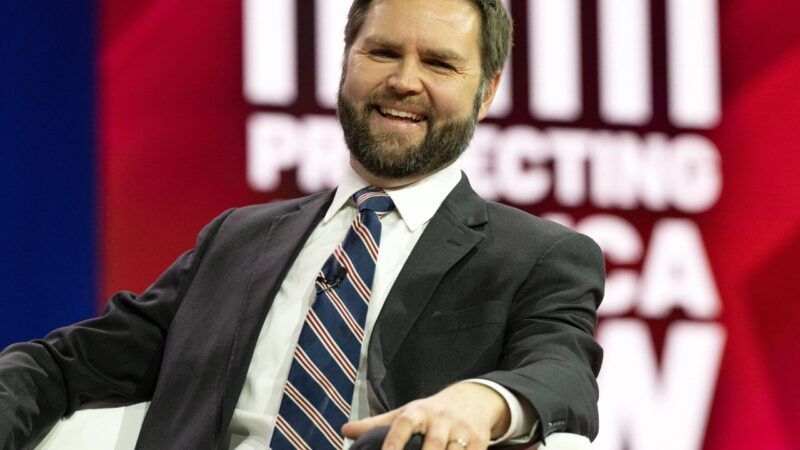
On Wednesday night, Sen. J.D. Vance (R–Ohio) took the stage at Catholic University in Washington, D.C., and declared—to the astonishment of many who subsequently read the quote online—that "there is no meaningful distinction between the public and the private sector in the American regime."
The remark came during a panel discussion about Regime Change, a new book by the "post-liberal" Notre Dame political scientist Patrick Deneen, in which Deneen argues that classical liberals and left-progressives are all pushing the same agenda and need to be "replaced" by a new conservative elite. (Keep an eye out for a review in the August/September issue of Reason.)
A longer version of the Vance quote gives the context:
One of the really bad hangovers from that uniparty that Patrick talked about is this idea that there is this extremely strong division between the public sector and the private sector. You know, the public sector is the necessary evil of government. We want to limit it as much as possible, because to the extent that we don't limit it, it's going to do a lot of terrible things. And then you have the private sector, that which comes from spontaneous order. It's organic. It's very Burkean. And we want to let people do as much free exchange within that realm as possible. And the reality of politics as I've seen it practiced, the way that lobbyists interact with bureaucrats interact with corporations, there is no meaningful distinction between the public and the private sector in the American regime. It is all fused together, it is all melded together, and it is all, in my view, very much aligned against the people who I represent in the state of Ohio.
I will give you a couple of examples here. One, when I talk to sort of more traditionalist economic conservatives, what Patrick would call economic liberals, when I talk to these guys about, for example, why has corporate America gone so woke, I see in their eyes this desperate desire to think that it's all just coming from the [Securities and Exchange Commission]. That there are a couple of bad regulations at the SEC, and that in fact [BlackRock CEO] Larry Fink would love to not be a super woke driver of American enterprise, and that Budweiser has no desire to put out a series of advertisements that alienate half their customer base. They're just being forced to do it by evil bureaucrats. And there is an element of truth to that. The element of truth is that the regime is the public and private sector. It's the corporate CEOs, it's the H.R. professionals at Budweiser, and they are working together, not against one another, in a way that destroys the American common good. That is the fact that we are dealing with.
There are, of course, countless ways that the public sector—government—has its tentacles in private sector affairs. Through taxation and regulation; through the subsidies and targeted benefits that are a mainstay of the industrial policy that so many on the New Right want to double down on; and, yes, through insidious pressure campaigns like those uncovered through the Twitter and Facebook Files, state power is routinely brought to bear to nudge or compel private actors into doing what those holding the power want. Needless to say, we should be skeptical, if not hostile, toward all such efforts.
Interestingly, this does not appear to be what Vance is referring to. If anything, he's saying it's naive to focus on instances of state coercion. Instead, Vance seems upset that some business executives share the same "woke" values that government actors express. (They are, after all, highly educated fellow members of the professional managerial class!) And because they believe in radical environmentalism, trans-inclusive politics, and all the rest, according to Vance, these private sector leaders are all too happy to collaborate with lawmakers and federal bureaucrats to put those values into practice.
Vance here is channeling the neoreactionary blogger Curtis Yarvin, a.k.a. Mencius Moldbug, who has popularized the idea that "all the modern world's legitimate and prestigious intellectual institutions, even though they have no central organizational connection, behave in many ways as if they were a single organizational structure" with "one clear doctrine or perspective." He calls this decentralized entity "the Cathedral" and argues that the only way to combat it is by replacing America's liberal democratic regime with an absolute monarchy or (benevolent, one hopes) dictatorship.
But Vance goes further even than Yarvin, who defines the Cathedral as consisting of the mainstream media and the universities; Vance insists that government officials are also implicated. This step is critical, because the New Right, rejecting the classical liberal commitment to limited government and rule of law, openly calls on conservatives to wield state power against their domestic political "enemies," among whom it counts lefty corporations, universities, and nonprofits.
I've made this point almost ad nauseam by now, but if you need a refresher, look no further than this illustrative quote from Heritage Foundation President Kevin Roberts: "This is our moment," he recently told The American Conservative, "to demand that our politicians use the power they have. This is the moment for us to demand of companies, whether they're Google, or Facebook, or Disney, that you listen to us, rather than ram down our throats and into our own families all of the garbage that you've been pushing on us. This is our time to demand that you do what we say. And it's glorious."
For an even more concrete example, consider the time Vance went on live TV and proposed targeting left-wing institutions such as the Ford Foundation and Harvard for their political views. "Why don't we seize the assets," he asked, "tax their assets, and give it to the people who've had their lives destroyed by their radical open borders agenda?"
This is obviously contrary to the laws of our land. The American constitutional system "protects private actors," says Notre Dame law professor Richard W. Garnett, while constraining how government officials can exercise their power. "Private actors have free speech rights. The government doesn't. Private actors have freedom of religion. Government doesn't. Private schools can train kids for their sacraments. Government schools can't. The whole landscape of our constitutionally protected freedoms depends on this conceptual distinction between state power and the nonstate sphere."
But that distinction is an obstacle preventing post-liberals such as Vance from using the government to punish private entities who express views or implement policies that they, the post-liberals, dislike. And so, to give themselves permission to do what they want, they have to get people to believe that the distinction is already obsolete.
It's not. In fact, the "collusion" that Vance would use as justification to strip private actors of their rights consists of some of the very activities named in the First Amendment: voicing political opinions and advocating for changes to public policy. That some business executives happen to agree with some federal bureaucrats on some topics does nothing to transform private entities into public ones or to erase the distinction between the two spheres. (And that assumes Vance et al. are correct about the scope of the overlap, which they've thus far made little effort to demonstrate.)
None of this means you have to like the way companies use their rights. "If there are large private entities that are engaging in speech that some might find offensive," Garnett says, "you can boycott them, you can not patronize them, you can criticize them, you can set up your own businesses" to compete with them. But the New Right appears to be "impatient" with these remedies.
"It seems to me that it's perfectly appropriate to point out, as Deneen and Vance are doing, that a lot of corporate America seems to be going outside of its lane in very ideological ways," Garnett says. "But it doesn't follow from that that the government can silence them or punish them."




