
Reason.com - Free Minds and Free Markets
Reason logo Reason logo
  • Latest
  • Magazine
    • Current Issue
    • Archives
    • Subscribe
    • Crossword
  • Video
    • Reason TV
    • The Reason Roundtable
    • Just Asking Questions
    • Free Media
    • The Reason Interview
  • Podcasts
    • All Shows
    • The Reason Roundtable
    • The Reason Interview With Nick Gillespie
    • The Soho Forum Debates
    • Just Asking Questions
  • Volokh
  • Newsletters
  • Donate
    • Donate Online
    • Donate Crypto
    • Ways To Give To Reason Foundation
    • Torchbearer Society
    • Planned Giving
  • Subscribe
    • Reason Plus Subscription
    • Gift Subscriptions
    • Print Subscription
    • Subscriber Support

Login Form

Create new account
Forgot password
Reason logo

Reason's Annual Webathon is underway! Donate today to see your name here.

Reason is supported by:
Scott Schneider

Donate

Media

Klobuchar's Media Bill Won't Save the Press

It'll just lend a hand to the outlets the senator prefers.
Jennifer Huddleston | 8.29.2022 7:30 AM

Share on FacebookShare on XShare on RedditShare by emailPrint friendly versionCopy page URL Add Reason to Google
Media Contact & Reprint Requests
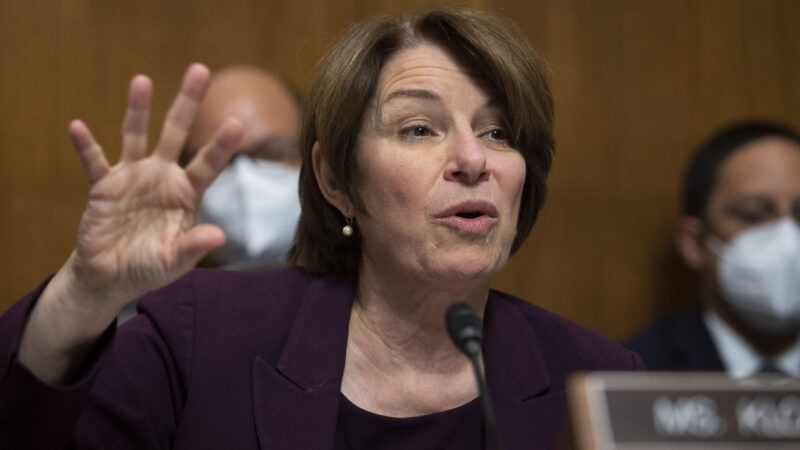
Amy Klobuchar with her hand up | Cliff Owen - CNP/picture alliance / Consolidated News Photos/Newscom
(Cliff Owen - CNP/picture alliance / Consolidated News Photos/Newscom)

Sen. Amy Klobuchar (D–Minn.) likes to paint herself as a 21st century trustbuster. However, her latest antitrust proposal, the Journalism Competition and Preservation Act (JCPA), is pro-collusion and provides an antitrust exemption for politically well-connected news media companies.

What this bill reveals is that the heart of the antitrust crusade by Klobuchar and other neo-Brandeisians is not actually about consumer protection or small businesses. They seek to use antitrust and the force of the government to protect the companies and industries they prefer.

The JCPA pits digital platforms like Facebook and Google against "traditional" media services such as newspapers. To "help" these traditional media companies against the supposedly big, bad tech companies, the JCPA mandates that platforms pay news publishers to link to their articles, creates an artificial limit discouraging news platforms from expanding their newsrooms' reach to reap the law's benefits, and creates an eight-year safe harbor from existing antitrust laws including allowing news companies to collude with one another. In short, this proposal empowers the government to help out its favored, eligible news services while also attacking today's successful tech companies. The real losers, however, are the American people.

The media plays an important role in public discourse, and one incredible benefit of the internet is the ability to access both hyperlocal information and news sources from around the world. For the average consumer, this means access to more sources of information and different voices than ever before. No longer is it just a matter of what makes the morning edition of a few newspapers, but instead, we can see what is happening on the other side of the world and read commentary from new perspectives.

It has allowed us to stay connected to what's going on back home even when we're far away and unable to get our favorite local news sources in print. For example, a beloved local pub in Arlington, Virginia, recently caught fire after a car crashed into it. Like many familiar with Ireland's Four Courts, I rushed online to see what had happened. Initially, the first reports of the incident came from bystander tweets of a local news site. Much to my and others' benefit, social platforms enable the quick sharing of this information rather than having to physically go find it, or worse, wait until the evening news or the next day's local or national paper decides to run it (or not).

But laws like the JCPA could make it more difficult and costly for platforms to provide access and allow users to share this sort of information from small, local news sources. Consumers might end up facing additional paywalls as online platforms will have to pay for sharing news.

Looking into the media industry itself, it's no secret that Americans increasingly distrust legacy news organizations. According to a recent Gallup poll, trust in the media has crashed over the past 30 years. But the press as an idea is still seen as very important to democracy.

As such, Americans and people globally still rely on local and niche news sources to obtain information that may not be important to others. But today, consumers are getting that information from more and different forms than ever before. Not only do we have traditional newspapers, TV, and radio channels, but we also have new types of media emerging, such as podcasts, apps, videos, blogs, and newsletters.

This dynamism is increasing the reach of legacy and emerging outlets alike without the need for the government to step in. However, traditional media outlets seem to be worried about current sentiments against their industry, and they may be turning to the government to ensure they remain viable even if Americans reject them. It's a playbook seen in other instances of industries running to the government and begging it to make things "fair" when the competition heats up, rather than evolving with market demands. The result would likely be, as has happened before, that the government unfairly props up those who are least useful in a changing market by giving them special privileges.

But the potential damage that laws like the JCPA could do is not purely theoretical. We can look at the consequences Australia has faced in light of a similar law. Like the JCPA, Australia's Media Bargaining Code was portrayed as protecting journalism from its loss to social media. Its actual results remain murky at best, and the way it's designed favors certain media players like Rupert Murdoch's News Corp. Increasingly, it has been revealed that proposals like the JCPA are less about helping local news and more about crony capitalism.

Today's journalists face many serious challenges, including the pressure to conform rather than innovate and improve. But the JCPA would further fail today's independent journalists, decrease the amount of information available, and raise costs for consumers, small outlets, and online platforms.

Start your day with Reason. Get a daily brief of the most important stories and trends every weekday morning when you subscribe to Reason Roundup.

This field is for validation purposes and should be left unchanged.

NEXT: How J.K. Rowling Became Targeted by Both Progressive Millennials and Christian Conservatives

Jennifer Huddleston is a senior fellow in technology policy at the Cato Institute and an adjunct professor at George Mason University's Antonin Scalia Law School.

MediaAntitrustJournalismMedia CriticismFacebookGoogle
Share on FacebookShare on XShare on RedditShare by emailPrint friendly versionCopy page URL Add Reason to Google
Media Contact & Reprint Requests

Show Comments (105)

Dec. 2 - Dec. 9, 2025 Thanks to 192 donors, we've reached $44,100 of our $400,000 goal!

Reason Webathon 2023

Donate Now! Donate Now

Latest

Trump's Crackdown on Afghan Refugees Won't Make America Any Safer

Autumn Billings | 12.3.2025 6:30 AM

Brickbat: Sold Out

Charles Oliver | 12.3.2025 4:00 AM

Trump Tries To Cut Congress Out of U.S. Attorney Appointments

Jacob Sullum | 12.3.2025 12:01 AM

The Law of War Was Not Designed for Trump's Bogus 'Armed Conflict' With Drug Smugglers

Jacob Sullum | 12.2.2025 6:20 PM

In Connecticut, Zoning Reform Is Back From the Dead

Christian Britschgi | 12.2.2025 1:30 PM

Recommended

  • About
  • Browse Topics
  • Events
  • Staff
  • Jobs
  • Donate
  • Advertise
  • Subscribe
  • Contact
  • Media
  • Shop
  • Amazon
Reason Facebook@reason on XReason InstagramReason TikTokReason YoutubeApple PodcastsReason on FlipboardReason RSS Add Reason to Google

© 2025 Reason Foundation | Accessibility | Privacy Policy | Terms Of Use

This site is protected by reCAPTCHA and the Google Privacy Policy and Terms of Service apply.

r

HELP EXPAND REASON’S JOURNALISM

Reason is an independent, audience-supported media organization. Your investment helps us reach millions of people every month.

Yes, I’ll invest in Reason’s growth! No thanks
r

I WANT TO FUND FREE MINDS AND FREE MARKETS

Every dollar I give helps to fund more journalists, more videos, and more amazing stories that celebrate liberty.

Yes! I want to put my money where your mouth is! Not interested
r

SUPPORT HONEST JOURNALISM

So much of the media tries telling you what to think. Support journalism that helps you to think for yourself.

I’ll donate to Reason right now! No thanks
r

PUSH BACK

Push back against misleading media lies and bad ideas. Support Reason’s journalism today.

My donation today will help Reason push back! Not today
r

HELP KEEP MEDIA FREE & FEARLESS

Back journalism committed to transparency, independence, and intellectual honesty.

Yes, I’ll donate to Reason today! No thanks
r

STAND FOR FREE MINDS

Support journalism that challenges central planning, big government overreach, and creeping socialism.

Yes, I’ll support Reason today! No thanks
r

PUSH BACK AGAINST SOCIALIST IDEAS

Support journalism that exposes bad economics, failed policies, and threats to open markets.

Yes, I’ll donate to Reason today! No thanks
r

FIGHT BAD IDEAS WITH FACTS

Back independent media that examines the real-world consequences of socialist policies.

Yes, I’ll donate to Reason today! No thanks
r

BAD ECONOMIC IDEAS ARE EVERYWHERE. LET’S FIGHT BACK.

Support journalism that challenges government overreach with rational analysis and clear reasoning.

Yes, I’ll donate to Reason today! No thanks
r

JOIN THE FIGHT FOR FREEDOM

Support journalism that challenges centralized power and defends individual liberty.

Yes, I’ll donate to Reason today! No thanks
r

BACK JOURNALISM THAT PUSHES BACK AGAINST SOCIALISM

Your support helps expose the real-world costs of socialist policy proposals—and highlight better alternatives.

Yes, I’ll donate to Reason today! No thanks
r

STAND FOR FREEDOM

Your donation supports the journalism that questions big-government promises and exposes failed ideas.

Yes, I’ll donate to Reason today! No thanks
r

FIGHT BACK AGAINST BAD ECONOMICS.

Donate today to fuel reporting that exposes the real costs of heavy-handed government.

Yes, I’ll donate to Reason today! No thanks