

Police

Armed Agents of the State Shouldn't Be Enforcing Traffic Laws

Interactions between the public and the police should be kept to a minimum.
|

Police officers have difficult jobs, going up against murderers, rapists, muggers, thieves, and hardened traffic violators. 

Which of those groups doesn't belong? 

The question is especially relevant as protesters take to the streets over unaccountable, abusive policing. A majority of Americans now support police reform. And some of the most important reforms we could be enacting are changes that would simply reduce interactions between the public and armed agents of the state.

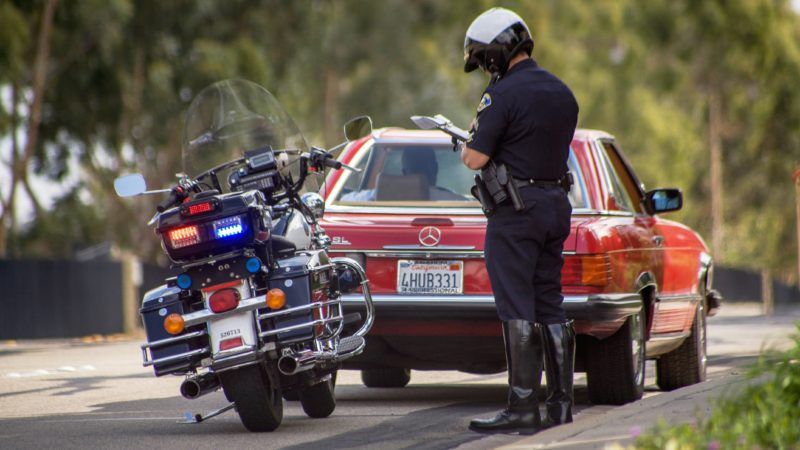
Cops pull over 20 million motorists a year—by far the most common form of police interactions with the American people. Those encounters occasionally end violently and tragically. Consider the cases of Darrius Stewart, Samuel DuBose, Philando Castile, and Maurice Gordon, all of whom were shot during routine traffic stops. Gordon was killed by a New Jersey state trooper just last month.

Those traffic stops often evolve into drug searches, which carry serious Fourth Amendment concerns. They also disproportionately impact black and Hispanic people. (Blacks are four times more likely to be arrested for drug offenses and 2.5 times more likely to be arrested for drug possession, though whites use drugs at comparable rates.) Those with fewer means are more likely to be fined, arrested, and shuffled through the legal system, notwithstanding the fact that they're less able to afford getting trapped in that cycle.

In Colorado and Washington, where marijuana has been legalized, search rates at traffic stops have dramatically declined, a testament to how often those arbitrary searches are tied to drug laws that have no impact on traffic safety.

But even traffic safety doesn't necessarily need to be enforced by the police. "Don't use a hammer if you don't need to pound a nail," writes economist Alex Tabarrok at Marginal Revolution. "The responsibility for handing out speeding tickets and citations should be handled by an unarmed agency. Put the safety patrol in bright yellow cars and have them carry a bit of extra gasoline and jumper cables to help stranded motorists as part of their job—make road safety nice."

It's a worthy idea. But it'll be tough to get state and local governments to accept it. Police departments, many of them furnished with weapons fit for a battlefield, often act as revenue raisers for the cities in which they serve.

"A Police Executive Research Forum report on St. Louis law enforcement found that local governments within the county were using police to 'plug revenue gaps' by running up the number of traffic citations, which coincided with many low-level arrests," writes Derek Thompson in The Atlantic. "As one St. Louis County resident told the report's authors: 'It's no secret that a lot of these municipal police officers are only supposed to be revenue drivers for their cities.'"

Relieving cops from traffic duty isn't the only way to reduce police encounters with the public. Eric Garner died at the hands of New York City police officer Daniel Pantaleo after Garner was approached for selling loose cigarettes. A Louisville cop shot Breonna Taylor during a no-knock drug raid. Taylor was not a drug dealer, but had previously dated someone who had been suspected of using her address to receive packages. Nevertheless, her killing was not unlike that of Osama Bin Laden's. She was shot 8 times after police broke into her home.

We could minimize such encounters just by having fewer laws. "Things like the war on drugs, they've given police officers multiple reasons to be present in [minority] communities," Reason's Zuri Davis recently told the Washington Examiner's Siraj Hashmi. That "gives rise to a lot more interaction—and negative interaction." If we want fewer innocent people to die at police officers' hands, we need to cut back on the encounters that keep spiralling into such deaths.

NEXT: San Francisco Police Were Ordered To Turn Off Body Cameras in Raid on Journalist's Home

Editor's Note: We invite comments and request that they be civil and on-topic. We do not moderate or assume any responsibility for comments, which are owned by the readers who post them. Comments do not represent the views of Reason.com or Reason Foundation. We reserve the right to delete any comment for any reason at any time. Report abuses.

  1. The responsibility for handing out speeding tickets and citations should be handled by an unarmed agency.

    SOFT ON CRIME.

    Fine, I agree as long as those touchy-feely social workers on wheels will be trained to smell marijuana and call in the big guns to search and detain the stoners.

    1. Actually, the opposite would happen as the safety patrol officers (who probably failed the police entrance exam) would still act like thugs to show the real cops that they’re badasses, too.

  2. When do cops go up against murderers, rapists, muggers and thieves? They solve, what, 17% of murders in Chicago? Tens of thousands of rape kits sit untested. Stolen property is rarely recovered. BTW Binion drugs were never sent to Breonna Taylor’s house that was a lie.

    1. Well, at least they file reports on such things to make it a little easier when dealing with insurance.

  3. But even traffic safety doesn’t necessarily need to be enforced by the police. “Don’t use a hammer if you don’t need to pound a nail,” writes economist Alex Tabarrok at Marginal Revolution. “The responsibility for handing out speeding tickets and citations should be handled by an unarmed agency.

    Why “an unarmed agency” when you can mandate AI-based remote electronic surveillance of every car? Or is that what Alex is alluding to?

    1. Why stop at monitoring? Just have the AI set your optimum traveling speed.

    2. “… mandate AI-based remote electronic surveillance of every car?”

      The problem with that, of course, is that some judges have thrown similar technologies (cameras) out of court… citing the inability of the defendant to “question the witness,” so I am thinking that is not to what Alex is referring. Then again, I don’t read minds.

      1. What if the AI is able to answer witness questions?

  4. Hmmm… maybe have cops on traffic duty keep their utility belt, with the pistol, etc., in the trunk? Brightly-colored cars are a good idea. Studies I have read seem to indicate that a highly visible police presence results in lower traffic speeds. But then, that would defeat their “fund-raising efforts,” no?

    1. Yeah, you know it’s getting towards the end of the month when the cops at the freeway emergency turn-arounds start hiding behind the trees with radar gun out instead of parking in plain sight with chair back and hat down.

      1. And just after the beginning of the month when they start lurking under highway bridges in U-turn lanes, looking for people with out of date registration/safety inspection stickers. I’ve personally seen one overzealous tax farmer actually jump in front of a moving car to induce the driver to stop. One of the stupidest things I’ve ever seen.

  5. Change the name of traffic enforcement to Super Big Hugs Happytime Adventure doesn’t really fix anything. The problem is too many damn laws, including traffic laws. Deputizing meter maids to pass out tickets while also being witness to probable cause as they pass on information to actual cops is as laughably stupid as defunding the police.

    Can we get some actually competent to consider police reform who can at least consider how police department would abuse any reform?

  6. Violative stops are a cornerstone of American Criminal Justice how can we possibly rid ourselves of the agents? Won’t someone please think of the children.

    1. Especially the diaspora of immigrant children who are disproportionately affected by racist and sexist traffic stops.

      #AbolishICE
      #DefundRacism
      #ImmigrantsAreBeautiful
      #CHAZ

  7. So you want to create a separate law enforcement agency for traffic? It forms not actually solve the incentive for local governments to use traffic enforcement as a revenue source.

    Keep in mind what happened in Atlanta was not merely a traffic infraction. He was blocking the Wendy’s drive thru, it was initially more a trespassing issue.

    1. (I’m just spouting off because I’ve read zilch about the actual details of the Atlanta thing)

      And the Wendy’s manager learned from his high school principal that the first thing you do in any situation is always call the cops. Never do something simple, like pound on the guy’s window and tell him to get his ass moving.

  8. Meter maids with better wheels?

  9. “Police officers have difficult jobs, going up against murderers, rapists, muggers, thieves, and hardened traffic violators. ”

    Because rapists, muggers and thieves never break traffic laws?

    There’s some overlap in that Venn diagram.

  10. For years now I’ve been irritated by the people who turn every instance of police brutality into a reason to harp on systemic racism instead of addressing the actual problem. The problem being the myriad laws that put police into violent conflict with other citizens. I’ve always focused on the War on Drugs and other regulations that create victimless crimes (gun laws, knife laws, loose cigarette laws, etc.), but I’m adding this one to my list. Traffic violations in and of themselves are victimless crimes too. So, yeah I think this is a good idea. Most of the work could probably be done by cameras.

    Oh, but obviously the best solution would be to privatize all the roads.

    1. Traffic laws are victimless crimes until they cause an accident. I agree that if my failure to use a turn signal didn’t cause an accident I don’t need a citation, but if my failure to use a turn signal does cause an accident the fact that I was disobeying the law is what warrants me being on the hook for the damages done. So they should be done away with. They should be fine-less unless an accident occurs. Other traffic laws, excessive speeding or running a red light, can have such a high price if an accident does occur that they are closer to the random discharge of a weapon in a crowded area. They should be fined and monitored to discourage people from doing it.

  11. Police departments, many of them furnished with weapons fit for a battlefield, often act as revenue raisers for the cities in which they serve.

    In most places that’s their primary job, and has been for quite some time.

  12. Fun fact-I was pulled over back in 1994 or so for some unknown reason, and 6 cop cars showed up. A plainclothes officer approached and started screaming at me as they thoroughly searched the car and even my pack of cigarettes. Turns out they were filming an episode of COPS, but my incident didn’t make the cut, I guess because they didn’t find anything on me.

  13. Knowing they are unharmed in their clown cars would make some think about not bothering to stop.

    1. Feature, not a flaw.

Please to post comments


