

Reason.com - Free Minds and Free Markets
Reason logo Reason logo
  • Latest
  • Magazine
    • Current Issue
    • Archives
    • Subscribe
    • Crossword
  • Video
    • Reason TV
    • The Reason Roundtable
    • Just Asking Questions
    • Free Media
    • The Reason Interview
  • Podcasts
    • All Shows
    • The Reason Roundtable
    • The Reason Interview With Nick Gillespie
    • The Soho Forum Debates
    • Just Asking Questions
  • Volokh
  • Newsletters
  • Donate
    • Donate Online
    • Donate Crypto
    • Ways To Give To Reason Foundation
    • Torchbearer Society
    • Planned Giving
  • Subscribe
    • Reason Plus Subscription
    • Gift Subscriptions
    • Print Subscription
    • Subscriber Support

Login Form

Create new account
Forgot password

Politics

The FCC's New Internet Rules Put the FCC in Charge of the Internet

New net neutrality rules give the agency veto power over ISP innovations.
Peter Suderman | 3.12.2015 1:31 PM

Share on FacebookShare on XShare on RedditShare by emailPrint friendly versionCopy page URL Add Reason to Google
Media Contact & Reprint Requests
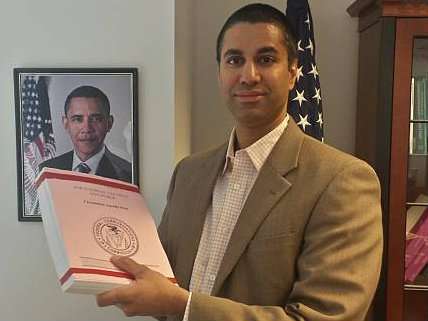
Ajit Pai/Twitter

It's been two weeks since the Federal Communications Commission voted to overhaul the way broadband Interner service is regulated, changing it from a Title I information service to a Title II telecommunications service—essentially making it a utility, like the phone system—in order to enforce net neutrality rules.

And yet only today is the 300-page order, drawn up by FCC Chairman Tom Wheeler and supported by the commission's two Democratic members, available for public viewing. This was perhaps the most consequential shift in Internet policy in nearly two decades, and it was put in place without full public access.

And yet even though the rules are now available for all to see, it remains somewhat unclear how exactly they will work in practice. As The New York Times notes today, the FCC is "set to decide what is acceptable on a case-by-case basis. The regulations include a subjective catchall provision, requiring 'just and reasonable' conduct."

What counts as 'just and reasonable' will, naturally, be up to the whims of the FCC.

In some ways, this is the worst part of the agency's net neutrality push: It's not even that it puts in place bad rules; it's that it installs potentially strict but ultimately vague rules, and leaves the FCC as the final arbiter of what is and isn't acceptable, with little to constrain its decisions. The FCC will have some guidelines, of course, but Wheeler's book-length bureaucratic proposal will surely provide legal ammunition for whatever creative interpretation the agency settles on (or desires) at any given time.

Wheeler's description of how this will play out is flawed but also instructive. "We don't really know. We don't know where things go next," he said, according to The New York Times. "We have created a playing field where there are known rules, and the F.C.C. will sit there as a referee and will throw the flag."

On the contrary, under the standard set by the order, the FCC isn't enforcing known rules; it is roaming the field making the rules up on the spot. Imagine a game in which the referee was authorized to throw a flag for "unjust" or "unreasonable" conduct any time players attempted a new strategy or innovative style of play. Players might have some general sense of what would trigger a ref's particular sensibility, but wouldn't ever know for sure.

As a result, you'd expect two things to happen: Players would deploy new moves more cautiously, and teams would spend more time pressuring the refs to use their wide discretion to allow certain types of plays—probably while arguing that their opponents' signature plays were out of bounds.

This is more or less what to expect in the wake of the FCC's rules: ISPs will probably invest and innovate more cautiously, knowing that the FCC has veto power over their decisions. And armies of expensive telecom lawyers will spend their days arguing about what, exactly, constitutes "just and reasonable" in a wide variety of circumstances.

As telecom analyst Roger Entner told the Times, "Telecom lawyers in Washington popped the corks on the champagne," when the rules were passed last month. "It will be at a least a hundred million in billable hours for them. This will go on for a while."

Critics sometimes describe net neutrality as a government takeover of the Internet. This is in most ways an exaggeration; the Net will remain for the most part privately operated, with competing though heavily regulated firms continuing to own and operate the infrastructure. But though this line is an exaggeration, it has a grain of truth, in that the FCC has now inserted itself in a potentially prominent into the decision-making of these private Internet service providers. ISPs will now need the FCC's permission, at least tacitly, to innovate and to invest, and they will inevitably make major business decisions with the FCC's veto power in mind. The agency, and its murky "just and reasonable" standard, will be a shadow presence whenever any major move is contemplated. The publication of the FCC's order, in other words, mostly serves to confirm that the rules will mean whatever the agency wants them to mean. 

Start your day with Reason. Get a daily brief of the most important stories and trends every weekday morning when you subscribe to Reason Roundup.

This field is for validation purposes and should be left unchanged.

NEXT: 5 Ways States Are Trying to Erode Abortion Access This Week

Peter Suderman is features editor at Reason.

PoliticsPolicyScience & TechnologyNet NeutralityInternetTelecommunications Policy
Share on FacebookShare on XShare on RedditShare by emailPrint friendly versionCopy page URL Add Reason to Google
Media Contact & Reprint Requests

Show Comments (223)

Latest

Hegseth's Alleged Order To 'Kill Everybody' Complicates Trump's Defense of His Murderous Anti-Drug Campaign

Jacob Sullum | 12.1.2025 3:35 PM

Chicago Is the Latest Example of How Public School Spending Doesn't Prioritize Students

Gregory Lyakhov | 12.1.2025 2:00 PM

Livestream: Behind the Scenes With Reason's Libertarian Journalists

Liz Wolfe | 12.1.2025 1:20 PM

To the Socialists of All Parties

Katherine Mangu-Ward | From the January 2026 issue

Lawmakers To Consider 19 Bills for Childproofing the Internet

Elizabeth Nolan Brown | 12.1.2025 12:12 PM

Recommended

  • About
  • Browse Topics
  • Events
  • Staff
  • Jobs
  • Donate
  • Advertise
  • Subscribe
  • Contact
  • Media
  • Shop
  • Amazon
Reason Facebook@reason on XReason InstagramReason TikTokReason YoutubeApple PodcastsReason on FlipboardReason RSS Add Reason to Google

© 2025 Reason Foundation | Accessibility | Privacy Policy | Terms Of Use

This site is protected by reCAPTCHA and the Google Privacy Policy and Terms of Service apply.

r

HELP EXPAND REASON’S JOURNALISM

Reason is an independent, audience-supported media organization. Your investment helps us reach millions of people every month.

Yes, I’ll invest in Reason’s growth! No thanks
r

I WANT TO FUND FREE MINDS AND FREE MARKETS

Every dollar I give helps to fund more journalists, more videos, and more amazing stories that celebrate liberty.

Yes! I want to put my money where your mouth is! Not interested
r

SUPPORT HONEST JOURNALISM

So much of the media tries telling you what to think. Support journalism that helps you to think for yourself.

I’ll donate to Reason right now! No thanks
r

PUSH BACK

Push back against misleading media lies and bad ideas. Support Reason’s journalism today.

My donation today will help Reason push back! Not today

Donate to Reason Webathon 2019 because:

You can count on it to deliver facts not fallacies.

Yes, I want to support Reason's quality journalism! No thanks

Donate to Reason Webathon 2019 because:

You can count on it to deliver facts not fallacies.

Yes, I want to support Reason's quality journalism! No thanks

Donate to Reason Webathon 2019 because:

You can count on it to deliver facts not fallacies.

Yes, I want to support Reason's quality journalism! No thanks

Donate to Reason Webathon 2019 because:

You can count on it to deliver facts not fallacies.

Yes, I want to support Reason's quality journalism! No thanks

Donate to Reason Webathon 2019 because:

You can count on it to deliver facts not fallacies.

Yes, I want to support Reason's quality journalism! No thanks

Donate to Reason Webathon 2019 because:

You can count on it to deliver facts not fallacies.

Yes, I want to support Reason's quality journalism! No thanks

Donate to Reason Webathon 2019 because:

You can count on it to deliver facts not fallacies.

Yes, I want to support Reason's quality journalism! No thanks

Donate to Reason Webathon 2019 because:

You can count on it to deliver facts not fallacies.

Yes, I want to support Reason's quality journalism! No thanks

Donate to Reason Webathon 2019 because:

You can count on it to deliver facts not fallacies.

Yes, I want to support Reason's quality journalism! No thanks


