The court allowed the case to go forward in an opinion on June 2: Press accounts, on which defendant political organization (the Senate Majority PAC) was generally entitled to rely, had said that (1) Moore "had been banned from the mall because he repeatedly badgered teen-age girls" and that (2) he had told a 14-year-old girl at the mall "she looked pretty." But the organization had apparently juxtaposed the two quotes, in a way that may have been suggested that he solicited sex from a 14-year-old girl:
"Moore was actually banned from the Gadsden Mall … for soliciting sex from young girls." –New American Journal, 11/12/2017
"One he approached 'was 14 and working as Santa's helper.' " –AL.com, 11/13/2017
The court had concluded that,
[V]iewing the evidence in the light most favorable to Moore, … telling viewers that Moore was banned from the mall for soliciting sex from a 14-year-old Santa's Helper is more stinging than telling viewers that Moore complimented a 14-year-old girl on her appearance or telling them more generally that Moore was banned from the mall for soliciting young girls. The jury must decide whether the substance or sting of the juxtaposed ad was justified.
The jury apparently agreed, giving a verdict for Moore after getting instructions based on that legal conclusion. The 14-year-old girl had "told the Washington Post that when she was 14 and working as Santa's Helper, 'Moore told her that she looked pretty' then when she was 16, 'he began asking her out on dates in the presence of her mother at the photo both.'" And I take it the jury took the view that there's a sufficient difference between a 30-year-old's asking out a 16-year-old—which I expect many would disapprove of, but is perfectly legal in most states, including Alabama, even if the goal is sex—and a 30-year-old's soliciting sex from 14-year-old, which was a crime both then and now.
From Beathard v. Lyons, decided Thursday by Judge James Shadid (C.D. Ill.):
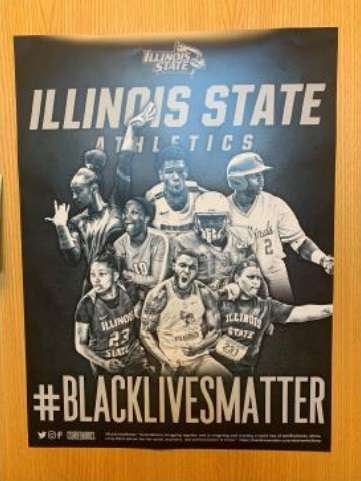
The following facts are taken from Plaintiff's Complaint, which the Court accepts as true for the purposes of a motion to dismiss. Plaintiff filed a complaint alleging that he was terminated from his position because of his viewpoint on a matter of public concern—the Black Lives Matter Movement ("BLM"). Plaintiff was employed by Illinois State University ("ISU") as a football coach. In mid-August of 2020, ISU's Athletic Department printed posters for the BLM Movement. Many staff members pasted the poster onto their doors, and one was pasted onto Plaintiff's office door. An image of the poster has been reproduced below:
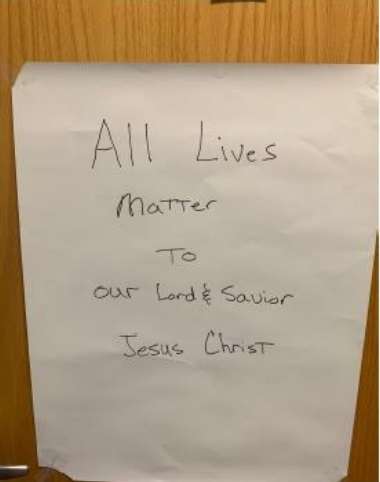
Plaintiff removed the poster from his door and replaced it with one that embodied his own personal beliefs on the matter. An image of Plaintiff's poster ("replacement poster") has been reproduced below:
Eugene has kindly invited me to contribute a series of posts, briefly describing my taxonomy of new variants of the most-favored-nation theory of religious liberty (forthcoming in the Iowa Law Review). I'm particularly pleased by the invitation, because I wrote the piece in conscious emulation of the kind of careful cataloguing of the capillaries of First Amendment doctrine that he does better than, well, anybody.
The First Amendment provides in pertinent part: "Congress shall make no law respecting an establishment of religion, or prohibiting the free exercise thereof." In Employment Division v. Smith (1990), the Court read this provision narrowly, holding that burdens on religion do not in themselves create any presumptive right to exemption from generally applicable laws. However, the Court later explained in Church of Lukumi Babalu Aye v. Hialeah (1993), "the protections of the Free Exercise Clause pertain if the law at issue discriminates against some or all religious beliefs or regulates or prohibits conduct because it is undertaken for religious reasons." Lukumi held that, although religion is entitled to no special privileges, it is protected from discrimination.
Since then, the Court has construed that protection with increasing breadth. It now embraces what has been called the "most-favored-nation" theory (hereinafter MFN), which holds that the denial of a religious exemption is presumptively unconstitutional if the state "treats some comparable secular activities more favorably." That made sense in the context in which it was originally formulated, but the theory has mutated.
The Court has broadened its understanding of what counts as discrimination against religion, reaching beyond malice to include selective sympathy and indifference. Strict scrutiny applies even to a law that does not mention religion, so long as the law permits secular activities that the judges regard as comparable. The Court has been remarkably casual in its findings of underinclusiveness, repeatedly mischaracterizing the comparative harms of religious and secular claims. It has declared that the mere possibility of an exception, even if it has never been exercised, triggers strict scrutiny.
The First Amendment prohibits discrimination against religion. In a short time, mostly in cases challenging efforts to contain the Covid pandemic, the Supreme Court has transformed this familiar rule into new, more exacting doctrines that might exempt religious people from almost any law. This article taxonomizes these doctrinal variants, showing that they are dangerous, indefensible mutations of the most-favored-nation (MFN) theory of religious discrimination. These variants go well beyond the most attractive rationale for MFN. Their implications are so anarchic that the Court cannot possibly pursue them to the limits of their logic. Their deployment in practice will necessarily be selective, and is likely to benefit claimants the judges like and to constrain laws the judges dislike.
I've long been troubled by the relatively aggressive versions of this "most-favored-nation" theory, starting with my A Common-Law Model for Religious Exemptionsarticle in 1999 (pp. 1539-42) on to my Fulton v. City of Philadelphia amicus brief (pp. 23-30); and I'm therefore particularly glad to see Prof. Koppelman's contribution.
Law students around the country will be starting classes over the next few weeks. Back in 2018, I wrote a post offering advice to entering students. I tried to focus on points that I rarely, if ever, see made in other pieces of this type. I think all three of the suggestions I made remain just as relevant today. So I reprint my advice from the original post largely unaltered:
1. Think carefully about what kind of law you want to practice.
Law is a profession with relatively high income and social status. Yet studies repeatedly show that many lawyers are deeply unhappy, a higher percentage than in most other professions. One reason for this is that many of them hate the work they do. It doesn't necessarily have to be that way. There are lots of different types of legal careers out there, and it's likely that one of them will be a good fit for you. A person who would be miserable working for a large "Biglaw" firm might be happy as a public interest lawyer or a family law practitioner, and so on. But to take advantage of this diversity, you need to start considering what type of legal career best fits your needs and interests.
There are many ways to find out about potential options. But one place to start is to talk to the career services office at your school, which should have information about a range of possibilities. Many also often have databases of alumni working in various types of legal careers. Talking to these people can give you a sense of what life as a practitioner in Field X is really like.
Regardless, don't just "go with the flow" in terms of choosing what kind of legal career you want to try. The jobs that many of your classmates want may be terrible for you (and vice versa). Keep in mind, also, that you likely have a wider range of options now than you will in five or ten years, when it may be much harder to switch to a very different field from the one you have been working in since graduation.
2. Get to know as many of your classmates and professors as you reasonably can.
Law is a "people" business. Connections are extremely important. No matter how brilliant a legal thinker you may be, it's hard to get ahead as a lawyer purely by working alone at your desk. Many of your law school classmates could turn out to be useful connections down the road. This is obviously true at big-name national schools whose alumni routinely become judges, powerful government officials, and partners at major firms. But it's also true at schools whose reputation is more regional or local in nature. If you plan to make a career in that area yourself, many of your classmates could turn out to be useful contacts. The same holds true for professors, many of whom have extensive connections in their respective fields. They are sometimes harder to get to know than students. But the effort is often worth it, anyway. And many of them are actually more than eager to talk about their work.
This is one front on which I didn't do very well when I was in law school, myself. Nonetheless, I am still going to suggest you do as I say, not as I actually did. You will be better off if you learn from my mistake than if you repeat it.
3. Think about whether what you plan to do is right and just.
Law presents more serious moral dilemmas than many other professions. What lawyers do can often cost innocent people their liberty, their property, or even their lives. It can also save all three. Lawyers have played key roles in almost every major advance for liberty and justice in American history, including the establishment of the Constitution, the antislavery movement, the civil rights movement and many others. But they have also been among the major perpetrators of most of the great injustices in our history, as well.
Robert Cover's classic book Justice Accused - a work that made a big impression on me when I was a law student - describes how some of the greatest judges and legal minds of antebellum America became complicit in the perpetuation of slavery. While we have made great progress since that time, the legal system is not as far removed from the days of the Fugitive Slave Acts as we might like to think. There are still grave injustices in the system, and lawyers whose work has the effect of perpetuating and exacerbating them. We even still have lawyers who do such things as come up with dubious rationales for deporting literal escaped slaves back to places where they are likely to face further oppression.
Law school is the right time to start working to ensure that the career you pursue is at least morally defensible. You don't necessarily have a moral obligation to devote your career to doing good. But you should at least avoid exacerbating evil. And it's easier to do that if you think carefully about the issues involved now (when you still have a wide range of options), than if you wait until you are already enmeshed in a job that involves perpetrating injustice. At that point, it may be too late, both for you and (more importantly) for the people harmed.
The experience of the Covid-19 pandemic has, I think, highlighted the importance of Point 2. The loss of much in-person contact was a serious problem, and we should take advantage of the rise of vaccination and natural immunity to bring it back more fully than many educational institutions did in the last academic year.
I don't think I need to dwell on how the events of the last few years have reinforced the significance of Point 3. Suffice to say there are many recent examples of lawyers facilitating both good and evil. Even if you don't make a point of maximizing the former, you should try to avoid contributing to the latter.
8/14/1935: President Roosevelt signs into law the Social Security Act of 1935. The Supreme Court upheld the constitutionality of this law in Helvering v. Davis (1937).
City of Wichita v. Trotter, decided today by the Kansas Supreme Court (in a unanimous opinion written by Justice Evelyn Zabel Wilson) struck down as unconstitutionally overbroad W.M.O. [Wichita Municipal Ordinances] 3.06.030., which required licenses "after-hours establishments" that included, among other things, music, trivia, or games:
"'After-hours establishment' means any venue for a series of events or ongoing activity or business, occurring alone or as part of another business, to which the public is invited or allowed which is open anytime between midnight and 6:00 a.m., where individuals gather and is not otherwise licensed for the sale of alcoholic beverages or cereal malt beverages or otherwise licensed by the City of Wichita or state of Kansas for a business at that location. This term shall not include hospitals, hotels, motels or other boarding houses nor is it intended to apply to private homes where specifically invited guests gather. A combination of two or more of the following factors is prima facie evidence that an establishment is an 'after-hours establishment':
"(1) Playing of music either recorded or live;
"(2) Entertainment such as trivia or games;
"(3) Sporting events in person or broadcasted on screens;
"(4) Crowds in excess of 20 people;
"(5) Alcoholic beverages present;
"(6) Food by an unlicensed vendor offered for purchase or as a benefit of paid entry;
"(7) Entry allowed only upon payment of a fee or membership;
"(8) Establishment monitored by security guards;
"(9) Advertisements or notifications on social media or by other means that invite the public to attend or participate in functions or activities located on the premises of such establishment…..
The suspect has apparently just been identified as Hadi Matar; the N.Y. Sun (Joe Marino & Evan Simko-Bednarski) reports,
A New Jersey man with sympathies toward the Iranian government was arrested and accused of stabbing famed novelist Salman Rushdie on Friday, according to law enforcement sources briefed on the investigation….
Sources told The Post that an initial investigation suggests Hadi is sympathetic to the Iranian regime and the Islamic Revolutionary Guard.
The talk, at the Chautauqua Institution, was to be on "the United States as asylum for writers and other artists in exile and as a home for freedom of creative expression."
UPDATE [9:22 pm]: "Rushdie is on a ventilator"; "will likely lose one eye; the nerves in his arm were severed; and his liver was stabbed and damaged" (N.Y. Times [Jay Root, David Gelles, Elizabeth A. Harris & Julia Jacobs]).
They appear to be here (the order to unseal is here).
UPDATE: This only includes the warrant and the receipt, which is apparently all that the Justice Department asked to unseal. Third parties have apparently also asked for unsealing of the warrant application and the affidavit used to justify the warrant; presumably that remains pending.
Please enjoy the latest edition of Short Circuit, a weekly feature written by a bunch of people at the Institute for Justice.
Friends, Short Circuit Live is heading to New York City. Please join us on October 26th for a live recording of the Short Circuit podcast focusing on the Second Circuit, featuring Maaren Shah of Quinn Emanuel, Bruce Green of Fordham Law, and Alexander Reinert of Cardozo Law (who incidentally has a new paper out that blows SCOTUS's common-law justification for qualified immunity to smithereens). Click here to RSVP.
Back in 2019, the House Ways and Means Committee asked the Treasury Department to turn over the federal tax returns for one Donald John Trump. Is there a valid legislative purpose behind the request? D.C. Circuit: Yes. The information is relevant to the efficacy of the Presidential Audit Program. Cough 'em up.
In 2016, D.C. officials crafted new regulations requiring childcare providers to obtain college credentials in early childhood education. Daycare providers and parents: Which will throw a lot of us out of work and raise the cost of childcare (that is already the highest in the nation) while providing no actual benefits to children. D.C. Circuit: It is rational to make it illegal to take care of 2-year-olds without first passing college-level math courses. (This is an IJ case.)
Affixing a bump stock to a semiautomatic weapon allows a shooter to fire multiple times with a single "pull" of the trigger; the bump stock manages recoil so that the trigger reengages continuously until the shooter releases their grip on the barrel or they're out of ammo, allowing them to fire an estimated 400 to 800 rounds per minute compared to 180 without. D.C. Circuit: Which makes it an illegal machine gun. [Ed.: By the by, this might be the first time your humble staff has seen a pro se amicus referenced.]
Would-be developer of affordable apartments (half set aside for seniors) spends years working with Islip, N.Y. planning officials on traffic, wetland, and other issues. But the town board declines to hold a scheduled vote in 2016 after residents roundly, rowdily object to the types of folks who'd move in. District court: So the town never gave a final decision on the project (notwithstanding the town attorney's alleged statements to the contrary), and the developer's suit isn't ripe. Second Circuit: Vacated and remanded.
More than 10 years after her 18-day jail sentence (for harassment), Linden, N.J. woman's conviction is reversed. She files a Section 1983 claim for the prosecutorial and judicial misconduct (related to the improper appointment of a private prosecutor) that led to her conviction in the first place. Is she too late? Third Circuit: No! Her case was Heck barred until her conviction was reversed, which means the statute of limitations wasn't running either.
In circumstances that can charitably be described as "not ideal," man is found passed out in his car with an empty bottle of Hennessey by his side, a marijuana blunt in the ashtray, and $69k in cash in the trunk. But does that make him a drug dealer? And should the government be able to forfeit his cash? Fourth Circuit: Not necessarily. We reject the gov't's argument "that lawful citizens do not carry around large amounts of cash." Indeed, "not using a bank does not necessarily make one a criminal." The case goes to a jury. (Note: IJ filed an amicus brief in this case and participated at oral argument).
Allegation: Texas A&M employee is fired for complaining about HR hassles. Wrongful termination in violation of the Fair Labor Standards Act? Judge Costa, concurring: "It says something about how much qualified immunity dominates section 1983 litigation that everyone in the district court—the experienced lawyers and judges alike—assumed the immunity exists whenever a public official is sued." Anyhoo, the Fifth Circuit sends the case back down for a look at whether QI applies to FLSA claims.
As USPS mail carrier delivers package to Lafayette, La. home, her thumb slips into a pre-existing hole in the package; she thinks she feels marijuana. Out of concern for nearby children, she then lifts an already torn flap, and, after doing some internet research on her phone, now suspects it's meth. (She's right the second time.) Suppress the evidence? The Fifth Circuit says no; the Fourth Amendment only applies to law enforcement, and she wasn't doing law enforcement. Concurrence: Why are we saying the Fourth Amendment doesn't apply when we have all these exceptions to the exclusionary rule to work with?
Man and woman are shot to death in their Texas home and their bodies lit on fire; the fumes asphyxiate their three young daughters upstairs. Police home in on a friend of the man's who had been shooting pool in the house that night and had been having an affair with the woman. No physical evidence links the friend to the murders, and he has an alibi. The state relies heavily on two factors to obtain a conviction and death sentence: jailhouse snitches and the presence of the friend's semen in the woman. District court: The prosecutor (now a true-crime TV host) suppressed evidence that the snitches were lying and that semen can survive in a mouth for 72 hours. Habeas granted. Fifth Circuit: Reversed and death sentence restored. Habeas is a high bar that you do not meet.
Summoned to prevent a suicide, El Paso, Tex. officer sees man on his tiptoes with his hands around a rope that is around his neck and hanging from a basketball hoop. The man declines to show his hands; the officer tases him. The man dies. Officer: It was dark. He could have had a weapon. Fifth Circuit: Qualified immunity. There's no case from this circuit that clearly establishes this is unconstitutional (nor is there one now). Also, even if there were such a case it might not count; Supreme Court opinions might be the only cases that clearly establish anything.
Adrian, Mich. officer impounds a driver's car for bad plates and no insurance. When the driver's dad comes to pick her up, he and the officer argue; the dad yells "fuck you" and flips the officer off. The officer (dropping several f-bombs himself) then repeatedly tases dad and punches and kicks him while he's prone and saying that he's not resisting. Sixth Circuit: No qualified immunity.
Michigan inmate dies of a fentanyl overdose—the third overdose in his unit in three days. His mom alleges prison officials violated Eighth Amendment by allowing a dangerous drug-smuggling ring to operate, involving a prison-guard collaborator and drugs tossed over the prison fence in basketballs. Sixth Circuit: Seems like the officials were pretty deliberately indifferent to people dying of bad drugs, some of these claims should not have been dismissed. Dissent: "If ever a claim was designed for qualified immunity, this is it."
Motorist drives to end of driveway, stops, and turns into the street. Yikes! An Elyria, Ohio officer pulls him over and discovers contraband. Was there probable cause for the stop? Officer: Indeed, state law required the motorist to stop before the end of the driveway, in the "sidewalk area" where an unmarked sidewalk crossed the driveway. Sixth Circuit: Maybe the law says that. Maybe it doesn't. No need to suppress the evidence.
Milwaukee man is exonerated by DNA evidence after spending 24 years in prison. He sues the officers involved in his arrest, alleging, among other issues, that they used "unduly suggestive identification procedures" that led to him being falsely picked out of the line-up. Seventh Circuit: It's definitely possible that they were unduly suggestive, but not clearly establishedly so. Qualified immunity granted.
In 1969, an Illinois political candidate and a voter teamed up to file a federal lawsuit challenging Illinois's tradition of rampant political patronage, and in 1972, they secured a consent decree. Now fifty years later, it's time the federal courts retire that decree, says the Seventh Circuit (over the protestations, remarkably, of the same two original plaintiffs).
Hartland, Wisc. officials pass an ordinance that caps the number of new sex offenders who can move within the village's idyllic borders. Sex offender: That feels like retroactive punishment in violation of the Constitution's Ex Post Facto Clause. Seventh Circuit: Under binding precedent, you'd be wrong. We've previously said that these kinds of forward-looking laws aren't impermissibly "retroactive" even if they impose legal disabilities based on past misdeeds. But you know what? That binding precedent is wrong. So it's overruled. Case remanded for the district court to evaluate whether the village's ordinance was punitive.
Several Anoka County, Minn. residents sue a school district and a teachers' union over agreement that will allegedly result in the district paying teachers for time spent on the union's political activities. Eighth Circuit: Generally taxpayers don't have standing to sue over a policy they don't like simply because it impacts the public fisc. But these plaintiffs are suing as municipal taxpayers (rather than as state or federal ones), and there's an exception for that. Case undismissed.
At supervised-release-revocation hearing, federal judge forces man (initially imprisoned for threatening to kill a federal judge) to choose between representing himself and being represented by appointed counsel who doesn't know anything about his case and admitted to being "as dumb as a doorbell or a doorknob." Eighth Circuit (over a dissent): Which violated his right to counsel.
Distressed by the content of a college course discussing Islamic terrorism, Islamic student sues for violations of his First Amendment rights. Ninth Circuit: But we can't find any cases where the content of a college course was found to violate the religion clauses, so qualified immunity. Dissent: The student lost credit for refusing to agree with statements like, "Terrorism is justified within the context of jihad in Islam." There's enough here to go to a jury.
States love banning non-residents from gathering petition signatures almost as much as federal appellate courts—here, the Ninth Circuit, joining the Fourth, Sixth, Seventh, and Tenth—love striking those prohibitions down.
Air Force general allegedly sexually assaults colonel in her Simi Valley, Calif. hotel room. (He later becomes vice chairman of the Joint Chiefs of Staff). Ninth Circuit: Usually service members can't sue over injuries sustained in the service, but since they were at a private hotel and attending a conference hosted by a civilian organization with comparatively few military officials, this gets past a motion to dismiss.
Allegation: Mesa, Ariz. high school teacher begins relationship with student over Snapchat, which becomes sexual when the student turns 16 and then continues for four years. Ninth Circuit (unpublished): Alas, the student brought her case two years too late. A state statute extending the statute of limitations for child-sexual-abuse claims doesn't apply based on our precedent, which we, as a three-judge panel, cannot reverse.
In 1981, a Utah jury convicted a virulently racist serial killer of federal civil rights violations for killing two black men jogging in a public park. (He was later executed in Missouri for ambushing a synagogue there.) Key testimony at his Utah trial came from a 16-year-old witness who was hit with shrapnel. Thirty-five years later, she sues the prosecutor who had prepared her for the trial, alleging that he'd repeatedly raped her. Utah Supreme Court: The state law passed in 2016 to extend the statute of limitations for child-sexual-abuse claims is unconstitutional. Tenth Circuit: Which means her case is toast.
Lawyer: Colorado criminalizes disclosing any information contained in records of child abuse or neglect. I represent parents in child abuse cases and this violates my First Amendment rights. Colorado: We have to do this to get money under the federal Child Abuse Prevention and Treatment Act. Tenth Circuit: "It is no excuse for a state that is violating the constitutional rights of its citizens to say 'the federal government is paying us to do it.'"
Man invents the "Device for the Autonomous Bootstrapping of United Science," or DABUS, and then asserts that the program itself then invented two inventions. The man fills out paperwork to patent them and doesn't list his name as the "inventor," but DABUS's. Can an artificial intelligence entity get a patent? Patent and Trademark Office: No. District court: Also no. Federal Circuit: No again. The Patent Act says "individual" and that means a human one.
And in en banc news, the D.C. Circuit will not reconsider its decision that members of the House Oversight Committee were entitled to documents showing how much former President Trump was benefitting from the Trump Organization's lease of the Old Post Office building.
And in amicus brief news, IJ is asking the Supreme Court to grant cert and figuratively murder this Fifth Circuit opinion, which holds that New Orleans property owners who were awarded $10.5 mil by a state court after officials took their property for a flood control project can't go to federal court to force the city to pay up. Bizarrely, under Louisiana's constitution such judgments are merely unenforceable IOUs. But the federal Constitution trumps the state's, and it provides a remedy here. (We discussed the Fifth Circuit's opinion on the podcast.)
In a decisive victory for good order and common sense, this week the Arizona Supreme Court unanimously ruled that when state officials demanded that IJ client Greg Mills comply with an (onerous and unnecessary) licensing rule or shut down his business, that right there was enough to let Greg file a challenge to the rule under the Arizona Constitution. The lower courts had dismissed the case, holding that he needed to wait for the agency to finish administratively prosecuting him—a veritable license for officials to delay judicial review indefinitely. "Arizona law makes clear people don't have to live under a cloud of uncertainty when their rights are threatened," says IJ-AZ Managing Attorney Paul Avelar. "[The] decision is yet another rebuke of government attempts to threaten people's rights and then deny them a timely day in court." Click here to learn more.
From today's opinion by Judge Gregory Woods in Flynn v. CNN(S.D.N.Y.):
What does it say about you if you "follow" someone on Twitter? What does it say about you when you retweet someone else's tweet? These are not just questions for Millennials or Zoomers. They are critical questions in this motion to dismiss.
CNN argues that the Court should conclude as a matter of law that by retweeting another's tweet, the retweeter is adopting every word in the tweet as their own. A retweet, in CNN's view, cannot merely be used to comment on another's tweet or to forward the fact of its existence to another. CNN also argues that the Court should adopt the position that when you "follow" a person's Twitter feed, you become that person's "follower," in the sense that you are now an adherent to the entire belief system of the tweeter. By following someone on Twitter, in CNN's view, you are not merely interested in seeing what the person you are following has to say.
The Court remains unwilling to adopt as a matter of law CNN's sweeping assertions regarding the significance of a retweet, or what it means to "follow" someone on Twitter, and therefore denies CNN's motion for reconsideration in part and denies CNN's motion to certify an interlocutory appeal….
There's a case just docketed in the Fifth Circuit, under the name Buckert v. Volokh, and, no, the second party isn't Maria Volokh—it's me. Thankfully, I'm not actually the defendant, but rather the intervenor and appellee: The case below is Buckert v. Traynor; I moved to intervene and unseal, and prevailed; and now plaintiff is appealing that decision.
But the district court record, including the unsealing order that's being appealed from, remains entirely under seal, except for the docket. (Think of the docket as the corona, which shines out from behind the sealing moon, even when the sun of the actual court filings and decisions is eclipsed. And, true to the metaphor, the eclipsed court materials don't lack power—just as the eclipse of the sun, thankfully, doesn't strip the sun of its gravitational force—but are rendered largely invisible.)
I had only learned about the case because some of the earlier decisions in the case had been posted on Westlaw, perhaps erroneously. Apparently all the documents in the case were sealed; I moved to intervene and unseal; and six months after my motion, the District Court issued an unsealing order:
140 Aug 3, 2022 ORDER VACATING ORDER TO SEAL, re 9 Order on Motion to Seal, DENIED AS MOOT 117 MOTION to Intervene filed by Eugene Volokh. The Court DIRECTS the Clerks Office to unseal all filings in this case. The Court further DIRECTS the Clerks Office to no longer seal future filings. All filings in this case will be available to the general public. Signed by Judge Xavier Rodriguez. (wg) (Entered: 08/04/2022)
But then when plaintiff appealed and moved for a stay pending appeal, the District Court sealed everything—including the text of its sealing order, which it had originally issued as a publicly accessible document—though note again that the docket entries, which I quote are not sealed:
"All law is a compromise between past and present, between tradition and convenience. Hence pure analysis, since it deals with the present only, can never fully explain any legal system."
-- James Bryce, Studies in History and Jurisprudence, vol. 2, at 616 (1901).
For a high school extracurricular project, my son Sam, with the help of his brother Ben, put together these Stand With Ukraine Flip-Flops, which he's selling at StandWithUkraineFlipFlops.com. Sam is into zoos (he's a volunteer Avian Specialist Docent at the L.A. Zoo), so all proceeds will be donated to benefit Ukrainian zoos, which have apparently been hard hit by the war (and, of course, as most of you know, I'm from Ukraine, so Sam feels a connection because of that). The particular charity he's routing it to is the European Association of Zoos and Aquaria and its Emergency Appeal for Ukrainian Zoos, in which the L.A. Zoo is participating. Check them out if you're interested!
The Ukrainian phrase, "Разом з Україною," literally means "together with Ukraine," but that's the standard way that "stand with Ukraine" is expressed in Ukrainian.
Last Tuesday and Wednesday, I blogged the Introduction and the beginning of the argument in favor of such statutes, followed by an explanation of why such statutes usually don't violate employers' constitutional rights. This week, I've discussed some other arguments against such statutes (and you can see the whole article right now, if you'd like, by looking at the PDF). Say, though, that we do conclude that there should be some protection for private employee speech. Just what sort of protection should this be, and in particular what exceptions, if any, should there be for speech that unduly interferes with the employer's interests?
[* * *]
One possible answer, which I discussed yesterday, is that there should be such exceptions, written in general and necessarily vague terms, and potentially applicable to a wide range of ways in which speech can interfere with the employer's business.
But some statutes have, apparently without visibly bad results, eschewed such vague exceptions, and focused on more specific categories of speech. New Hampshire law has renounced the state's and local governments' powers to fire employees based on the Pickering balance, though in a statute addressed only to public employers; instead, it created a special exception just for "confidential and privileged records":
98-E:1 Freedom of Expression…. [A] public employee … shall have a full right to publicly discuss and give opinions as an individual on all matters concerning any government entity and its policies. It is the intention of this chapter to balance the rights of expression of the employee with the need of the employer to protect legitimate confidential records, communications, and proceedings….
98-E:2 Interference Prohibited. No person shall interfere in any way with the right of freedom of speech, full criticism, or disclosure by any public employee.
98-E:3 Confidential Records. Nothing in this chapter shall suspend or affect any law relating to confidential and privileged records or communications….[1]
This has apparently not caused major problems in New Hampshire, or at least sufficient problems to lead the Legislature to repeal the law or add some sort of balancing.[2]