

The Volokh Conspiracy
Mostly law professors | Sometimes contrarian | Often libertarian | Always independent
The Nazi-Skokie Controversy
In 1977, a planned neo-Nazi march in Skokie, Illinois set off one of history's most contentious debates about the limits of free speech.
In the mid-1960s, the idea of legal restrictions on hate speech was one whose time seemed to have come and gone. Yet only a decade later, the public's interest in hate speech laws surged.
This renewed interest can be attributed, in part, to changing attitudes toward freedom of speech. By the 1970s, many Americans had come to believe that freedom of speech had not secured the just and humane society that liberals of the 1960s envisioned. The 1970s saw economic hardship and what President Jimmy Carter famously described as national "malaise." Pornography proliferated, crime wracked the nation, and racism continued to flourish. Waning confidence in freedom of speech coincided with an unexpected series of events that produced one of American history's most important dialogues on freedom of speech and hate speech.
In 1977, a small group of uniformed Nazis attempted to march into a Chicago suburb populated by Holocaust survivors. The "Nazi–Skokie affair" generated a firestorm that altered the terms of the hate speech debate.
The Skokie incident set off an unprecedented conversation about hate speech and legal limitations on hate speech. For the first time, ordinary Americans learned that the First Amendment protected most forms of hate speech. In dining rooms, community centers, and schools, people debated: Why should Nazis be allowed to march in Skokie? Should freedom of speech have limits? Should a nation that is committed to racial and religious equality tolerate the speech of racists and fascists?
The Nazi–Skokie controversy shattered the liberal consensus on freedom of speech. After Skokie, liberals increasingly questioned whether freedom of speech was compatible with equality and whether there were times when democracy demands less, rather than more, expression. The impassioned arguments of the Holocaust survivors served as a reminder of the powerful and dangerous consequences of uninhibited speech. To many Americans, the specter of swastika-bearing Nazis marching in a Jewish suburb under the protections of the Constitution seemed to be another indication of how freedom of speech had failed to live up to its promises.
The Nazi–Skokie controversy revived calls for hate speech laws and added a significant new rationale to the arguments for those laws—that hate speech should be banned or limited because it creates psychological and emotional harm. This concept, presaged by the 1964 Cleveland-Marshall Law School "Group Defamation" symposium, radically shifted the terms of the debate.
The Nazi–Skokie incident began with George Lincoln Rockwell's assassination in 1967. After Rockwell's death, the American Nazi movement splintered. Without Rockwell's charisma and the loyalty that he inspired, his National Socialist White People's Party (NSWPP) became bogged down in an intense leadership struggle and fractured into hostile factions. One potential successor was Frank Collin, a twenty-six-year-old neo-Nazi from Chicago who headed the NSWPP's Midwestern branch.
Collin's career in the NSWPP came to an abrupt halt when his colleagues discovered he was Jewish. In 1969, the FBI received a tip that Collin was one-half Jewish. His father, Max, born as Max Simon Cohn in Munich, had been in the Dachau concentration camp in 1938 and later emigrated to the United States.
The FBI sent an anonymous letter to the NSWPP headquarters with this information and also leaked it to the press. This led to Collin's ousting. In 1970, he went on to create a rival group, the National Socialist Party of America (NSPA). Collin played to the same racist, antisemitic, and anti-integration sentiment that had won Rockwell support in the Chicago area. Black people were inferior and should be deported to Africa, he contended. Jews were involved in an "international financial and communist conspiracy" and should be relegated to ghettoes or sent to concentration camps.
Unlike the charismatic and strapping Rockwell, Collin was short, pudgy, and beady-eyed. He combed his dark, thinning hair to the side like Hitler. He had a weak and nasal voice and was a shrill and woefully ineffective speaker. He had the demeanor of a high school teacher, store clerk, or furniture salesman. He was, in the words of one journalist, the "kind of guy who used to eat erasers in class and roll his eyeballs up into his head to get attention."
Like Rockwell's NSWPP, the NSPA was little more than a façade with the air of a high school costume party. The NSPA copied the military uniform of Hitler's "brownshirts." Collin's "stormtroopers" wore brown shirts with dark brown ties, swastika pins, black belts with buckles, a steel helmet, and the swastika armband on one arm and the American flag on the other.
Collin had none of Rockwell's leadership ability, although he studied Rockwell's tactics meticulously. He knew that Nazi symbolism, especially the use of the swastika, created fear and that fear generated reactions and media publicity. "The swastika [is] the only thing that makes them [Jews] blow their cool," he said. "We carry the swastika," Collin explained, "because it is the ancient symbol of our white people throughout history and the world.… The swastika is the emblem of racial brotherhood and comradeship among white people everywhere."
Even more than Rockwell, Collin commanded media attention. With his swastikas, tough talk, and phalanx of storm troopers, he had a noisy, visual presence that was practically made for television. Collin's genius was his ability to manipulate powerful symbols and emotions to capture the interest of the public and the press.
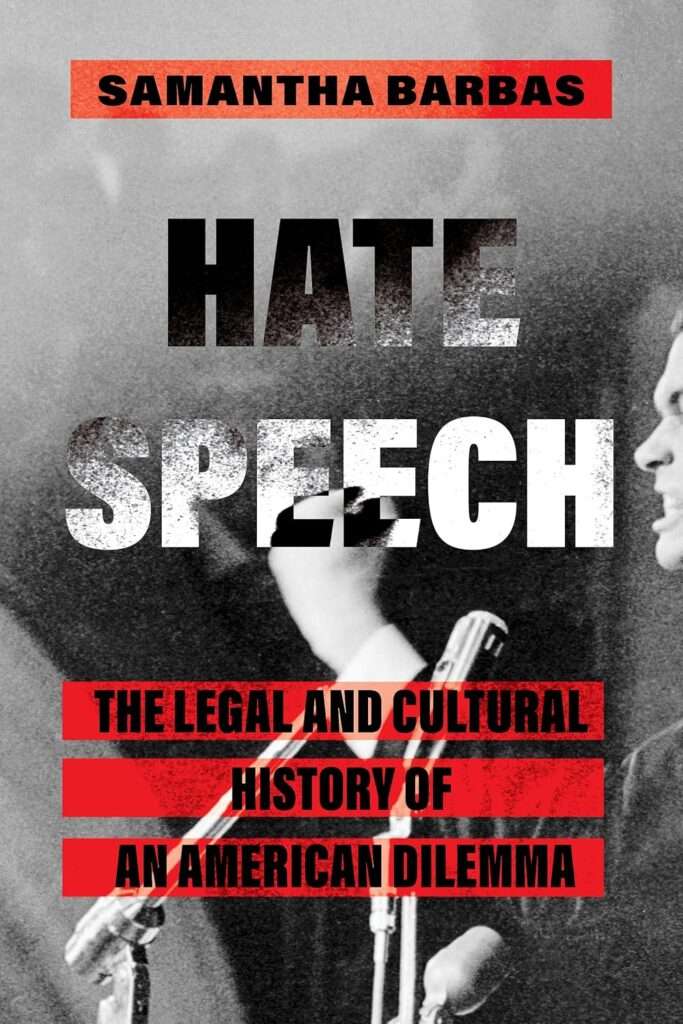
Excerpted from Hate Speech: The Legal and Cultural History of an American Dilemma by Samantha Barbas, courtesy of the University of California Press. Copyright © 2026.




