

Facebook Algorithm Flags, Removes Declaration of Independence Text as Hate Speech
The social media site has a difficult time telling the difference between white nationalist ravings and the writing of Thomas Jefferson.
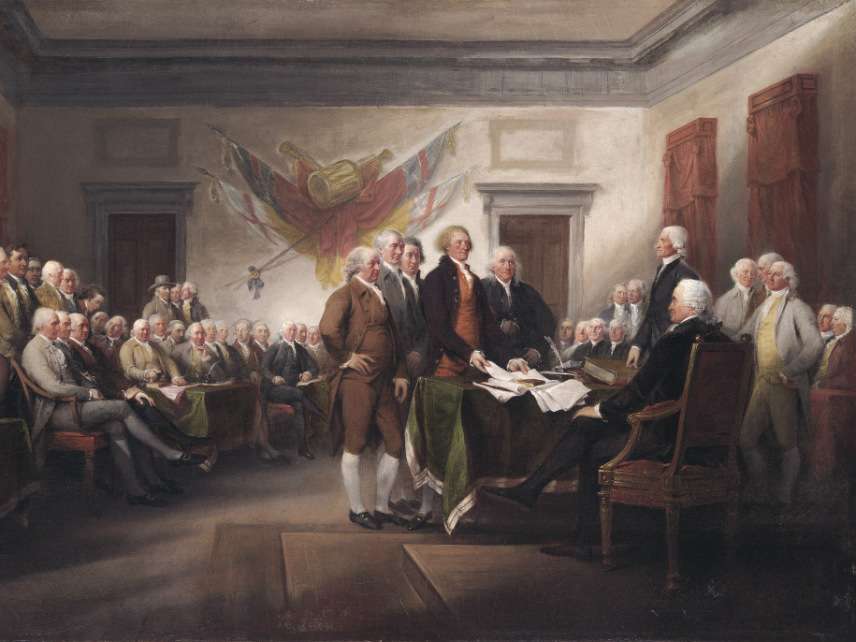
America's founding document might be too politically incorrect for Facebook, which flagged and removed a post consisting almost entirely of text from the Declaration of Independence. The excerpt, posted by a small community newspaper in Texas, apparently violated the social media site's policies against hate speech.
Since June 24, the Liberty County Vindicator of Liberty County, Texas, has been sharing daily excerpts from the declaration in the run up to July Fourth. The idea was to encourage historical literacy among the Vindicator's readers.
The first nine such posts of the project went up without incident.
"But part 10," writes Vindicator managing editor Casey Stinnett, "did not appear. Instead, The Vindicator received a notice from Facebook saying that the post 'goes against our standards on hate speech.'"
The post in question contained paragraphs 27 through 31 of the Declaration of Independence, the grievance section of the document wherein the put-upon colonists detail all the irreconcilable differences they have with King George III.
Stinnett says that he cannot be sure which exact grievance ran afoul of Facebook's policy, but he assumes that it's paragraph 31, which excoriates the King for inciting "domestic insurrections amongst us, and has endeavored to bring on the inhabitants of our frontiers, the merciless Indian Savages."
The removal of the post was an automated action, and Stinnett sent a "feedback message" to Facebook with the hopes of reaching a human being who could then exempt the Declaration of Independence from its hate speech restrictions.
Fearful that sharing more of the text might trigger the deletion of its Facebook page, The Vindicator has suspended its serialization of the declaration.*
In his article, Stinnett is remarkably sanguine about this censorship. While unhappy about the decision, he reminds readers "that Facebook is a business corporation, not the government, and as such it is allowed to restrict use of its services as long as those restrictions do not violate any laws. Plus, The Vindicator is using Facebook for free, so the newspaper has little grounds for complaint other than the silliness of it."
Of course, Facebook's actions here are silly. They demonstrate a problem with automated enforcement of hate speech policies, which is that a robot trained to spot politically incorrect language isn't smart enough to detect when that language is part of a historically significant document.
None of this is meant as a defense of referring to Native Americans as "savages." That phrasing is clearly racist and serves as another example of the American Revolution's mixed legacy; one that won crucial liberties for a certain segment of the population, while continuing to deny those same liberties to Native Americans and African slaves. But by allowing the less controversial parts of the declaration to be shared while deleting the reference to "Indian savages," Facebook succeeds only in whitewashing America's founding just as we get ready to celebrate it.
A more thoughtful approach to Independence Day—for both celebrants and social media companies alike—would be to grapple with those historical demons.
Update: Facebook has reportedly restored The Vindicator's declaration post, deeming it to not be a violation of the social media site's community standards and apologizing to the paper for its "incorrect action."




