
Trump Promised To Undo Biden's Energy Agenda. Instead, He Changed Who Benefits.
From canceling permitted projects to taking equity stakes in companies, Trump is using bogus national security claims to justify his takeover of the energy sector.
The sandy shores of Virginia Beach are idyllic, but what makes the place truly special lies about 27 miles off the coast, at the site of the Coastal Virginia Offshore Wind project, the largest offshore wind farm under construction in the country.
The project has been more than a decade in the making. In 2013, Dominion Energy secured a leasing agreement with the Bureau of Ocean Energy Management. In 2017, during the first Trump administration, the agency approved Dominion's site plan for the project, and in 2020 its two pilot turbines turned on. But it wasn't until October 2023 that federal regulators gave the final stamp of approval, allowing the rest of the farm to begin construction.
From the shore, it's hard to tell that construction has been underway. Except at certain times at night, the turbines are pretty much impossible to see with the human eye. (If you want to see them from the shore, you have to find the perfect spot and use binoculars.) But if you take a boat ride out to the Outer Continental Shelf, you'll begin to appreciate the scale of the project: 800-foot-tall turbines towering over the open seas like skyscrapers capable of withstanding Category 3 hurricane winds, anchored to the ocean floor with 1,500-ton metal tubes that are 31 feet in diameter.
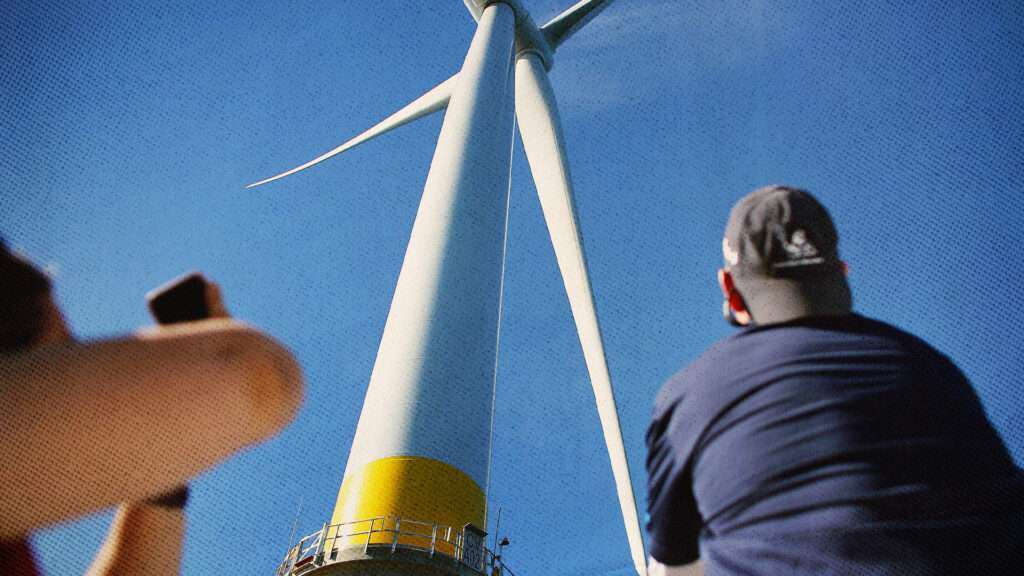
Despite their industrial appearance, the turbines have been a net positive to the local environment. They serve as artificial reefs for fish and other wildlife, and they have allowed fishermen to continue catching flounder, cobia, and mahi in the Atlantic's deep waters.
When construction is completed—an event scheduled for late 2027—the wind farm will be the largest such project in the country. Its 176 turbines are expected to deliver 9.5 million megawatt-hours of clean energy to the Virginia grid every year. That will be enough to power 660,000 homes, according to Dominion. At this point, the company expects the farm to support 1,100 jobs and generate $200 million in annual economic output for the region.
And one needn't wait until 2027 to see that the project is proving beneficial to the area. Every year during its construction phase, Dominion estimates, the wind farm has supported 900 direct and indirect jobs and generated $143 million in economic output.
But in December 2025, the Interior Department issued a stop-work order for the Coastal Virginia project out of the blue.
What might compel the Trump administration to halt the construction of a project that supported countless jobs and was backed by the first Trump administration? The same rationale that keeps recurring when the president tries to justify his takeover of America's energy markets: "national security."
Trump's National Energy Emergency and the Defense Production Act
When President Donald Trump was on the campaign trail in 2024, he promised to unleash America's energy dominance. "We're going to be energy-dominant, we're going to make a fortune, we're going to supply it all over Europe, all over the world," he told Fox News' Maria Bartiromo that August. "We're going to be double and triple what they're doing. We're going to have tremendous energy, and we're going to lower our prices of energy."
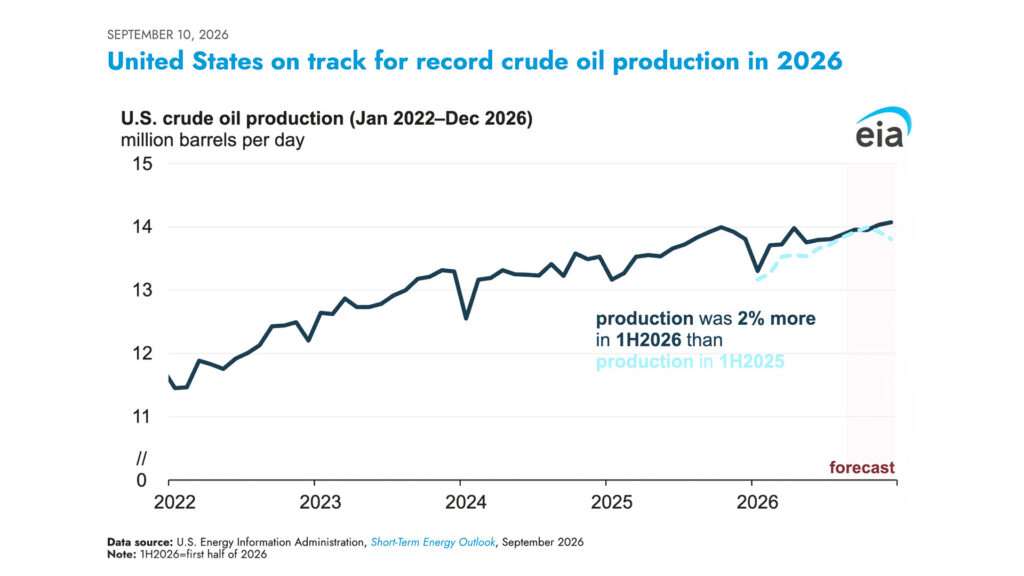
Depending on the energy source, Trump's first 22 months back in office have been either "tremendous" or a toil. Fossil fuels are enjoying favorable policies, and their production has reached new heights. Renewable energy projects face government roadblock after government roadblock (in addition to the cancellation of wasteful subsidies).
On Day 1—the same day Trump "temporarily" halted all permitting for offshore wind projects in federal waters—Trump signed an executive order declaring a National Energy Emergency. "The policies of the previous administration have driven our Nation into a national emergency, where a precariously inadequate and intermittent energy supply, and an increasingly unreliable grid, require swift and decisive action," the order read.
The "swift and decisive action" needed to fix such a dire situation? Increasing the government's power and reach. Specifically, the order directed federal agencies to "exercise any lawful emergency authorities available to them" to increase the generation of almost all energy sources—all but wind and solar—through the Defense Production Act (DPA).
The DPA was passed in 1950, a few months after the start of the Korean War, when Congress determined it "needed a mechanism for the president to direct industrial production towards defense needs without full nationalization," says Gabe Arrington, a national security expert and nonresident fellow at the Baker Institute for Public Policy at Rice University.
Once invoked, the DPA gives the president immense power, with nearly no congressional oversight, to meddle with private businesses. He can force private entities to prioritize certain contracts, award loans and loan agreements, and even block corporate mergers with foreign companies.
"We were coming right out of World War II, where we had a full nationalization effort. This was an intermediate step," says Arrington.
Yet the DPA has had a long legacy, and has been invoked at least once by each president since it passed. President Jimmy Carter used the act to fund research into synthetic fuels and to establish the Synthetic Fuels Corporation, which financed research and development into these energy sources from 1980 until Congress shut it down in 1986. President Ronald Reagan used the act to stockpile rare earth minerals for military purposes and to direct steel production.
After 9/11, its "use expanded dramatically," says Arrington, including for "body armor, military vehicles, [and] other military surveillance equipment." During the COVID-19 pandemic, both Trump and President Joe Biden used the DPA to procure billions of dollars' worth of personal protective equipment and medical and testing supplies. Biden then used it to boost production in the clean energy sector.
In April 2025, Trump decided to promote a different set of energy producers. In an executive order, the president declared it "the policy of the United States that coal is essential to our national and economic security." The order also designated coal a "critical mineral," opening up the door for future DPA funding.
With these moves in place, the Trump administration was ready to use the full weight of the federal government to shape the energy sector as it saw fit.
'The American People Won and the Special Interests Lost'
During the first Trump administration, the president signed deregulatory reforms for nuclear energy, modernized federal environmental reviews, and scrapped expensive restrictions on power plants. The market responded to Trump's (mostly) anti-interventionist approach: Inflation-adjusted energy spending fell, renewable energy generation and investments reached new heights, and in 2017 the U.S. became a net exporter of liquefied natural gas—a remarkable feat considering the first export of the fuel from the lower 48 states occurred only a year earlier.
Trump's successor scrapped this hands-off approach.
On Day 1 of his presidency, Joe Biden axed the Keystone Pipeline and paused new oil and gas leasing on federal lands. Then, in 2022, Biden signed his legacy-defining (and ironically named) Inflation Reduction Act into law.
"With this law, the American people won and the special interests lost," Biden said at the bill signing in August 2022. A few months later, climate czar John Kerry predicted the bill would jumpstart "the biggest transformation, economically, since the Industrial Revolution."
That transformation never materialized. Instead, the government shelled out huge sums to the green energy industry.
The Inflation Reduction Act appropriated billions in new spending, $12 billion of which was funneled to the Energy Department's Loan Programs Office. This sum, and the office's $100 billion in new lending authority, was directed to support such projects as a Ford factory in Tennessee (which displaced the area's residents), grid upgrades for California's largest power utility, and a solar facility for a South Korean manufacturer owned by Stellantis (formerly Chrysler).
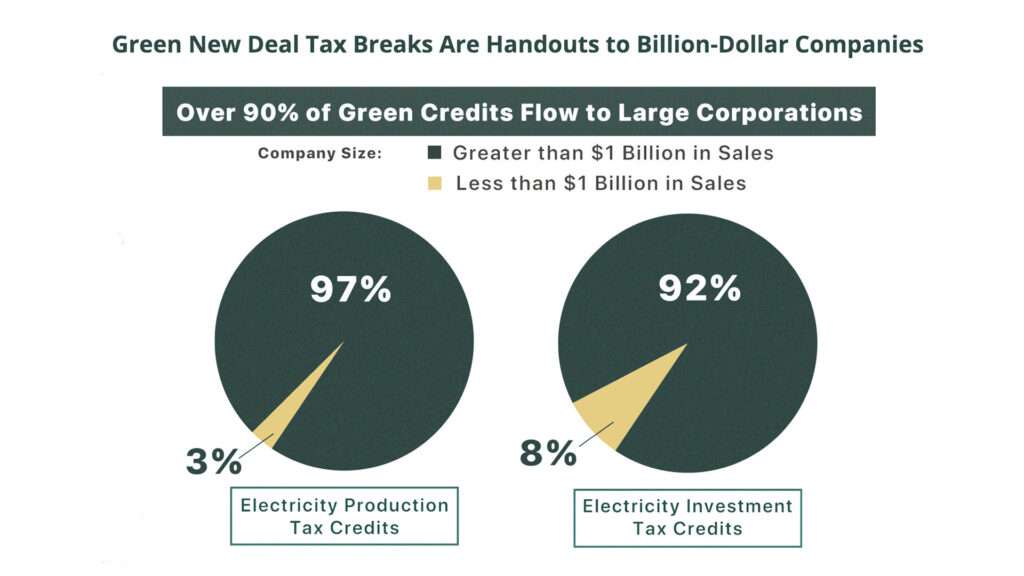
The law also offered expensive tax credits and subsidies for renewables and green tech. Wealthy homeowners and large corporations claimed the majority of tax credits. Renewable energy production, which reached then-historic highs in 2024, lagged significantly behind fossil fuels.
Meanwhile, grid operators were issuing dire warnings about the status of the power grid. In 2023, PJM Interconnection, the largest grid operator in the country, reported that grid demand—driven by electrification and data centers—was outpacing supply. A year later, the operator warned that "continuing generator retirements and increasing demand" were eroding its energy reserves, which could impact its response to the summer's extreme heat. Trump's Energy Department would later release a report finding that, if power plant retirements continued, blackouts would be 100 times more likely to occur in 2030.
This price crunch, coupled with record spending, prompted conservative policy wonks to demand drastic action. Diana Furchtgott-Roth, then of the conservative Heritage Foundation, wrote in the days leading up to Trump's second inauguration that "America faces a national energy emergency because the Biden administration has created a serious and dangerous energy situation so damaging to ordinary people and our country that it requires immediate action." By taking "immediate action" and declaring a national energy emergency, she wrote, "Trump can ensure that America does not walk down the same yellow brick road of Europe's energy and climate policies."
Trump's National Security Claims Are a Weak Justification To Block Wind and Prop Up Coal
Enough people agreed that the Biden green agenda was a disaster that Trump reentered office with significant leeway to recreate his first term's lighter-touch approach to energy markets. Instead, he doubled down on Biden's intrusiveness.
For example, in 2026 Trump adopted a novel strategy in his battle against wind projects: Pay them to stop operating. In March, the administration reached a deal with TotalEnergies to shutter two of the company's offshore wind projects in North Carolina and New York. Under the agreement, TotalEnergies was given $928 million—a "dollar-for-dollar" payback from what it spent on procuring its offshore leases—which it then invested in oil and natural gas projects. The company also pledged "not to develop any new offshore wind projects in the United States," according to a government press release.
The Interior Department cited national security concerns when spearheading the deal. It has since brokered four other agreements to pay developers to cancel permitted offshore wind projects and invest in fossil fuel generation. Meanwhile, the Defense Department has stalled approvals for onshore wind farms on private lands under the guise of "national security," the Financial Times reported in May.
Projects like these regularly require approval from the Defense Department to ensure they don't mess with radar systems. If they do, the fix is simple: The developer can negotiate with the Pentagon on a fee to update the radar system. If they don't, the project can move forward. As the Financial Times points out, 50 of the projects facing a shutdown would "probably have been declared risk-free." Meanwhile, 30 had "undergone negotiations, received verbal signoffs and were waiting for written confirmation," making Trump's national security justification all the more thin.
As Jason Grumet, CEO of the American Clean Power Association, told the Financial Times, "The fact the administration is telling private landowners they're not allowed to pursue economic activity and generate value from their property is hard to reconcile with conservative values."
Luckily for developers, a federal judge froze the Pentagon's wind order in August. In November, the Senate passed a sprawling bipartisan permitting reform bill that would, among other things, prohibit the executive branch from rescinding or altering an approved permit or impeding the construction of a previously approved project. Certain conditions—including new information on national security risks—would still allow a federal agency to interfere. But even then, the agency would have to provide advance written warning to justify its actions. At press time, the legislation is in the House of Representatives; the White House says it backs the bill.
The government has also intervened to prop up favored industries, especially coal. In May 2025, citing Trump's national energy emergency order, Energy Secretary Chris Wright ordered J.H. Campbell—a 1,560 megawatt coal-fired power plant in Michigan that was scheduled to shut down that month—to "temporarily" remain open for the summer. Over a year later, J.H. Campbell is still open. Consumers Energy, the plant's majority owner, is seeking $303 million in cost recovery from ratepayers in the region. In September, a federal court vacated the Energy Department's initial order to keep the power plant open. Despite this ruling, the agency issued a 90-day order in November to keep the plant open through mid-February.
"I think that the reliability and stability of the grid is both an economic concern and there can be national security concerns," such as brownouts and cybersecurity threats, says Nick Loris, president of C3 Solutions, a free market energy think tank. But "it doesn't seem like [J.H. Campbell is] generating that much electricity, so I don't know if it's actually solving a problem."
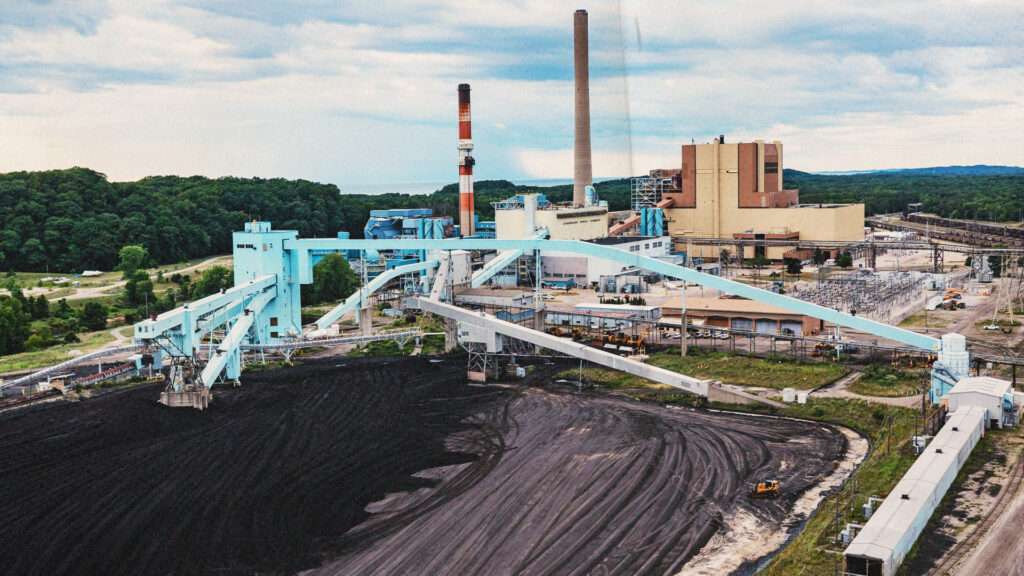
Loris warns that decisions like these can have "secondary and tertiary effects" on the market and prevent investments into cleaner, cheaper technologies. That's happening in Indiana, where an Energy Department order to keep a retiring coal plant open has made it impossible for one of the units to be replaced by cleaner-burning natural gas.
The Trump administration has kept pumping money into coal. Using its DPA authority, the Energy Department has given $425 million to modernize coal plants, while opening up other funding opportunities for the industry. Thanks to an April order, more DPA funding is incoming for the industry to support its supply chains and extend other coal power plants. Yet exports are down.
Nuclear energy, too, has enjoyed favored status under Trump 2.0, including using the DPA to enrich nuclear fuel. This move has been praised by the industry, which sees America's lack of uranium enrichment—nearly all of America's enriched uranium is imported—as a national security threat. Christo Liebenberg, president of LIS Technologies, a startup that uses laser technology to enrich uranium, argues that the Energy Department's use of the DPA to finance uranium enrichment is "needed because the demand is just so big, and the supply is so small." Liebenberg says that to meet the government's goal of quadrupling nuclear power by 2050, the U.S. will need a 12-fold increase in its domestic enrichment capabilities.
The administration used the same national security rationale to take an ownership stake in Westinghouse last year. In June, the Energy Department unveiled a $17.5 billion loan program to deploy 10 Westinghouse AP1000 reactors. Not coincidentally, per the terms of the ownership agreement, the government will "get a 20% share in any dividends paid out by Westinghouse above a $17.5 billion threshold," according to Bloomberg.
So even when a national security argument may have some truth to it, it can become a slippery slope. "Rather than making an investment that is targeted for a specific national security need," says Loris, "it ends up being more of a balloon payment to industries and companies writ large that really aren't addressing the legitimate national security questions."
This seems to have been the M.O. under the second Trump administration: using seemingly justifiable, though mostly bogus, national security claims to bolster favored companies and industries. Trump is certainly not the first president to do this. But he is doing it even as administration officials such as Wright have identified a better set of fixes to America's energy challenges—namely, deregulation.
Consumers may not immediately feel the negative impacts of Trump's energy socialism, but the continued distortion of energy markets will soon be seen in higher utility bills and steeper power-plant construction costs. They may also be felt politically when President Alexandria Ocasio-Cortez halts all oil and gas projects and supercharges solar development with the same "national security" tools that Trump is using now.
What Happened to the Coastal Virginia Offshore Wind Project?
Despite being targeted by the Trump administration, the Coastal Virginia Offshore Wind project lives on. In January, a federal judge struck down the administration's work stoppage, and later that month a turbine generator was installed. In March, the farm delivered its first power to the grid.
But in August, Dominion reported that the project's cost had risen by nearly $300 million, thanks to Trump's tariffs and to updated turbine installation projections.
Trump came into office promising to reverse Biden's energy policies. But while he may have changed who directly benefits from those policies, he has used many of the same policy levers, which in turn have yielded similarly expensive and harmful outcomes. The U.S. needs more energy, but bogus national security claims are getting in the way.