

5th Circuit Judge James Ho Says a Presidentially Declared 'Invasion' Overrides Birthright Citizenship
The potential SCOTUS nominee qualifies his longstanding position that the U.S.-born children of unauthorized immigrants are citizens under the 14th Amendment.
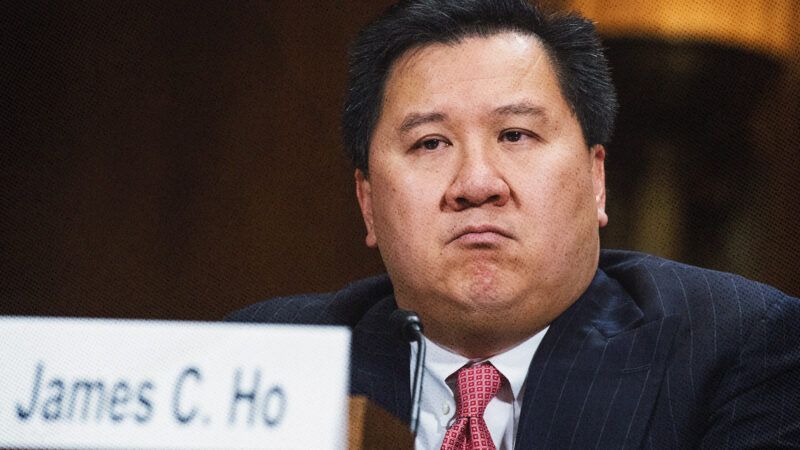
James Ho, whom President Donald Trump appointed to the U.S. Court of Appeals for the 5th Circuit in 2017 and considered as a potential Supreme Court nominee, recently criticized Trump v. Barbara, the June 2026 decision rejecting Trump's attempted restrictions on birthright citizenship. Ho's remarks, part of a speech he delivered on October 5 to a gathering of Christian activists at the Museum of the Bible in Washington, D.C., are striking because they seem to contradict his longstanding position that the children of unauthorized immigrants qualify as citizens under the 14th Amendment when they are born in the United States.
The New York Times presents Ho's speech as evidence that he hopes Trump will nominate him to the Supreme Court, assuming that opportunity arises during the next two years. But whatever you make of that theory, Ho's position on Trump v. Barbara is hard to reconcile with what he has repeatedly said about the meaning of the 14th Amendment's Citizenship Clause.
"Birthright citizenship is guaranteed by the Fourteenth Amendment," Ho wrote in a 2006 law journal article. "That birthright is protected no less for children of undocumented persons than for descendants of Mayflower passengers."
Ho reiterated that position in a 2011 Wall Street Journal essay. "Opponents of illegal immigration cannot claim to champion the rule of law and then, in the same breath, propose policies that violate our Constitution," he wrote.
The first sentence of the 14th Amendment, Ho noted, says "all persons born or naturalized in the United States, and subject to the jurisdiction thereof, are citizens of the United States." The "plain meaning" of that language "is clear," Ho said. "A foreign national living in the United States is 'subject to the jurisdiction thereof' because he is legally required to obey U.S. law." The historical evidence, he added, shows that "both proponents and opponents of the citizenship clause agreed" that "it would extend birthright citizenship to the U.S.-born children of Chinese laborers and other noncitizens."
So why does Ho think the Supreme Court reached the wrong result in Trump v. Barbara? "Foreign governments weaponize illegal immigration in order to hurt other countries," he said at the Museum of the Bible conference, which was convened by the Judicial Action Group. "For decades, administrations of both parties have warned the people about the use of illegal immigration as a weapon of war, and judges are supposed to defer to presidential proclamations about a state of invasion. So the Supreme Court should have upheld the president's birthright citizenship order in full based on his invasion proclamation."
Ho hinted at this position in a November 2024 interview with South Texas College of Law professor Josh Blackman, who agrees with Ho that the Citizenship Clause covers the U.S.-born children of unauthorized residents. The previous July in United States v. Abbott, Blackman noted, Ho had written a dissenting opinion arguing that illegal immigration could qualify as an "invasion" under Article I, Section 10, Clause 3 of the Constitution, which says no state may "engage in war, unless actually invaded, or in such imminent danger as will not admit of delay."
Blackman asked Ho to address criticism of that opinion. "Anyone who reads my prior writings on these topics should see a direct connection between birthright citizenship and invasion," Ho replied. "Birthright citizenship is supported by various Supreme Court opinions, both unanimous and separate opinions involving Justices Scalia, Thomas, Alito, and others. But birthright citizenship obviously doesn't apply in case of war or invasion. No one to my knowledge has ever argued that the children of invading aliens are entitled to birthright citizenship. And I can't imagine what the legal argument for that would be."
The problem with Ho's qualification is that it empowers the president to override birthright citizenship, which Ho has said is guaranteed by the 14th Amendment, simply by declaring that illegal immigration amounts to an "invasion." It is not hard to see why that position would appeal to Trump, since it means he can unilaterally redefine citizenship.
Does that mean Ho is kissing up to Trump because he wants to replace any justice who might retire before the end of Trump's term? That is what Times reporter Mattathias Schwartz suggests. Schwartz concedes that Ho, like most of the potential Supreme Court nominees that Trump listed during his first term, falls into the category of "traditional conservatives with strong ties to the Federalist Society." But Schwartz says "some experts perceive Judge Ho's remarks" as "an attempt to show his alignment with Mr. Trump's worldview."
How so? Ho's speech "channeled frustrations shared by Mr. Trump and his base that the Supreme Court's six-judge conservative supermajority—three of whom are Mr. Trump's appointees—have failed to uniformly back his agenda," Schwartz writes. "Despite a string of conservative wins on abortion, gun rights, and gerrymandering, there is a sense on the Trump-aligned right that Justices Brett M. Kavanaugh, Amy Coney Barrett and Neil M. Gorsuch are becoming unreliably centrist swing votes—'squishes' in the online parlance—in the mold of Justices Anthony M. Kennedy and David H. Souter."
That framing implies that backing Trump's agenda is a matter of conservative principle. But Trump himself has no coherent ideology, and his authoritarian impulses often run headlong into conservative principles such as originalism, the rule of law, and the separation of powers. It makes sense to describe justices who occasionally disagree with Trump as "centrist" only if you accept the idea that his views are the standard by which judicial performance should be judged.
In any event, Schwartz suggests that Ho is presenting himself as a Trump-friendly judge who, unlike Kavanaugh, Barrett, and Gorsuch, could be relied upon to take the president's side. But the evidence that Schwartz cites to support that take is thin.
As Schwartz acknowledges, it is not even clear that Ho wants the job for which he supposedly is auditioning. His wife, Allyson N. Ho, works for a law firm that frequently litigates Supreme Court cases, and Judge Ho has suggested that her career would be ruined if he joined Court. "I can't imagine that Allyson's firm would want to be categorically recused from the highest court in the land," Ho said in a recent interview. "To have to tell every client that, if you hire them, they can only seek cert from an eight-member Court? That would effectively end her career and her practice—one she's worked so hard, for decades, to build."
Undeterred by that wrinkle, Schwartz cites parts of Ho's speech that he thinks suggest a desire to please the president. "Judge Ho lamented the values of 'this fallen world,'" Schwartz writes. "He called on the judiciary to stand up to 'cultural elites who control the national discourse.' He also bluntly rebuked the Supreme Court for legalizing same-sex marriage. He said the court's majority was wrong not to block the distribution of an abortion drug. And he said it was wrong again when it rejected Mr. Trump's attempt to limit birthright citizenship."
Those comments presumably appealed to the Christian conservatives in the audience. But with the exception of Ho's position on Trump v. Barbara, none of this seems tailored to ingratiate Ho with Trump, who is not particularly religious and seems to have no real interest in revisiting same-sex marriage or overriding state abortion policies.
While opposition to "cultural elites" sounds consistent with Trump's populism, the context of that phrase makes it clear that Ho was defending originalism against result-oriented jurisprudence. "We know that originalism may be permitted in polite company," Ho said, "but only until it leads to outcomes that are detested by the cultural elites who control the national discourse and who dispense the prestige and the respect and the stature craved by so many judges."
Although Ho's speech was peppered with Christian rhetoric, some of which the Times quotes, he emphasized that originalism does not entail interpreting the law according to religious principles. "Being an originalist means following the text and original understanding of the law no matter the outcome, no matter the effect on the judge's standing or reputation in the community," he said. "And if that's truly what you're doing, there actually should not be a Christian interpretation of the text or an atheist interpretation of the text. There would just be a dutiful, faithful interpretation of the text."
If you think Trump honestly cares about judicial methodology, "faithful interpretation of the text," or adherence to the original understanding of the Constitution, you have not been paying attention to his criticism of judges and justices, which is always based on their failure to agree with him. Michael Fragoso, former chief counsel to Sen. Mitch McConnell (R–Ky.), who was the Senate majority leader when Trump nominated Kavanaugh, Gorsuch, and Barrett, made exactly that point in an interview with Schwartz.
"One thing the activist class hasn't figured out is that the president doesn't really care about any of those substantive questions," Fragoso said. "He sees this as a loyalty issue."
Given that reality, you might expect that a judge trying to signal "his alignment" with Trump would say something about tariffs, his signature policy. But Ho's criticism of recent Supreme Court rulings did not extend to its decision last February in Learning Resources v. Trump, which rejected Trump's claim to sweeping tariff powers under the International Emergency Economic Powers Act.
Of all his judicial setbacks during his current term, Trump was probably angriest about that one—in particular, the role that Gorsuch and Barrett played by joining the majority. Yet Ho, who supposedly was channeling Trump's frustration with such traitors, did not mention that case. Nor did he say anything about the Supreme Court's ruling against Trump's National Guard deployments or its decision constraining his use of the Alien Enemies Act, which were both big losses for him.
Those omissions are puzzling if Ho was mainly interested in boosting his chances at a Supreme Court nomination. Less so if he was simply expressing his honest opinions.



