Trump Administration Urges SCOTUS To Uphold Federal Ban on Distilling Liquor at Home
The justices will decide the case later this term.
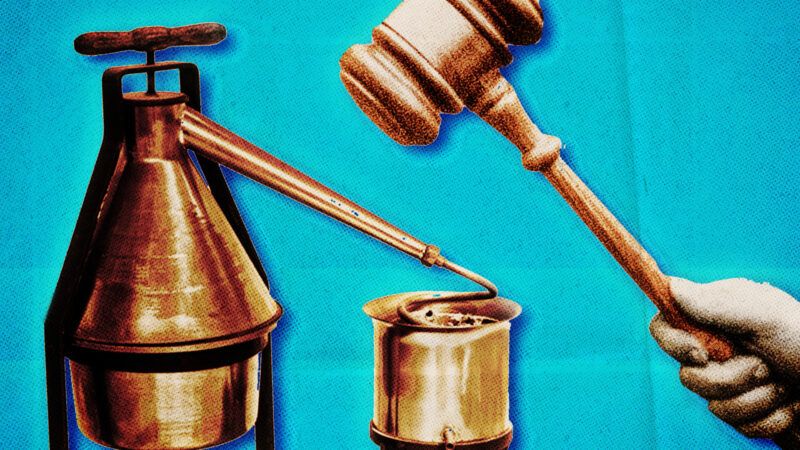
The U.S. Supreme Court's 2026–2027 term just got a whole lot boozier. On Monday, the justices agreed to hear arguments later this year or next in the case of Department of Justice v. McNutt. At issue is whether the 1868 federal ban on distilling liquor at home is unconstitutional because it exceeds the lawful regulatory power of the federal government. If any modern Supreme Court case ever deserved its own drinking game, this one is it.
You’re reading Injustice System from Damon Root and Reason. Get more of Damon’s commentary on constitutional law and American history.
In April, the U.S. Court of Appeals for the 5th Circuit found the federal ban on home distilling to be unconstitutional because Congress lacked the proper authority to issue such a ban in the first place. It was not a legitimate exercise of the congressional authority "To Lay and collect Taxes," the appellate court reasoned, because "the purpose of a tax is to raise revenue for the government;" yet this law "amount[s] to an anti-revenue provision" that only "prevents distilled spirits from coming into existence." And if it does not exist, of course, the government cannot tax it.
The 5th Circuit also denied that the federal ban on home distilling could be saved by the government's appeal to the Necessary and Proper Clause, which says that Congress has the authority "To make all Laws which shall be necessary and proper for carrying into Execution the foregoing Powers, and all other Powers vested by this Constitution in the Government of the United States, or in any Department or Officer thereof."
But the federal ban on home distilling cannot be "necessary" to the execution of the enumerated taxing power, the 5th Circuit argued, because the provisions of federal law at issue "tax nothing, and are distinct from the regulation of distilling alcoholic products that is permitted by federal tax law."
Nor did the 5th Circuit find the ban to be "proper." "By purporting to ban activity without a plain connection to the exercise of Congress's taxation power," it held, "Congress has essentially—and 'improperly'—invaded the reserved police and regulatory power of the states."
The Trump administration lost this case at the 5th Circuit and has now successfully urged the justices to hear its appeal. In its petition seeking review, the Trump administration faulted the 5th Circuit for its overeagerness to "second-guess" the "legislative judgment" of Congress. Instead, the Trump administration argued, the federal judiciary owes a great deal more deference to the federal government's regulatory priorities in a case like this. "A law is necessary and proper if it is 'convenient' or 'useful' for carrying an enumerated power into effect, and 'plainly adapted' to that legitimate end," the Justice Department's brief argued. "That is the case here."
This case may lead to an interesting divide among the Supreme Court's more conservative members. In United States v. Comstock (2010), a 7–2 Supreme Court embraced the Necessary and Proper Clause as sufficient constitutional grounding for the Adam Walsh Child Protection and Safety Act, which had empowered federal officials to order the indefinite civil commitment of "sexually dangerous" individuals who had already finished serving their prison sentences. Chief Justice John Roberts joined the majority opinion in that case, while Justice Samuel Alito voted in concurrence. In other words, they both endorsed a broad view of congressional power under the Necessary and Proper Clause. By contrast, Justice Clarence Thomas, joined by the late Justice Antonin Scalia, voted in dissent. The Comstock ruling, Thomas protested, "comes perilously close to transforming the Necessary and Proper Clause into a basis for the federal police power that 'we always have rejected.'"
Are we about to see a similar Alito-Thomas split over the proper reach of federal power in this case? And what about Justices Neil Gorsuch, Amy Coney Barrett, and Brett Kavanaugh? Will one or more of them play the Scalia part and similarly reject the Trump administration's broad reading of the Necessary and Proper Clause?
Stay tuned.