Reason.com - Free Minds and Free Markets
Reason logo Reason logo
  • Latest
  • Magazine
    • Current Issue
    • Archives
    • Subscribe
    • Crossword
  • Video
    • Reason TV
    • The Reason Roundtable
    • Free Media
    • The Reason Interview
  • Podcasts
    • All Shows
    • The Reason Roundtable
    • The Reason Interview With Nick Gillespie
    • Freed Up
    • The Soho Forum Debates
  • Volokh
  • Newsletters
  • Donate
    • Donate Online
    • Ways To Give To Reason Foundation
    • Torchbearer Society
    • Planned Giving
  • Subscribe
    • Reason Plus Subscription
    • Print Subscription
    • Gift Subscriptions
    • Subscriber Support

Log In

Create new account

Supreme Court

Alito's 'Practical Originalism' Doesn't Sound Very Originalist

The conservative justice seems to favor the kind of results-oriented judging that originalists are supposed to oppose.
Damon Root | 10.8.2026 7:00 AM

Share on FacebookShare on XShare on RedditShare by emailPrint friendly versionCopy page URL Add Reason to Google
Media Contact & Reprint Requests
Alito-Practical-Originalist | Bob Daemmrich/ZUMAPRESS/Newscom
(Bob Daemmrich/ZUMAPRESS/Newscom)

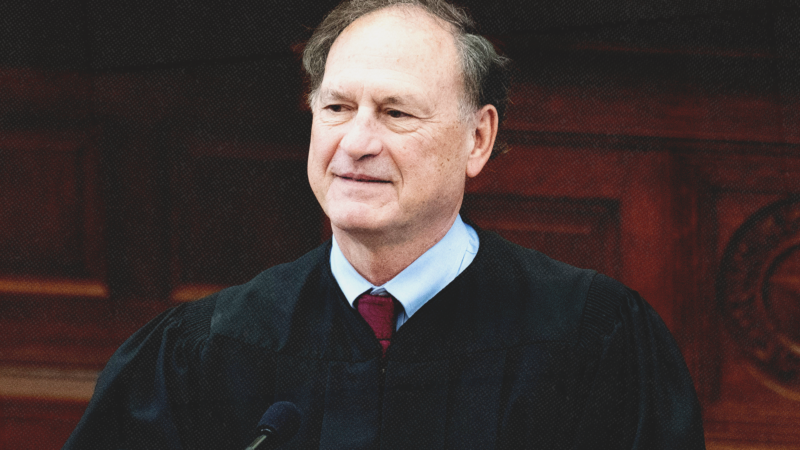
U.S. Supreme Court Justice Samuel Alito recently took to the pages of The Wall Street Journal with an article adapted from his new book, So Ordered: An Originalist's View of the Constitution, the Court and Our Country. In the piece, Alito dubbed himself a "practical originalist" and a "working judicial originalist." But as he proceeded to actually detail his legal views, they sounded much more like the results-oriented "living constitutionalism" that originalists are supposed to oppose.

You’re reading Injustice System from Damon Root and Reason. Get more of Damon’s commentary on constitutional law and American history.

This field is for validation purposes and should be left unchanged.

Consider what Alito had to say about the landmark gun rights case McDonald v. Chicago (2010). At issue were two closely intertwined questions. First, does the Second Amendment right to keep and bear arms apply against state and local governments, just like it applies against the federal government? And second, if the Court did find that the amendment applies against the states, what is the proper constitutional means for applying it?

The historical evidence in the case all pointed in the same direction: The most thoroughly and consistently originalist way of applying the Second Amendment against the states was via the Privileges or Immunities Clause of the 14th Amendment.

But Alito rejected that originalist approach then and still rejects it now. To make his current case, Alito has enlisted the aid of the late Justice Antonin Scalia, who vocally opposed the Privileges or Immunities Clause argument during the McDonald proceedings. "Why did Scalia, a former law professor, say that?" Alito wrote in the Journal. "Because accepting the Privileges or Immunities argument would have opened a can of worms. Libertarians, social conservatives, progressives, socialists and others could all make a pitch for whatever rights they favored."

Of course, any judicial decision in support of a constitutional right may open a can of worms. If the Supreme Court strikes down one state's infringement on freedom of speech (or the right to keep and bear arms, or the right to be free from unreasonable searches and seizures, or any other constitutional liberty), it necessarily risks opening a can of worms, because other people in other states whose rights may have been similarly infringed would now have a handy SCOTUS precedent to cite when they file their own constitutional grievance against the allegedly offending government.

But what's wrong with that? If the Constitution demands that the government stop acting in a certain way, why should a self-professed originalist put his fears about opening a can of worms ahead of his judicial duty to follow the constitutional text where it leads?

In the McDonald case, Scalia and Alito each gave short shrift to historical evidence about the original meaning of the 14th Amendment because they worried about libertarians and others "mak[ing] a pitch for whatever rights they favored." That approach by Scalia and Alito sounds like results-oriented judging and not like any kind of principled adherence to the Constitution's original meaning.

Alito's apparent penchant for results-oriented judging is also evident in his positive invocation of the right-wing law professor Adrian Vermeule, who has argued that conservatives should abandon originalism entirely because originalism sometimes leads to libertarian results. "Libertarian assumptions central to free-speech law and free-speech ideology" must be discarded, Vermeule has argued, because they have led to the idea "that government is forbidden to judge the quality and moral worth of public speech." According to Vermeule, "libertarian conceptions of property rights and economic rights will also have to go, insofar as they bar the state from enforcing duties of community and solidarity in the use and distribution of resources."

Citing Vermeule, Alito has now argued that "practical originalists" must not be "allergic to any evaluation of results." Like Vermeule, Alito seems to think that the Constitution is only worth following faithfully when it leads to results that he happens to find worthy.

If that now counts as a kind of originalism, all I can say is that the term no longer means what it originally meant.


Start your day with Reason. Get a daily brief of the most important stories and trends every weekday morning when you subscribe to Reason Roundup.

This field is for validation purposes and should be left unchanged.

NEXT: The Democrats' Socialist Moment

Damon Root is a senior editor at Reason and the author of three books, including A Glorious Liberty: Frederick Douglass and the Fight for an Antislavery Constitution (Potomac Books). His latest book is Emancipation War: The Fall of Slavery and the Coming of the Thirteenth Amendment (Potomac Books).

Supreme CourtConstitution14th AmendmentHistoryLaw & GovernmentGun RightsGunsCourtsJudiciarySamuel Alito
Share on FacebookShare on XShare on RedditShare by emailPrint friendly versionCopy page URL Add Reason to Google
Media Contact & Reprint Requests

Hide Comments (29)

Editor's Note: As of February 29, 2024, commenting privileges on reason.com posts are limited to Reason Plus subscribers. Past commenters are grandfathered in for a temporary period. Subscribe here to preserve your ability to comment. Your Reason Plus subscription also gives you an ad-free version of reason.com, along with full access to the digital edition and archives of Reason magazine. We request that comments be civil and on-topic. We do not moderate or assume any responsibility for comments, which are owned by the readers who post them. Comments do not represent the views of reason.com or Reason Foundation. We reserve the right to delete any comment and ban commenters for any reason at any time. Comments may only be edited within 5 minutes of posting. Report abuses.

  1. SRG3   2 months ago

    This is hardly a surprise, but at least it's a good counter to the laughably sycophantic Josh Blackman articles about Alito and other "originalists".

    1. Stupid Government Tricks   2 months ago

      Too bad Damon Root has so little similar interest in raking the lefty justices over the same coals. Judges are partisans, and anyone pretending otherwise is just another partisan hack with blinders on. The Rule of Law is present in only a very diluted form.

      1. Nelson   1 month ago

        Holding someone like Alito to the standard he claims for himself is wrong unless you also hold others to the standard that … Alito claims for himself?

        That’s like criticizing a Jew for not worshipping Jesus as the Messiah.

    2. Patrick Henry, the 2nd   1 month ago

      Except Josh's articles are fair and truthful.

  2. Bhagwad   2 months ago

    The danger of latching onto words, is that people will change their meanings, then drape those words around them to claim the mantle of those words.

    And also the reverse. People will change the meanings of words, and then use those words to target those they don't like. I leave it to your imagination to come up with examples of both types.

  3. JesseAz (RIP CK)   2 months ago

    Damon is doing the atheist telling the Christian what his Christianity means schtick.

    1. Nelson   1 month ago

      You mean by accurately quoting a Christian nationalist? Yeah, that accurate reporting of words and ideas is terrible!

      1. Patrick Henry, the 2nd   1 month ago

        Except he went further and implied what Alito meant to fit his own narrative. And he was hilariously wrong.

    2. SRG3   1 month ago

      Well, when someone claims to be a Christian and yet by their deeds it's clear they're not following Jesus' own teachings, you can criticise them for their self-description regardless of your own beliefs or lack thereof.

      1. mad.casual   1 month ago

        By that same token, when Scalia and Alito 'worried about libertarians and others "mak[ing] a pitch for whatever rights they favored."' and then Root proceeds to, in the very next sentence, (re)interpret their words regardless of spirit, intent, or principles, according to his own whims, he's pretty self-evidently retarded, no matter how nobly his creator may've endowed him.

        The idea of an originalist interpretation... of the court's majority... requisitely running through the 14th *Amendment* while still arriving at the same judgement is mind-numbingly retarded.

        First, take the plank from your own eye, morons.

      2. Patrick Henry, the 2nd   1 month ago

        Yes but it's clear that's not what Alito is.

  4. Nelson   1 month ago

    “ The conservative justice seems to favor the kind of results-oriented judging that originalists are supposed to oppose.”

    Ya think?

  5. Nelson   1 month ago

    “ "Libertarian assumptions central to free-speech law and free-speech ideology" must be discarded, Vermeule has argued, because they have led to the idea "that government is forbidden to judge the quality and moral worth of public speech."”

    A morality test to allow free speech? What could possibly go wrong?

    “ "libertarian conceptions of property rights and economic rights will also have to go, insofar as they bar the state from enforcing duties of community and solidarity in the use and distribution of resources."”

    Christian nationalism with socialism thrown in? Sure, why not take one terrible idea for a free society and add another on top of it. Doubling down on the suppression of rights by the government sounds awesome!

    This is what Christian nationalists want. Does it surprise anyone that Alito is on board with it?

    1. charliehall   1 month ago

      "Christian nationalism with socialism thrown in?"

      That accurately describes Fascism in most of the Fascist states in mid-20th century Europe. (Interestingly, not including Mussolini, who hated Christianity.)

      1. Nelson   1 month ago

        Fascism preferred crony capitalism to socialism. Private businesses that profit from connections to the ruling class, not government ownership of companies. It’s one of the major differences between communist snd fascist economic systems.

  6. MollyGodiva   1 month ago

    Well said. Alito is a politician in a black robe.

    1. Brett Bellmore   1 month ago

      You can't get a job on the Supreme court if you're not thought to be a hack. That's a tradition that FDR started, and everybody maintains it, because if you ever got a majority of non-hacks on the Court, a whole bunch of precedents giving the federal government powers it deliberately wasn't delegated might go up in smoke.

  7. Mike Hansberry   1 month ago

    This article ought to be retitled Deep Thoughts by Damon Root.

    Even a cursory dive into the rights persons had under the federal government that the 14th amendment made actionable versus the state governments would show that the goal was not to limit the authority of the state governments to the exact same extent that the Constitution limited the power of the federal government with respect to the everyday lives of individuals. The goal was to impose the core rights expressed in the Bill of Rights onto the governments of the various states. That did not include the expansive and unenumerated rights of the 9th amendment, which were added to the constitution along with the 10th amendment in order to make certain that the federal government remained in its lane.

    1. Brett Bellmore   1 month ago

      "The goal was to impose the core rights expressed in the Bill of Rights onto the governments of the various states. That did not include the expansive and unenumerated rights of the 9th amendment, which were added to the constitution along with the 10th amendment in order to make certain that the federal government remained in its lane."

      Obviously it didn't include the 9th and 10th amendments, which rather than listing rights set out rules for interpretation: That failing to enumerate a right did not establish that it didn't exist, and that failing to enumerate a power, by contrast, did establish that it was reserved to the states.

      But, Jacob Howard was very clear in introducing the 14th amendment, that the P&I encompassed many rights that were not enumerated, which is to say, 9th amendment rights.

      Speech Introducing the Fourteenth Amendment to the Senate (1866)

      "Such is the character of the privileges and immunities spoken of in the section of the fourth article of the Constitution. To these privileges and immunities, whatever they may be—for they are not and cannot be fully defined in their entire extent and precise nature—to these should be added the personal rights guaranteed and secured by the first eight amendments of the Constitution;"

      The 14th amendment, expressly, was not limited to incorporating amendments 1-8.

      1. mad.casual   1 month ago

        The 14th amendment, expressly, was not limited to incorporating amendments 1-8.

        This is the complete opposite of the words you wrote and highlighted.

        The 9th and 10th had already relegated "everything else" to The States and The People to protect (or not) as they saw fit. The 14th is specifically **ADDING** 1-8 by Howards' own words. You're inverting the context.

        Even further, either interpretation doesn't in any way espouse the idea of making up extra rights (outside The States, FedGov, 14th, or all of the above) and using the 14th to force The States to enforce those.

        This is pretty elementary combinatorics. [d, e, f] does not contain [a, b, c] but should. Just because an operation combines them to make [a, b, c, d, e, f] does not mean g, or e1, or f1 or ef1 is or should be a part of any or all sets or that the operation necessarily performs that function without explicitly saying so. You're retconning (or just using) an emergent or "living" Constitutional interpretation a la Roe v. Wade.

        And this is skipping past Root's retardation about McDonald arriving at the right, but unoriginalist, conclusion by invoking 1-8 rather than the 14th.

        1. Brett Bellmore   4 weeks ago

          I can link to and quote it to you, I can't understand it for you. Suffice to say, you're reading it wrong.

      2. Mike Hansberry   1 month ago

        Section 1 of the 14th amendment extended US and state citizenship to the former slaves and made further guarantees of due process and equal protection to any person within each state’s jurisdiction.

        The minimalist view of Section 1 of the 14th amendment holds that the amendment additionally only guaranteed that citizens of others states would have the same rights of citizens of the state they were currently in. Thus treating the P&I clause of the 14th as a restatement of Art 4, Secs Clause 1 to reinforce the equal citizenship of the former slaves in whichever state they were in.

        The middle view is that Sec 1 also extended to the states certain rights that citizens held versus the federal government. This view is derived from statements made during drafting as well as from The Civil Rights Act which preceded the 14th amendment and came to be know as Incorporation Doctrine.

        The expanded view is that the P&I clause meant something more in the 14th that it did in Art4, Sec2, Cl1 of the Constitution. This might mean that all rights a citizen has with respect to the federal government, he also has with respect to the state governments.

        But nowhere in the history of the 14th amendment was it suggested that the 9th amendment would apply the same way to the states as it applies to the federal government. The federal government was created to make rules for national issues while domestic police was the domain of the states. The Radical Republicans of the time were not so radical as to completely overthrow Federalism, they sought to tweak the balance of Federal vs State powers so that states could not violate basic rights, but they were not seeking to grant the Federal government with a general police power or to remove jurisdiction over domestic affairs from the states.

        1. Brett Bellmore   4 weeks ago

          "But nowhere in the history of the 14th amendment was it suggested that the 9th amendment would apply the same way to the states as it applies to the federal government."

          Again,

          "Such is the character of the privileges and immunities spoken of in the section of the fourth article of the Constitution. To these privileges and immunities, whatever they may be—for they are not and cannot be fully defined in their entire extent and precise nature—to these should be added the personal rights guaranteed and secured by the first eight amendments of the Constitution"

          Very next paragraph:

          "The great object of the first section of this amendment is, therefore, to restrain the power of the States and compel them at all times to respect these great fundamental guarantees."

    2. MWAocdoc   1 month ago

      What part of "No State shall make or enforce any law which shall abridge the privileges or immunities of citizens of the United States" which, clearly, includes all enumerated rights and unenumerated rates retained by The People in the original Bill of Rights? How is this even questionable?

      1. Mike Hansberry   1 month ago

        Some argue that the P&I clause of the 14th amendment incudes the expansive 9th amendment despite the fact that it was not expressly mentioned in debate. If the P&I of the 14th had included the 9th, the powers not delegated to the United States by the Constitution, would also then be prohibited by it to the states, and reserved only to the people.

        A general police power would then not reside in either the state or federal governments. Cool beans for the anarchists amongst us, but not a reasonable reading of the text or history.

        1. Mike Hansberry   1 month ago

          Correction: Need to add that rights are the flip side of powers. So neither the 9th or 10th amendments could reasonably be said to be included in the P&I of the 14th. Including the 9th in the P&I of the 14th directly implicates the 10th as well.

          If the federal government were the arbiter of all rights retained by the people against the states, there would be in effect no powers actually reserved to the states. All powers a state sought to exercise would and could be subject to federal negation or be stuck down by courts based on an some imagined right.

          The 9th amendment as originally written was meant to keep the federal government in its lane, including it in the 14th upends, rather than tweaks, the carefully constructed system of federalism.

  8. willful knowledge   1 month ago

    The operative word is "practical". If it fits the agenda it's practical. If not, it doesn't.

  9. MWAocdoc   1 month ago

    A jurist who must frustate libertarians at all costs regardless of what the Constitution says and means is not ANY kind of originalist. Not only is Alito NOT any kind of originalist, he's a traitor to his oath to support and defend the Constitution of the United States of America. When jurists like Alito sign their names to a lie on an official ruling document, they should burn in Hell for all eternity in consequence.

  10. See.More   1 month ago

    [...] The historical evidence in the case all pointed in the same direction: The most thoroughly and consistently originalist way of applying the Second Amendment against the states was via the Privileges or Immunities Clause of the 14th Amendment[...]

    FedGov (all three branches) have long ignored, and tortured logic to repudiate, regarding the Bill of Rights, Article V clearly stating that, properly ratified, Amendments are part of the Constitution in combination with the Supremacy Clause of Article VI.

    A. Properly ratified Amendments are part of the Constitution.

    B. The Constitution is the Supreme Law of the Land and even the States are bound by it (where applicable).

    C. The Second Amendment has no language restricting it's scope to Congress or FedGov. It lacks any verbiage analogous to the 1A, "Congress shall make now law," language.

    Therefore, from a plain reading of the Constitution, the Second through Tenth Amendments apply to the States as well as FedGov.

Please log in to post comments

Mute this user?

  • Mute User
  • Cancel

Ban this user?

  • Ban User
  • Cancel

Un-ban this user?

  • Un-ban User
  • Cancel

Nuke this user?

  • Nuke User
  • Cancel

Un-nuke this user?

  • Un-nuke User
  • Cancel

Flag this comment?

  • Flag Comment
  • Cancel

Un-flag this comment?

  • Un-flag Comment
  • Cancel

Latest

America Needs More Nurses. The Trump Administration Wants To Make Them Much Harder To Hire.

Billy Binion | 11.22.2026 7:00 AM

Rents, Internet Speeds, and Airfares: 3 Deregulation Success Stories From Milei's Argentina

Marcos Falcone | From the December 2026 issue

D.C. May Abolish the Tip Credit—Again. This Time, the Minimum Wage Would Be $25.

C. Jarrett Dieterle | 11.21.2026 7:00 AM

Milei's Push To Privatize Companies Is Running Up Against Congressional Pushback

Ricardo Manuel Rojas | From the December 2026 issue

The Absurd Overreach of Britain's New Porn Law

Niko Vorobyov | 11.21.2026 6:00 AM

Recommended

  • About
  • Browse Topics
  • Events
  • Staff
  • Jobs
  • Donate
  • Advertise
  • Subscribe
  • Contact
  • Media
  • Amazon
Reason Facebook@reason on XReason InstagramReason TikTokReason YoutubeApple PodcastsReason on FlipboardReason RSS Add Reason to Google

© 2026 Reason Foundation | Accessibility | Privacy Policy | Terms Of Use | Manage your privacy choices

This site is protected by reCAPTCHA and the Google Privacy Policy and Terms of Service apply.

Reason

The All-Argentina Issue is Here

New from Reason: a look into what Javier Milei has accomplished and what it will take to make the most of Argentina’s window for real change. Out now for subscribers.

Subscribe & Start Reading Learn More
