

FCC Has 'Our Head on the Guillotine,' Disney Tells Federal Judge
Disney asked a federal court to end the FCC's investigation of its ABC broadcast licenses, which it has called "pretextual" and "retaliatory."
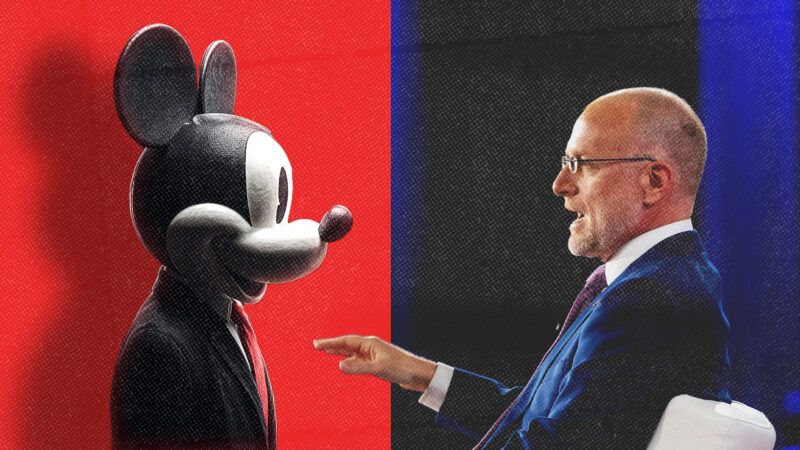
In his second term, President Donald Trump has shown no compunction about using the powers of government against people he doesn't like. Aside from politically motivated prosecutions, the president has also threatened broadcasters with reprisal.
In particular, Trump has singled out ABC, saying repeatedly that the Federal Communications Commission (FCC) should revoke its broadcast licenses for airing content he doesn't agree with.
Earlier this year, the FCC announced it was calling in eight of ABC's broadcast licenses for early review—specifically, all of the licenses owned by Disney, ABC's parent company.
Disney sued, asking the court to bar the FCC from continuing its "pretextual" investigation. This week, appearing before Judge Loren AliKhan of the U.S. District Court for the District of Columbia, the company made a desperate plea for relief.
"Over the last two years, there's been escalating threats against ABC," said Disney's attorney, Beth Wilkinson. The president, she added, "has control over vast regulatory powers that he's willing to use against those he does not like, he has put in place a chairman at the FCC who understands his marching orders and is not shy about saying so. These are blatant violations of the U.S. Constitution."
It was also rather unprecedented: Wilkinson noted that all of the targeted licenses were between two and five years away from expiration, and the FCC had not called in licenses for early renewal in almost 60 years.
In its original filing, Disney mentioned a number of Trump's public statements and social media posts threatening ABC and other networks over their coverage.
"ABC & NBC, in particular, are a disaster - A VIRTUAL ARM OF THE DEMOCRAT PARTY," he wrote in November 2025 on Truth Social. "They should be viewed as an illegal campaign to the Radical Left."
"If Network NEWSCASTS, and their Late Night Shows, are almost 100% Negative to President Donald J. Trump, MAGA, and the Republican Party," read a post the following month. "Shouldn't their very valuable Broadcast Licenses be terminated? I say, YES!"
In July, Trump threatened to revoke ABC's and NBC's licenses simply for not airing one of his speeches, in which he trotted out long-debunked allegations that the 2020 election was stolen from him. FCC Chairman Brendan Carr echoed the sentiment days later, saying that not airing Trump's speech would factor into ABC's review.
"The First Amendment demands an immediate end to the Commission's retaliatory campaign," Disney averred in an August filing. "The President and Chairman's own statements, the unprecedented nature of the early license renewals, and the timing of Defendants' actions all make abundantly clear that the Commission is using its regulatory power to retaliate against Plaintiffs for programming and editorial decisions the Administration dislikes."
According to ABC, the FCC's actions have already affected its coverage. "We are making different editorial decisions," Wilkinson said. "We are watching everything that we do because every time we do something—even not broadcasting this presidential speech—brings out the anger in the administration and the retaliation from the agency."
This would be an alarming First Amendment violation at any time, but especially now, with just over a month to go until a decisive midterm election.
"We sit with our head on the guillotine," Wilkinson added.
According to the FCC's announcement in April, the investigation stemmed from a discrimination complaint over Disney's alleged use of diversity, equity, and inclusion (DEI) initiatives in its hiring practices. Arguing for the government, Dimitar Georgiev-Remmel told AliKhan the FCC only initiated the review because Disney failed to provide requested documents as part of the DEI investigation.
But AliKhan had concerns about both Trump's and Carr's public statements. She singled out a social media post Carr wrote in March, tied to a complaint from Trump about newspapers giving less than flattering coverage to the war in Iran, in which Carr warned that any broadcasters "running hoaxes and news distortions" would "lose their licenses." (As CNN's Brian Stelter noted at the time, Carr was with Trump at Mar-a-Lago when he made the post.)
AliKhan wondered, given both Trump's and Carr's vocal complaints about ABC's broadcast content, if it was plausible that this all stems from "a discovery dispute."
"I imagine we have a lot of discovery disputes with a lot of your licensees," she asked. "So what is it that made this so different that you needed to call for an early license renewal?"
Georgiev-Remmel replied that broadcasters must act in the public interest—a recurring theme in his Carr's complaints—and that by refusing to air Trump's election fraud speech, ABC showed it was not doing so.
Of course, this is a ridiculously expansive view of the public interest, which is already broad enough to encompass nearly anything a regulator wants it to. The suggestion that networks must air every single presidential utterance or risk losing the right to broadcast would be a blatant violation of the First Amendment.
AliKhan did not rule on the injunction, but her questioning suggests she is skeptical of the government's case. In that, she's in good company.
"I'm not an administrative law expert, so I can't speak to whether there are procedural barriers to this sort of request for an injunction against the FCC. But the substantive First Amendment objections that ABC raises strike me as very serious," UCLA School of Law professor Eugene Volokh wrote in August about the lawsuit.
Last month, more than a dozen free speech advocacy organizations signed an amicus brief asking the court to take Disney's side and end the FCC's investigation.




