

Judge Preliminarily Blesses $1.5 Million Settlement for Victims of a Tiny Town's 'Policing for Profit'
Financially motivated traffic enforcement produced a huge surge in revenue for Brookside, Alabama, where "fines and forfeitures" accounted for half the city's income in 2020.
In March 2018, Michael Jones began serving as the police chief of Brookside, Alabama, a small town near Birmingham. During the next two years, the city's annual revenue from "fines and forfeitures" rose by 640 percent, from $82,467 to $610,307. The increase since 2017, the year before Jones took over, was even bigger: about 1,100 percent.
By 2020, fines and forfeitures accounted for nearly half of Brookside's annual revenue. But Jones thought he could do even better. While "a 600% increase" was "a positive story," he said, it was also "a failure" because "with more officers and more productivity you'd have more."
That "positive story," according to a class-action lawsuit that the Institute for Justice filed in June 2022, was actually a sordid tale of "policing for profit" that enriched the city, its police department, and its officials at the expense of drivers subjected to fines and towing fees based on trumped-up traffic offenses. On Wednesday, a federal judge in Alabama gave preliminary approval to a settlement that promises $1.5 million in compensation for victims of that racket and includes radical reforms aimed at ensuring that Brookside will no longer "treat people like ATMs."
That is how Brittany Coleman, the lead plaintiff in the lawsuit, describes what happened in Brookside. It is not hard to see why.
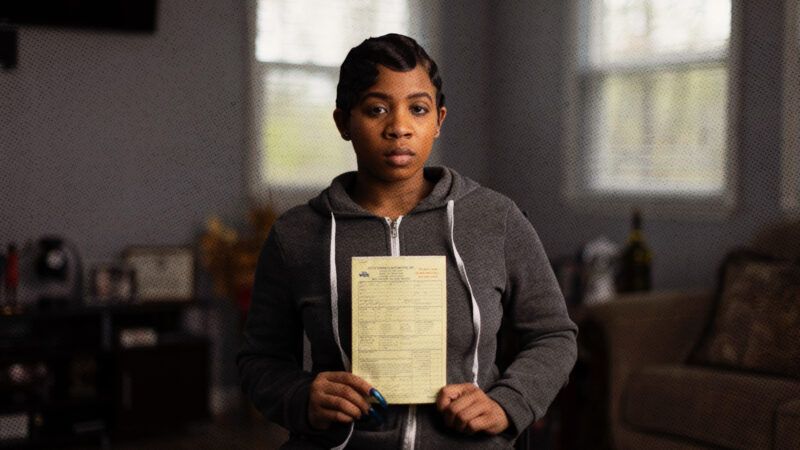
On a Saturday morning in April 2020, Coleman and her boyfriend were driving in separate cars to a breakfast celebrating her 25th birthday when Marcus Sellers, a Brookside police officer, pulled her over. According to the lawsuit, Coleman "was following three or four car lengths behind" her boyfriend's car. But Sellers claimed she was "tailgating." He also claimed to smell marijuana, which supposedly justified ordering Coleman out of her car and handcuffing her.
After she was pulled over, Coleman, worried about "the Brookside Police Department's reputation for escalation and harassment during traffic stops," called her boyfriend and told him to leave the scene and meet up with her later. So Coleman was left alone with Sellers and two other officers, standing handcuffed and sweating in the hot sun for 45 minutes as Sellers searched "every nook and cranny" of her car, "making a mess of the clothes and other belongings she had in the trunk."
Although the search discovered no contraband, Sellers charged Coleman with marijuana possession, which he said meant her car had to be towed away. The cops also had her perform several roadside sobriety tests, which she passed.
A municipal judge eventually dismissed the marijuana charge because there was no evidence to support it. But before that happened, Coleman had to show up in municipal court three times, hire an attorney, and pay $382 in "court costs." The bogus traffic citation cost her another $195. Retrieving her car from Jett's Towing, which had a cozy and profitable relationship with the police department, added $335 to her bill: $160 for the towing company plus a $175 "release" fee for the city. All told, Coleman had to pay Brookside and Jett's Towing nearly $1,000 to extricate herself from the situation created by the phony traffic stop.
When you multiply that experience thousands of times, you can start to see how Jones generated the windfall that Brookside enjoyed for years before a state audit and press coverage turned his "positive story" into a national disgrace, leading to his resignation in January 2022. By then, the Institute for Justice says, the city had managed to "squeeze nearly $2 million from unsuspecting drivers."
Where did the money go? It helped transform a police department staffed by a handful of part-time officers into an outsized law enforcement agency with nine full-time officers and several part-timers. That may not sound very big, but it was conspicuously disproportionate in a town of about 1,300 people with almost no serious crime, giving Brookside an officer-to-resident ratio almost five times the national average. As the lawsuit notes, the department's jurisdiction covers just "six miles of roads and a 1.5-mile stretch of Interstate 22."
According to the complaint, the loot collected from drivers like Coleman paid for "hiring, trainings, conferences, salaries, expensive unmarked SUVs, a new communications center and jail, a K9 unit, and a SWAT tactical operations team." It bought "a mine-resistant vehicle" that Jones "parked in front of city hall as a show of intimidation." It also funded steep salary increases for the town attorney and the municipal judge.
Annual figures cited in the lawsuit suggest what was necessary to keep this money machine running. From 2018 to 2020, police patrol hours rose from 1,735 to 17,375, the number of towed vehicles rose from 50 to 789 (two a day), and the number of misdemeanor arrests rose from 90 to 1,273.
According to the lawsuit, the "unlawful financial interest" that generated such numbers violated the 14th Amendment's guarantee of due process by encouraging biased law enforcement and adjudication. As part of the settlement agreement, the town pretty much agrees.
Brookside "recognizes" that its "policy of aggressive policing," which "prioritized generating revenue for the department's expansion," "likely interfered with the Town's obligation to administer justice equally under law," "undermined the public's trust in the justice system," and "raised serious constitutional concerns under the Due Process Clause of the Fourteenth Amendment." The city's leaders "apologize to the community and every person affected by the aggressive policing practice for the way it affected their faith and confidence in the judicial system." They say the town "has discontinued the policy of aggressive policing."
The settlement gives that commitment teeth. "Brookside will permanently repeal its fee to retrieve towed cars, severing the town's financial incentive to tow," the Institute for Justice explains. The town "will remove the Brookside Police Department from Interstate 22 for 10 years (unless necessary to respond to an emergency)."
The town also agreed that it will receive zero percent of police-generated revenue for five years, just 1 percent for the next 10 years, and 2.5 percent during the following 15 years. "In total," the Institute for Justice says, "that's a 30-year obligation for the town to sever the link between policing and revenue." And Brookside committed to "a slew of transparency measures designed to ensure compliance," including "documents to track those obligations for 10 years."
The compensation fund includes $1 million for drivers who were forced to pay Brookside's "release" fee for towed cars between March 1, 2018, and August 1, 2022. Another $500,000 is earmarked for "individuals who were charged with offenses in Brookside's municipal court during the same time period."
The next step is to inform members of those classes that they are eligible for compensation. After claims are submitted, U.S. District Judge Anna Manasco will decide whether to give the settlement final approval, which seems likely.
"Systems that permit policing for profit inevitably result in abuse," says Institute for Justice Senior Attorney Sam Gedge. "The court has preliminarily approved a settlement that compensates those impacted by Brookside's system and keeps it from recurring."
Chekeithia Grant, who joined Coleman and two other drivers as a named plaintiff in the lawsuit, hopes the settlement will have a deterrent effect. "Police are supposed to protect and serve, not ticket and collect," she says. "When that gets flipped around, people suffer. We brought this case to remind Brookside of that, and to get the town on the right track. This settlement should do that. And it should be a warning to other towns."




