

Once Recession-Proof, D.C. Feels the Pain From Federal Workforce Reductions
Formerly tax-supported workers are discovering the uncertainties the private sector faces every day.
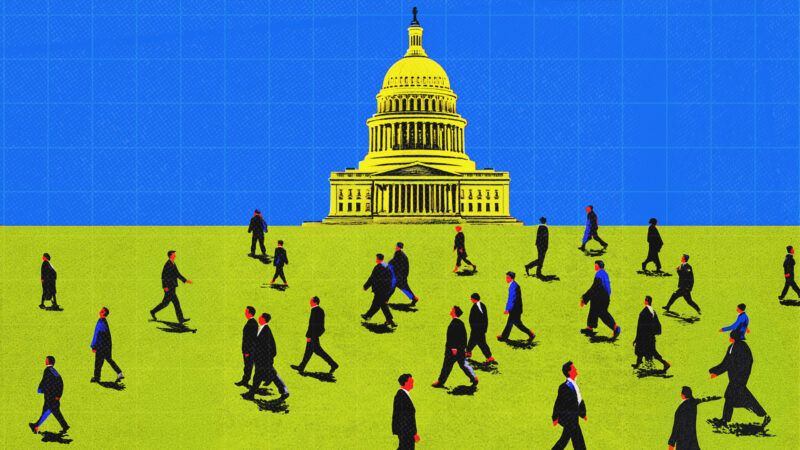
The Washington, D.C. area has long had a reputation for being both wealthy and recession-proof, based on money forcibly extracted in the form of taxes from people living productive lives elsewhere in the United States.
That may no longer be the case. Downsizing of the federal workforce concentrated in the DMV area—the District of Columbia and parts of Maryland and Virginia—has hit many residents hard, and some are considering leaving or have already done so. While it's not nice to wish troubles on anybody, there's nothing wrong with introducing government employees to the same risks and uncertainty that participants in the private sector face every day.
You are reading The Rattler from J.D. Tuccille and Reason. Get more of J.D.'s commentary on government overreach and threats to everyday liberty.
Federal Workforce Reductions Hit the D.C. Area
"Federal workforce reductions have rattled the local economy of the Greater Washington area, long anchored by government employment," Gallup reported last week. "More than half of DMV residents (55%) say they or someone in their household has been negatively impacted by federal job cuts, including 66% of those living in DC and 62% in Arlington County and Alexandria."
Those affected include people dismissed from jobs with the federal government, as well as others—including employees of nominally private federal contractors—who lost federal contracts, cash flows, and other amenities of close association with a bloated federal leviathan.
The survey results are drawn from the latest edition of the VoicesDMV Community Insights report, put together through a collaboration between Gallup and the Greater Washington Community Foundation. As such, it scrutinizes the "wellbeing" of residents of an area that has become increasingly dependent on federal employment and funding, even for private companies. The report notes that "no other major metropolitan region in the country is as directly tied to the federal government as Greater Washington. Federal agencies, contractors, and the businesses and nonprofits that support them form the backbone of much of our regional economy."
Tax Money Made the Area Immune to Economic Downturns
Because the area's economy is primarily dependent on taxes that Americans have no choice about paying, it has largely been immune to the economic ups and downs suffered by private-sector businesses that depend on voluntary transactions with people who buy only what meets their needs and who adjust expenditures based on their own economic fortunes.
In 2010, in the aftermath of the Great Recession, The Washington Post's Dina ElBoghdady reported that "the Washington region posted the highest year-over-year home price gains in the nation this fall, as real estate values slumped in nearly every other metropolitan area." The story added, "the Washington unemployment rate has consistently remained roughly three percentage points below the national average throughout the downturn in the economy."
The flow of tax dollars was not just steady, but generous. The financial publication Kiplinger reported in January that of the wealthiest counties in the United States, "the metro areas of Washington, D.C. dominate the list." Four of the 10 top counties on the list are suburbs of the nation's capital.
The Trump Administration Trimmed Federal Employment by 10 Percent
But the Trump administration came to office promising to trim the size of the federal government. And while the Department of Government Efficiency (DOGE) ran up against entrenched resistance and foundered, in part, on an unwillingness to go beyond cutting "waste" to really reducing the role of the state, it did accomplish some legitimate workforce reductions. That included very welcome layoffs at the Internal Revenue Service, but also wider reductions including the closure of whole agencies.
Pew Research reported in March that "the federal workforce shrank by 10.3% in 2025, or a net of nearly 238,000 workers." That was the outcome of layoffs, retirement, quitting and of slower hiring. That the reduced ranks of federal workers aren't illusory is clear from the VoicesDMV Community Insights report. Many of the laid-off workers don't anticipate returning to government (or government-adjacent) payrolls anytime soon.
"DMV residents' assessments of the local job market have deteriorated dramatically since 2023, directly affecting one of the primary conditions associated with thriving," according to the report. "In 2023, two in three residents (65%) rated the availability of jobs as 'excellent' or 'good.' Today, only half (51%) rate the local job availability positively—a 14-point drop."
Tellingly, it added, "DMV residents are about twice as likely to expect living conditions in the area to get 'worse' (34%) as they are to expect them to get 'better' (18%) in the next five years, while about half (48%) believe that conditions will remain about the same."
Once-Prosperous Federal Workers Look to the Exits
Not so surprisingly for a region that has long thrived on taxes extracted from private-sector workers, the report found, federal layoffs hit higher earners the hardest: "Most residents in households with annual earnings of $90,000 or more say they were negatively impacted by the reductions in workforce, whereas about half (48%) of residents whose households earned less than $90,000 report being impacted."
And with prospects for tax-funded jobs not so rosy, many people affected by the shrinking of the federal workforce are considering greener pastures: "About one in seven residents are considering leaving the region, and their reasons are almost entirely economic."
Respondents listed the rising cost of living, the rising cost of housing, and job cuts or hiring freezes as their top three reasons for relocating.
In truth, the report documents pain from the federal workforce reductions. More people are worried about paying bills, are accessing social services, and are troubled by the region's high prices. But these are also concerns for workers in the private sector who don't have cash flows guaranteed by coercion and must pay taxes before they can address their own needs. The federal layoffs just introduced a lot of former government workers and government-dependent contractors to the same tribulations other Americans face on a regular basis.
The temptations of schadenfreude can be difficult to resist for those of us who have seen government employees abuse power, intrude where they are not welcome, and thrive on the backs of fellow Americans. But I don't wish lingering pain on any of these people seeking new opportunities. Instead, I hope they find rewarding opportunities in the private sector where they can create wealth and live free and productive lives.




