

President Trump Stubbornly Clings to Archaic Mercantilist Economics
He who dies with the most hoarded cash does not, in fact, win.
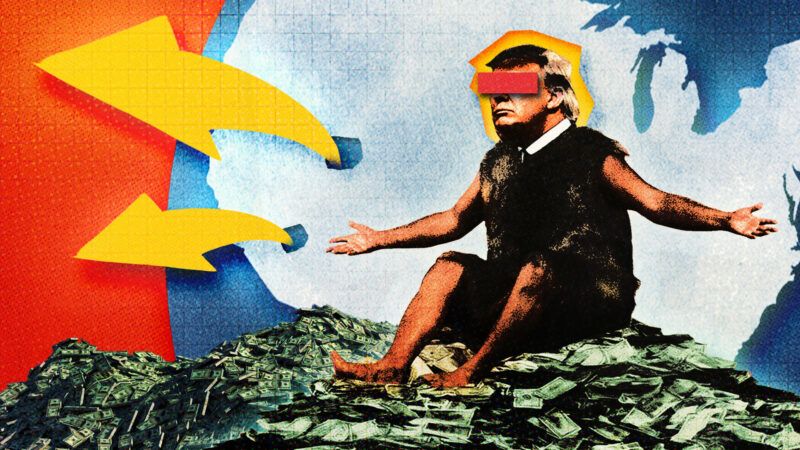
Politics is an industry in which ideas demonstrated to be ineffective and morally reprehensible live on long after they should have died. That's the case with President Donald Trump's fondness for mercantilism, as he espouses hoary old nostrums about the alleged benefits of hoarding money and preventing Americans from using their capital to purchase desired goods from other countries. Like a throwback to the 18th century, the president mistakes accumulating the means of exchange for building actual prosperity, as if we'd all be better off with overstuffed wallets than with the things our funds can purchase.
You are reading The Rattler from J.D. Tuccille and Reason. Get more of J.D.'s commentary on government overreach and threats to everyday liberty.
'Losing' Money on Voluntary Transactions?
Last week, when asked about the eternal political bogeyman of "trade deficits," Trump responded, "If we lose $50 billion a year with a country, and we say, 'we're not going to trade with you anymore,' we don't lose $50 billion a year. It's very simple. Right?"
The president's comments continued a theme he'd expounded on Truth Social, where he wrote, "If we stopped Trading with every country that we have a Deficit with, which is most of them, we would make, at least, 1.5 Trillion Dollars a year."
Earlier this month, the president threatened to entirely stop Americans from trading with businesses in countries with which the Unted States runs a trade deficit—that is, from which we overall buy more than its residents purchase from Americans. His position seems to be that we're better off hoarding cash than we would be using (or losing, from his perspective) our money to purchase things that we want.
But as the late economist Milton Friedman commented during an earlier incarnation of the eternal debate over the "fairness" or lack thereof of international trade, "the goods and services we import, they provide us with TV sets we can watch, automobiles we can drive, with all sorts of nice things for us to use. The gain from foreign trade is what we import. What we export is the cost of getting those imports. And the proper objective for a nation, as Adam Smith put it, is to arrange things so we get as large a volume of imports as possible, for as small a volume of exports as possible."
Of course, trade isn't a collective endeavor. Companies, organizations, and individuals buy and sell all the time, often without much regard for whether they're dealing with domestic purchasers and vendors or partners based overseas. So long as payments clear and orders arrive, everybody is happy buying what they want and selling inventory. If they weren't reasonably content, they wouldn't make deals.
The problem comes when we aggregate those uncountable separate transactions and treat them as a team sport in which countries lose if they use capital to pay for needed goods and services. It's a weird collectivist treatment of what are actually a multitude of market transactions, one that Trump obviously buys into with his comments about "we lose" in trade, and we'd be better off "if we stopped trading." It's a mindset that hearkens back to the days of absolute monarchs boasting about galleons full of gold.
Archaic Ideas About Hoarding Gold and Silver
As economist Laura LaHaye noted for the Library of Economics and Liberty, mercantilist policies dominated Europe from the 16th through 18th centuries: "The goal of these policies was, supposedly, to achieve a 'favorable' balance of trade that would bring gold and silver into the country and also to maintain domestic employment."
"During the mercantilist era it was often suggested, if not actually believed, that the principal benefit of foreign trade was the importation of gold and silver," LaHaye added. "According to this view the benefits to one nation were matched by costs to the other nations that exported gold and silver, and there were no net gains from trade."
The focus, then, was on keeping money within the borders of a country by keeping the economy as self-contained as possible. It's a point of view that treats hoards of money as ends in themselves rather than as means of acquiring what people want and need. It also ignores what Adam Smith pointed out was the comparative advantage in focusing on economic activities where you'll get the most bang for your buck and trading with others who do the same in areas where they excel.
Everybody Benefits From Free Trade
"Nothing, however, can be more absurd than this whole doctrine of the balance of trade," Smith warned in An Inquiry Into the Nature and Causes of the Wealth of Nations, published in 1776. "When two places trade with one another, this doctrine supposes that, if the balance be even, neither of them either loses or gains; but if it leans in any degree to one side, that one of them loses, and the other gains, in proportion to its declension from the exact equilibrium. Both suppositions are false." In fact, he pointed out, "trade which, without force or constraint, is naturally and regularly carried on between any two places, is always advantageous, though not always equally so, to both."
As Smith's criticism makes clear, the ideas of "balance of trade" and "trade deficits" are archaic throwbacks to mercantilism, even though they're still popular among politicians playing to ill-informed voters. Smith's points prevail among economists even in cases where one country burdens its population with trade barriers while allowing relatively unhindered exports.
"The wise course for us is precisely the opposite—to move unilaterally toward free trade," Friedman observed at a time when worries over trade balances focused on Japan. "If they still choose to impose restrictions, that is too bad but at least we have not added insult to injury."
Trump's archaic mercantilism is old both in historical terms and as an obsession of the president. During his first term, George Mason University economist Don Boudreaux called out Trump's protectionist instincts, writing, "Trump is a modern-day mercantilist, and quite an unalloyed one at that. The only difference between mercantilists…and Trump is apparent and not real: during mercantilism's heyday (16th-18th centuries), money was precious metals (gold & silver) while today money is fiat."
With his continual grumping that Americans "lose" money by buying from vendors in other countries, the president at least gets an "A" for consistency. But he's consistent at being wrong in his belief that we're better off accumulating money than we are in exchanging it for things we want, such as food.
"Just think how rich you'll be when you stop eating altogether!" Cato Institute economist Scott Lincicome snarked in response to Trump's grumbles, evoking a vision of fat wallets at the expense of empty bellies.
Trade isn't a team sport, and there are no losers—just different degrees of winners—when people freely buy and sell, exchanging money for the goods and services that satisfy their needs. Unfortunately, the president's economic notions are stuck in the mercantilist past.




