

Customs and Border Protection Doesn't Deny Using Facial Recognition To Target Foreign OnlyFans Models
The immigration system has a confusing and opaque approach to foreigners who have done sex work.
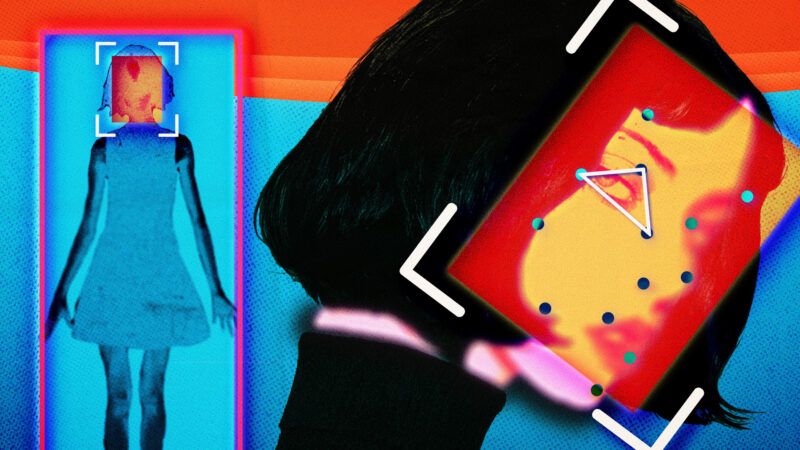
Escort Gigi Lenoir recently went viral for a chilling warning on social media. A friend of hers in the sex work industry had been pulled aside at the U.S. border, shown printouts of her website, and banned from the U.S. for five years. "Ladies that are face out, be careful. Facial recognition is out of control," Lenoir wrote, referring to sex workers who include pictures of their faces in public advertisements. The tweet went viral and provoked a conversation among sex workers about digital safety.
Omg one of my friends was detained at the border and DENIED entry to the USA for 5 years. She used to be face out and they basically had her whole website printed out and interrogated her. Ladies that are face out, be careful. Facial recognition is out of control
— Gigi Lenoir BIRTHDAY MONTH (@exploregigi) July 13, 2026
As a former State Department official who handled immigration, I have been trying to find out if the government is really using facial recognition to find the identity of foreigners who have done sex work online. An American sex worker told me a story of her border interrogation that suggested she was flagged by a computer program. When I asked, a spokesperson for Customs and Border Protection (CBP) didn't deny that the agency was using facial recognition to identify sex workers.
Stories of new forms of border harassment under the second Trump administration are a dime a dozen these days. Some of them are frightening or depressing because of their absurdity or sheer cruelty. Others seem to elide a bigger structural change. But the administration's approach to sex work is in line with longstanding and confusing U.S. policy.
U.S. immigration law's perspective on sex work is not about exploitation, harm, or even any coherent standard about what is legal and what isn't. While the law bans people from coming to the country under a vague definition of immorality, it also allows authorities to give special talent visas to popular OnlyFans models. Ordered to crank up enforcement on every metric, and given new tools of dubious utility, officers start going after easy targets: unpopular radicals and "low" women.
The American sex worker I spoke to was a dual citizen returning home to the U.S. from the other country where she holds citizenship. As a U.S. citizen, there was no way the government could deport her. But she was pulled into secondary screening at the border and could not get a straight answer for why she was being held. The other people in the waiting room were single Middle Eastern men, families and couples from Latin America and Africa, and women with a "bimboesque, influencer look" from her country, she says.
After a long wait, a man in a suit questioned her without identifying what agency he was from. Despite her U.S. citizenship, the man insisted on speaking in her other country's language, as if he was testing her fluency. He searched her bags and asked about her travel patterns, source of income, and exact addresses. Based on my experience in government, what happened at the border suggests that she had been flagged as a sex worker by a computer program.
CBP doesn't deny that it's doing this, though it didn't definitively confirm it either.
"U.S. Customs and Border Protection uses technology—including biometric tools—to support lawful border security operations, verify traveler identity, and facilitate legitimate travel consistent with applicable law and policy. Any inspection or enforcement action at the border is based on the totality of the circumstances and conducted consistent with CBP authorities, privacy requirements, and civil rights and civil liberties protections," a CBP spokesperson told me. "Under the Immigration and Nationality Act, an alien who is coming to the United States to engage in prostitution, or who has engaged in prostitution within 10 years of the date of application for admission, may appear to be inadmissible to the United States."
This isn't a situation in which the U.S. government is looking at combating sex trafficking or sexual exploitation seriously or systemically. If anything, the Trump administration is pulling officers off sex trafficking cases to do other immigration enforcement work.
There are several overlapping and vague definitions of "prostitution" and "commercialized vice" in U.S. immigration law, based on a perceived threat to public morality or the idea that sex workers themselves are bad people who shouldn't come here. They apply even to people who did fully legal sex work in their own countries. The same immigration system is fine with the production of pornographic media, treating workers in those industries like any other entertainer, unless their work crosses the line into "commercialized vice," a term that is undefined.
This vagueness has led courts to make sex worker entry bans easy to overturn. One of the most famous cases in immigration law, Matter of Hranka, was about a Canadian citizen deported from the U.S. in 1975 for engaging in sex work in Detroit. The Board of Immigration Appeals ruled that the government should grant visitor waivers for people with this kind of past on even the most minimal grounds.
Ironically, the system has actually started rewarding the most successful OnlyFans performers (among other social media influencers) with O-1 visas for "extraordinary ability." Some immigration lawyers told the Financial Times earlier this year that social media influencers make up more than half their clientele, simply because followers and likes are easy metrics that can be used to prove "talent" as an entertainer. The woman who described her border experience to me took it as par for the course for the realities of sex work and the hypocrisy of government enforcement.
"Girls that are high-end and citizens serving exclusively rich clientele have a way different experience to girls working the streets to live," she says.
The woman also described the conversations that sex workers have as they struggle to figure out the limits of digital safety.
"A lot of these girls are really just mostly normal girls following the formula set before them by other girls. They blur their face out because it's what all the other girls do, and to some degree, it might offer some protection for sure, say, from a stalker maybe," she says. "The government and its tools are a different game. The tools measure faces' proportions, even with blur. And most girls have nowhere near a strong enough blur to offer any real protection.
"A lot of girls have OnlyFans, Fansly, ManyVids," she adds. "That's literally tied to an ID. I think as a sex worker, to have any real sense of privacy, you have to be face out entirely, not even blur, no tattoos, and only operate via secure channels/bitcoin and no selling on normal platforms."
These vulnerabilities are built into having any online presence at all, and it's difficult to stay anonymous in a world where new global laws are attempting to tie online presence to verified ID, ostensibly to prevent sexual exploitation. After all, a hypothetical sex worker in Europe who wants to start an OnlyFans account might have de-anonymized themselves to the U.S. government in the process of doing so. It's unsettling to think of all the people being tracked by the government of a country where they do not live and do not plan to work.
The U.S. immigration system functions in an increasingly inchoate way. It isn't clear what's legal or not, or what kind of information the government is gathering on people. The chaos means different standards for different people, benefiting the most wealthy and well connected, as the O-1 visas for OnlyFans models demonstrate. That's the greatest irony of all. Instead of making border control fair and forthright for everyone, the rise of automatic systems and algorithms is making it more arbitrary and biased.




